How the Five Compare on the Numbers
A kitchen with one free socket does not care how well a machine tempers. It cares what the machine asks of the wall, and whether the listing says so. That is a narrower question than it sounds, because this keyword collects objects with nothing in common electrically: two tempering machines, a small dual pot, a folding warm cabinet, and a set of silicone cups that has no element in it at all.
Three of these five publish a wattage. One publishes a voltage. One plugs in and states no power figure of any kind, offering two temperature bands instead. One needs no outlet, because the only heat source its listing names is a microwave. All five, unusually, publish a temperature figure of some sort, which makes the power gap stand out more rather than less.
What the table cannot tell you is which of these loads will actually trip a shared circuit, because a published wattage is a rating and not a draw, and because the one figure you would most want beside a wattage, a voltage, appears on only one of the five. It also cannot tell you anything about the Brod and Taylor’s current, since that listing substitutes temperature for power and never comes back to it.
What the Published Watts Are Heating
The Water Bath and Why It Costs More
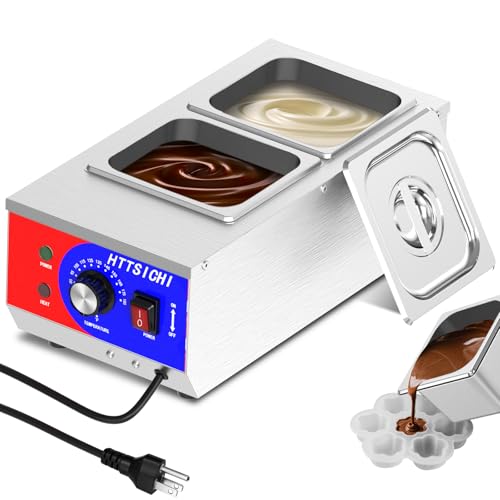
HTTSICHI is the only pick here that says where the power goes. Its listing states 1200 W on 110 V and then explains that the heat warms a bath of water rather than the metal beneath the chocolate, with a thickened U shaped heating tube doing the work and a built in water level line showing how much water the bath wants. Nothing else on this page puts a medium between its element and the chocolate.
That design accounts for the figure. Water absorbs a great deal of energy before it passes any on, so an indirect machine starts every cycle heating something that is not chocolate. The payoff is in the range it can hold, 86 to 185 F, which it also states as 30 to 85 C, the only pick here to give both scales. Capacity is 9L across two tanks, with a stated load of up to 7.5 kg, or 16.53 pounds.
Six Hundred Watts and a Stirring Wheel
Qiokoith takes the opposite approach on the same job. It publishes 600 W, half the HTTSICHI figure, against the largest stated capacity on this page at 14l, and it credits a detachable stirring wheel rather than extra power with getting the heat evenly through the batch. The wheel is also the part the listing says you take out to clean, which is a sensible admission about where chocolate sets hardest.
What it does not publish is the other half of the electrical picture. There is no voltage, no description of the element, and no statement of what the wheel motor adds to the 600 W. Its temperature information is one number, a ceiling of 60 C reached from room temperature under digital control. The bowl is food grade 201 stainless steel, and no dimension appears in any field.
The Low Draw Pot and the Plug With No Figure
Eighty Watts, a Timer and a Fuse
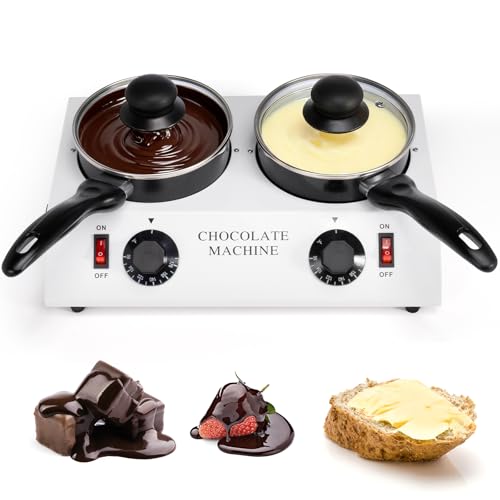
Dyna-Living publishes 80 W, and it is the only listing of the five that argues for its own number rather than just stating it. Heat comes from a heating plate, a PTC mode is credited with holding temperature at lower consumption, and the maker claims the result is 50 percent faster than a traditional stainless pot, without naming the pot. It is the only pick with a published melting time, 10 to 15 minutes.
It is also the only listing that treats electricity as something that can go wrong. Anti leakage protection and power off protection are both named, and the fuse is stated as replaceable, with the listing going as far as to say that swapping it is the fix if the pot stops heating or trips a breaker. The pots are removable, the base detaches, and the material is food grade aluminum rather than steel. No capacity figure appears anywhere.
A Plug, Two Temperature Bands, and No Wattage
Brod and Taylor is the awkward pick on a page about outlets. It plugs into the same wall as the three machines above and publishes no power figure at all, which means the one thing a reader came for is missing. In its place are two temperature bands, 70 to 120 F for proofing and 85 to 195 F in slow cook mode, and the maker points at the second band when it mentions melting chocolate.
Everything else about it is well documented. It folds down to 2.75 inches when it is not in use and the maker gives the opened size in its own sentence as 18 by 14.5 by 10 inches. The dimension fields disagree, reading 4 by 16 by 20 inches, so this page uses the sentence and sets the fields aside. The weight field reads 8.0 lb, and the accessory shelf is stated as sold separately.
Melting With Nothing Plugged In
A Cup Rated to 446 F
LUSHYUM answers the question by removing it. The only heat source its listing names is a microwave, the cups are stated as microwave and dishwasher safe, and the silicone carries a rating of minus 40 F to 446 F. That is a material rating rather than a working range, and it is the widest published rating on this page, which is what allows a filled cup to go from a freezer to a microwave without an intermediate vessel.
The rest is about handling rather than power. A detachable handle keeps a hand off the warm wall, raised vertical ribs reduce contact when the cup is steadied, and the rim can be squeezed into a narrower spout for drizzling. Three sizes arrive, 250 mL, 350 mL and 500 mL, with exterior markings and semi translucent walls, and the dimension fields read 4.3 by 4.3 by 4.7 inches against a weight field of 1.0 lb.
What You Give Up by Unplugging
Temperature holding, which is the whole argument for an appliance. A machine that states a range is promising to sit inside it while you work, and the three that publish a wattage all describe the mechanism that does the sitting: a water bath, a stirring wheel, a PTC mode. A silicone cup has none of that. Chocolate starts cooling the moment it leaves the microwave.
This keyword also holds passive vessels that are not on the page for the same reason. A stovetop double boiler pot and a double boiler lid both appear in the same pool, and both move the heat problem to a burner rather than a socket, which is a real answer for a kitchen short of outlets. Neither publishes anything about power, because neither has any, so neither can be ranked on this axis.
Which One Fits Your Kitchen
One free socket and a real batch to temper. HTTSICHI, on the strength of being the only pick that states both halves of its load, 1200 W at 110 V. If that figure is too large for the circuit, you know it before buying, which is more than the other three mains picks allow.
Volume on a modest draw. Qiokoith. It publishes 600 W against a 14l bowl, the largest stated capacity here, and leans on a stirring wheel for evenness. Accept that no voltage is published and that its weight field is not usable.
A shared circuit you do not want to test. Dyna-Living. At 80 W it states the smallest published wattage here, publishes 10 to 15 minutes to melt, and is the only listing that names a replaceable fuse and power off protection.
A drawer rather than a counter. Brod and Taylor, with eyes open. It folds to 2.75 inches, publishes 70 to 120 F and 85 to 195 F, and melts chocolate in slow cook mode. It will not tell you what it draws.
No spare outlet whatsoever. LUSHYUM. The only pick that names a microwave as its heat source, rated minus 40 F to 446 F, at 1.0 lb for three nesting cups. Nothing holds temperature, so work fast and reheat.
What We Could Not Verify
Everything above is read off each maker’s own listing. These are the things those listings do not say, and nothing on this page fills them in.
- Any wattage for Brod and Taylor, which plugs into a socket and publishes no power figure anywhere on its listing.
- A voltage for Qiokoith, Dyna-Living or Brod and Taylor, leaving one of the four mains picks with a complete electrical statement.
- What the Qiokoith stirring wheel motor adds to its stated 600 W, since the figure is given for heating alone.
- Any capacity figure for Dyna-Living, whose listing names a dual pot layout and never says what either pot holds.
- A usable weight for Qiokoith, whose field converts to exactly one kilogram and cannot describe a machine built around a 14l bowl.
- Which of the two Brod and Taylor size statements is right, since its own sentence and its dimension fields describe different objects.