Lush Food & Drink

Buying Guide ·Kitchen

Best Kitchen Timers for Eggs and Short Cooking Times

The deciding specification is how short a time each one can be set to, because two of these five cannot be set in seconds at all.

By the Lush Editorial Team·Researched & Compared

  • Researched & ComparedSpecs pulled from the manufacturer listing
  • Like-for-LikeSame measures across every model
  • No Paid PlacementsNobody pays to appear here

I compared the smallest interval each timer accepts, the setting method, maximum countdown, alarm output, power and published size across five kitchen timers, using each maker's own listing text and nothing else.

Our shortlist

Five products, one set of published numbers.
  1. Antonki 2 Pack Digital Timer for Kids Classroom Kitc...
    Best for two short timers at once

    Antonki 2 Pack Digital Timer for Kids Classroom Kitc...

    Two complete timers in one box with AAA batteries fitted, a range of 99 minutes 59 seconds set with M and S buttons, and three ways to mount each one.

    • Antonki
    • 2 Count (Pack of 1)
    • 0.1 lb
  2. 4-in-1 Digital Timer with Count Up/Down
    Best for seconds and hours on one keypad

    4-in-1 Digital Timer with Count Up/Down

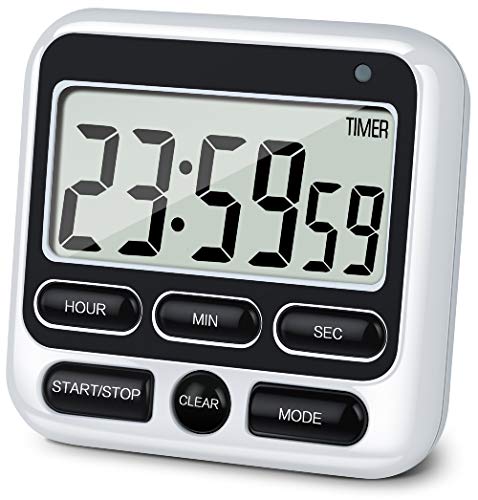
    Dedicated Hour, Min, Sec and Clear buttons behind a 24 hour range, with a 2.8 in LCD, 70 to 90 dB or a silent light mode, and three rear magnets.

    • KTKUDY
    • 3.15 x 3.15 x0.87 inch
    • 0.14 lb
  3. TempPro TM02 24H Kitchen Timer with Clock Mode & Dua...
    Best for two dishes on one screen

    TempPro TM02 24H Kitchen Timer with Clock Mode & Dua...

    Two countdowns running in one body up to 23 hours 59 minutes, with a calendar and clock and four volumes from 70 to 105 dB plus a silent mode.

    • TempPro
    • 0.23 lb
  4. Nkove Digital Kitchen Timer 24 Hour with Clock
    Best for a plain countdown on the fridge

    Nkove Digital Kitchen Timer 24 Hour with Clock

    A 24 hour countdown, a count up mode and a clock in a body published at 3.1 by 3.1 by 0.8 in, with a side switch for silence and a magnetic back.

    • Nkove
    • 0.14 lb
  5. 60 Minute Wind Up Timer
    Best for a kitchen with no spare batteries

    60 Minute Wind Up Timer

    A 60 minute wind up dial needing no power at all, at 0.24 lb, loud because the maker left the back cover off, and audibly ticking while it runs.

    • NUOSWEK
    • 0.24 lb

Side by side

Blank means the maker does not publish it.
ModelBrandSize (capacity)WeightBest for
Antonki 2 Pack Digital Timer for Kids Classroom Kitc... Antonki 2 Count (Pack of 1) 0.1 lb Best for two short timers at once
4-in-1 Digital Timer with Count Up/Down KTKUDY 3.15 x 3.15 x0.87 inch 0.14 lb Best for seconds and hours on one keypad
TempPro TM02 24H Kitchen Timer with Clock Mode & Dua... TempPro not published 0.23 lb Best for two dishes on one screen
Nkove Digital Kitchen Timer 24 Hour with Clock Nkove not published 0.14 lb Best for a plain countdown on the fridge
60 Minute Wind Up Timer NUOSWEK not published 0.24 lb Best for a kitchen with no spare batteries

Each pick in detail

What the listing says for it, and against it.
1 Best for two short timers at once

Antonki 2 Pack Digital Timer for Kids Classroom Kitc...

Two complete timers in one box with AAA batteries fitted, a range of 99 minutes 59 seconds set with M and S buttons, and three ways to mount each one.

  • For it
  • The whole range is minutes and seconds, 99 minutes 59 seconds, set with M and S buttons
  • Two complete timers in one box, so two short times can run in two places
  • Two AAA batteries included and fitted, ready out of the box
  • Three placement options each: a magnet, a fold out kickstand and a hanging hole
  • Against it
  • Publishes no decibel figure for the loud alarm
  • No clock or time of day mode, unlike three of the other picks
  • Cannot be set beyond 99 minutes 59 seconds
2 Best for seconds and hours on one keypad

4-in-1 Digital Timer with Count Up/Down

Dedicated Hour, Min, Sec and Clear buttons behind a 24 hour range, with a 2.8 in LCD, 70 to 90 dB or a silent light mode, and three rear magnets.

  • For it
  • Dedicated Hour, Min, Sec and Clear buttons, one button per job
  • Press and hold 3 seconds to advance a digit for a long countdown
  • 24 hours of range, with a 12 hour clock and a daily alarm as well
  • 70 to 90 dB in sound mode, or a light mode for a quiet room
  • Against it
  • Publishes no battery type, battery life or charging method
  • Publishes figures close enough to Nkove to be the same device under two brands
  • A 24 hour range means every setting passes through hours
3 Best for two dishes on one screen

TempPro TM02 24H Kitchen Timer with Clock Mode & Dua...

Two countdowns running in one body up to 23 hours 59 minutes, with a calendar and clock and four volumes from 70 to 105 dB plus a silent mode.

  • For it
  • Two countdowns running at once in one body, up to 23 hours 59 minutes
  • A calendar and clock with 12 and 24 hour display alongside the timers
  • Four alarm volumes from 70 to 105 dB, plus a silent mode
  • A stainless steel jacket rather than plastic, with a magnet and a tabletop stand
  • Against it
  • The published range stops at whole minutes, with no seconds in the figure
  • Never says whether the second countdown can start while the first is running
  • Publishes no battery type or battery life
4 Best for a plain countdown on the fridge

Nkove Digital Kitchen Timer 24 Hour with Clock

A 24 hour countdown, a count up mode and a clock in a body published at 3.1 by 3.1 by 0.8 in, with a side switch for silence and a magnetic back.

  • For it
  • A 24 hour countdown, a count up mode and a clock in one flat body
  • Published at 3.1 by 3.1 by 0.8 in and 0.14 lb
  • A side switch between silent and loud, with no menu to navigate
  • A magnetic back for a fridge, oven or appliance panel
  • Against it
  • Names no seconds control, so a short setting cannot be confirmed from the listing
  • Publishes no decibel figure for either alarm mode
  • Publishes no display size, unlike two of the other picks
5 Best for a kitchen with no spare batteries

60 Minute Wind Up Timer

A 60 minute wind up dial needing no power at all, at 0.24 lb, loud because the maker left the back cover off, and audibly ticking while it runs.

  • For it
  • Needs no battery at all, which is the one thing no digital pick here can claim
  • A 60 minute range, which covers most short cooking without passing through hours
  • Loud by design, because the maker states there is no back cover
  • The maker explains the winding requirement twice rather than hiding it
  • Against it
  • Cannot be set in seconds at all, and the dial stops at 60 minutes
  • Must be wound to 55 before a short time can be set, every time
  • No quiet option, and the maker states it ticks audibly while running

Our verdict

Antonki sets everything in minutes and seconds with M and S buttons inside a range of 99 minutes 59 seconds, and ships two units. KTKUDY has a dedicated Sec button behind a 24 hour range and a 2.8 in LCD. TempPro runs two countdowns but stops at 23 hours 59 minutes with no seconds in the figure. Nkove names no seconds control. NUOSWEK is a 60 minute dial that must be wound to 55 before any time is set.

“A short setting is harder to make than a long one.”

Lush Editorial Team

What separates these five

Seconds in the setting Antonki sets minutes and seconds only. KTKUDY has a dedicated Sec button. TempPro stops at minutes. Nkove names none. NUOSWEK is a dial.
Maximum countdown KTKUDY and Nkove 24 hours, TempPro 23 hours 59 minutes, Antonki 99 minutes 59 seconds, NUOSWEK 60 minutes.
Alarm output published TempPro 70 to 105 dB across four volumes, KTKUDY 70 to 90 dB. Antonki, Nkove and NUOSWEK publish no figure.
Two times at once TempPro runs two countdowns in one body. Antonki ships two separate timers. The other three run one.
Power Antonki includes two AAA batteries. NUOSWEK needs none. KTKUDY, TempPro and Nkove publish no battery information at all.

How we chose

Priorities, not a computed score. The inputs are published specifications, so we rank by what matters most and say how much.

  1. 30% The smallest interval it acceptsAn egg, a blanch and a rest between kneads are all timed in seconds, and two of these five publish no way to enter one.
  2. 25% How a time is actually setOne button per unit is the difference between a three minute setting taking one second or ten, and the wind up dial has to travel to 55 before it counts at all.
  3. 20% Maximum countdownThe range runs from 60 minutes to 24 hours here, and a long ceiling is paid for with an extra digit on every setting.
  4. 15% Being heard, and being quietTwo picks publish decibels, four offer a quiet mode and the wind up dial has neither, ticking audibly through the whole countdown.
  5. 10% Power and placementOne pick includes its batteries, one needs none, and the other three publish nothing at all about what powers them.

How the Five Compare on the Numbers

Six timers are on the fact sheet and one was left off. ALBAYRAK is a mechanical dial in 304 stainless steel with a magnetic back and an 85 dB alarm, and it publishes no maximum countdown, no dial range and no interval of any kind, so on a page about how short a time can be set it has nothing to be placed against. The other five all publish either a range or a setting method, and usually both.

What decides this page is the smallest interval each one will accept. Antonki publishes a whole range of 99 minutes 59 seconds and sets it with M and S buttons. KTKUDY has dedicated Hour, Min, Sec and Clear buttons behind a 24 hour range. TempPro stops at 23 hours 59 minutes, with no seconds in the figure at all. Nkove names no seconds control. NUOSWEK is a dial that must be wound to 55 before anything is set.

Specification Antonki KTKUDY TempPro Nkove NUOSWEK
Maximum countdown 99 minutes 59 seconds 24 hours 23 hours 59 minutes 24 hours 60 minutes
Seconds in the setting Yes, minutes and seconds only Yes, a dedicated Sec button No, the published range stops at minutes not published No, a wind up dial
How a time is set M and S buttons Hour, Min, Sec and Clear buttons, hold 3 seconds to advance Two countdowns set separately Side switch and buttons, not itemized Wind the dial up to 55 first, then set the time
Counts up as well Yes Yes not published Yes No
Two times at once Two separate units in the box One Two countdowns in one body One One
Clock or time of day not published 12 hour clock and a daily alarm Calendar with 12 and 24 hour display Clock mode not published
Alarm output published not published 70 to 90 dB 70 to 105 dB across four volumes not published not published
Quiet option Flashing red light, no beep Sound mode or light mode Silent mode alongside the volumes Silent switch on the side No, and it ticks while running
Power Two AAA batteries included not published not published not published None, wound by hand
Display size published not published 2.8 in LCD 2.6 in LCD not published not published
Size published 2.68 by 2.48 by 0.63 in in the maker’s words 3.15 by 3.15 by 0.87 in 4.5 by 4 by 1.5 in 3.1 by 3.1 by 0.8 in 3.4 by 3 by 1.2 in
Weight published 0.1 lb, covering both units 0.14 lb 0.23 lb 0.14 lb 0.24 lb
Mounting described Magnet, fold out kickstand and a hanging hole Three rear magnets and a fold out stand Magnet and a tabletop stand Magnet not published
Remembers the last setting Yes Yes Yes Yes not applicable

Two of these listings need a caveat. Antonki ships two timers in one box, so its 0.1 lb covers both units and its dimension fields describe the carton, which is why the figures quoted above are the ones in the maker’s own sentence, 2.68 by 2.48 by 0.63 in. KTKUDY and Nkove also publish figures close enough to be the same device under two brands: 0.14 lb each, 3.15 in against 3.1 in across, 0.87 in against 0.8 in deep, and the same 24 hour range. The table cannot tell you the shortest time any of these will actually accept, because only the setting buttons hint at it and none of the five states a minimum.

How Short a Time Each One Can Be Set To

Two Keypads With a Seconds Button

Antonki and KTKUDY are the two that publish a way to enter seconds. Antonki describes easy M and S buttons and a whole range of 99 minutes 59 seconds, which means every setting it takes is expressed in minutes and seconds. KTKUDY lists dedicated Hour, Min, Sec and Clear buttons, one button per job, with a press and hold of 3 seconds to advance a digit quickly when a long countdown is wanted.

That matters more than the range does for anything cooked briefly. A soft egg, a blanch, a rest between kneads and a shot of espresso are all timed in seconds, and a timer that only accepts whole minutes rounds the instruction before the food gets near it. Both of these two also remember the last countdown, which is worth as much as the buttons when the same three minutes is set every morning.

The Mechanical Dial Has to Be Wound to 55 First

NUOSWEK is the one pick here with no battery, and its own listing explains the cost. It is a 60 minute wind up timer, and the maker states in two separate bullets that the dial must be wound from 0, 5, 10, 15 and so on up to 55 before the spring is engaged, and only then set back to the time wanted. The listing also says that if it does not ring, the winding step was skipped.

For a long bake that is one extra motion. For a three minute egg it means winding almost a full revolution and then bringing the dial back to the short setting, every single time. The same listing notes there is no back cover, so the alarm is very loud, and that the gears tick audibly while the timer runs. None of that is a defect, and all of it is worth knowing before a timer is bought for short cooking.

Range, and What a Long Ceiling Costs

99 Minutes 59 Seconds Against 24 Hours

KTKUDY and Nkove both publish a 24 hour countdown, and KTKUDY sells the point directly, describing itself as far beyond timers limited to 99 minutes 59 seconds. TempPro publishes 23 hours 59 minutes. Antonki publishes 99 minutes 59 seconds, which is the ceiling KTKUDY is arguing against. NUOSWEK publishes 60 minutes on a dial and cannot be set beyond it.

A long ceiling is not free. Reaching 24 hours means the setting has to pass through hours, which is why KTKUDY needs a separate Hour button and a hold to advance. Antonki reaches its ceiling with two buttons because it never has to count hours at all. If nothing in the kitchen runs longer than an hour and a half, the shorter range is the simpler tool rather than the lesser one.

Two Countdowns, or Two Timers

Two picks solve the same problem in different ways. TempPro runs two countdowns at once in one body, so a pan and an oven can be tracked on one screen, and it adds a calendar with 12 and 24 hour display. Antonki simply ships two complete timers in one box with the batteries already in them, so one can sit on the fridge and one go in a pocket.

For short cooking the two devices arguably win, because two things timed in minutes are usually in two different places. The two in one body wins when both times are read at a glance from the same spot. What neither publishes is whether the second countdown can be started while the first is running, which is the detail that separates the two ideas in practice.

Being Told, and Where the Timer Sits

Decibels on Two of the Five

KTKUDY publishes 70 to 90 dB and says the alarm can be heard from another room. TempPro publishes 70 to 105 dB across four volume settings with a silent mode as well. Antonki and Nkove both describe a loud alarm and a quiet alternative without publishing a figure for either, and NUOSWEK publishes no decibels while stating that the absence of a back cover makes it very loud.

The quiet options are not the same thing either. Antonki triggers a flashing red light and no beep. KTKUDY switches between a sound mode and a light mode. TempPro and Nkove both name a silent mode. NUOSWEK has no quiet option at all and ticks continuously while running, which on a mechanical movement is normal and is still a noise in a small kitchen.

Batteries, Magnets and a Hanging Hole

Only two of these five say anything definite about power. Antonki includes two AAA batteries in the box and tells buyers to switch the unit off at the back when it is not in use. NUOSWEK needs no power at all. KTKUDY, TempPro and Nkove publish no battery type, no battery life and no charging method, which across three digital devices is a consistent silence.

Placement is better covered. Antonki publishes three options, a magnetic back, a fold out kickstand and a hanging hole. KTKUDY publishes three rear magnets and a fold out stand. TempPro publishes a magnet and a tabletop stand behind its 2.6 in LCD. Nkove publishes a magnet. NUOSWEK publishes nothing about mounting, which for a dial that has to be turned with one hand is the awkward gap.

Which One Fits Your Kitchen

Two short things cooking in two places. Antonki, which ships two complete timers with AAA batteries fitted, a range of 99 minutes 59 seconds set with M and S buttons, and a magnet, a kickstand and a hanging hole on each.

Seconds today and a slow cook tomorrow. KTKUDY, for dedicated Hour, Min and Sec buttons behind a 24 hour range, a 2.8 in LCD, 70 to 90 dB or a silent light mode, and three rear magnets.

A pan and an oven read from one spot. TempPro, for two countdowns in one body up to 23 hours 59 minutes, a calendar and clock, and four volumes from 70 to 105 dB with a silent setting. Its range stops at whole minutes.

A plain countdown on the fridge door. Nkove, for a 24 hour countdown, a count up mode and a clock in a body published at 3.1 by 3.1 by 0.8 in, with a side switch for silence. It names no seconds control.

A kitchen with no spare batteries. NUOSWEK, a 60 minute wind up dial at 0.24 lb needing no power. Accept the maker’s own instruction: wind to 55 first, then set the time, and expect ticking while it runs.

What We Could Not Verify

Every figure above comes from the maker’s own listing text. These are the things we went looking for and could not source in any of them.

  • Not one of the six listings states a minimum setting, so the shortest time each timer will actually accept has to be read off the setting buttons instead.
  • Nkove names no seconds control at all, so whether its 24 hour countdown can be set to a short interval is not answerable from the listing.
  • Three of the five digital picks publish no battery type, no battery life and no charging method, which on a device that has to be trusted overnight is a real gap.
  • TempPro publishes two countdowns but never says whether the second can be started while the first is still running.
  • Antonki and Nkove publish no decibel figure, so only two of the five can be compared on whether the alarm carries into the next room.
  • KTKUDY and Nkove publish figures close enough to be one device under two brands, and neither listing says anything that separates them beyond one extra mode.

Frequently asked questions

Which of these timers can be set in seconds?+

Two of the five publish a way to do it. Antonki sets everything with M and S buttons inside a range of 99 minutes 59 seconds, so its whole scale is minutes and seconds. KTKUDY lists dedicated Hour, Min, Sec and Clear buttons. TempPro publishes 23 hours 59 minutes, with no seconds in the figure. Nkove names no seconds control. NUOSWEK is a wind up dial with no seconds on it at all.

Why does the wind up timer have to be wound to 55 first?+

Because the spring has to be tensioned before the movement will run, and the maker says so twice. NUOSWEK states that the dial must be wound from 0, 5, 10, 15 and so on up to 55, and only then set back to the time wanted, and that a timer which does not ring is one where the winding step was skipped. For a long bake that is one extra motion. For a three minute egg it is most of a revolution each time.

Is a 24 hour range better than 99 minutes 59 seconds?+

Only if something in the kitchen runs longer than an hour and a half. KTKUDY and Nkove publish 24 hours and KTKUDY argues the point directly, describing itself as far beyond timers limited to 99 minutes 59 seconds. The cost is that every setting has to pass through hours, which is why KTKUDY needs a separate Hour button and a hold to advance digits. Antonki reaches its ceiling with two buttons because it never counts hours.

How do you time two short things at once?+

These five offer two answers. TempPro runs two countdowns simultaneously in one body up to 23 hours 59 minutes, so a pan and an oven are read on one screen. Antonki ships two complete timers in one box with AAA batteries fitted, so one can sit on the fridge and the other by the hob. Neither listing says whether TempPro's second countdown can be started while the first is running.

How loud are these timers?+

Two publish a figure. TempPro states 70 to 105 dB across four volume settings and adds a silent mode. KTKUDY states 70 to 90 dB and says it can be heard from another room. Antonki and Nkove describe a loud alarm and a quiet alternative without a number. NUOSWEK publishes no decibels but states that it has no back cover, which makes the alarm very loud, and that the gears tick while it runs.

Do any of these need batteries you have to supply?+

Only one answers clearly and only one avoids the question entirely. Antonki includes two AAA batteries already fitted and tells buyers to switch the unit off at the back between uses. NUOSWEK needs no power at all because it is mechanical. KTKUDY, TempPro and Nkove publish no battery type, no battery life and no charging method, so three of the four digital timers here leave power completely undocumented.

Specifications come from the manufacturers' own published listings. Lush Food & Drink may earn a commission if you buy through a link on this page, at no extra cost to you. How we research.