How the Five Compare on the Numbers
A madeleine pan is a long shallow tray, and the figure a baker needs is whether it clears the oven rack. All five of these listings publish a size figure somewhere, so the problem on this page is not an absence. It is what unit the figure is written in, and whether anything on the listing tells a reader working in inches what that number means.
They are written four different ways here. ZEENEEK and KEJJNYER give centimeters in the size row and nowhere else. Chicago Metallic spells the word inch out twice in the row and repeats the pair in its own product name. Beasea puts inches in the title and a bare cavity count in the size row. Wilewir leaves the size row to a word and buries inches in a bullet.
What the table cannot do is tell you which figure the maker meant. Three of these five publish an inch triple in their dimension fields, and not one of the three reproduces the size the same listing states in words. KEJJNYER reorders its figures, Chicago Metallic drops one and repeats another, and Wilewir publishes a triple that shares no figure with its own bullet.
What Unit the Size Row Is Written In
Two Listings That Only Speak Centimeters
ZEENEEK publishes 26.5 by 18.5 by 2.2 centimeters in its size row and no other measurement of the pan anywhere on the listing. In inches that is 10.43 by 7.28 by 0.87, which is a tray an ordinary oven rack takes without trouble, but the listing never does that arithmetic and the title says nothing about a size at all. The only other figure it gives is a steel thickness of 0.8 millimeters.
The inch figures ZEENEEK does publish sit in its package field, and they read 7.28 by 0.87 by 0.98 inches. The first two are the 18.5 and 2.2 centimeter figures converted. The 26.5 centimeter figure is missing, and 0.98 inches matches none of the three centimeter figures on the listing. A box of 7.28 by 0.87 by 0.98 inches cannot hold a pan 26.5 centimeters, or 10.43 inches, across, so that triple is not a carton either.
Where the Inch Sign Actually Sits
Chicago Metallic is the plainest of the five and it is plain by accident of naming. Its size row reads 15.75 inch by 7.75 inch with the word written out both times, and the same pair of figures sits inside the product name, so a reader meets the unit before reaching any specification table. It publishes those two figures and never says which of them is which.
Beasea puts 10 by 7 inches in its title and a bare cavity count, six, in the size row, and it publishes no dimension fields at all, so the title is the whole of the evidence. Wilewir leaves the size row to the word regular, a cavity count and a pack count, and states 12.4 by 7.9 by 0.6 inches in the middle of its third bullet instead.
Where the Inch Fields Came From
Right Figures, Wrong Slots
KEJJNYER is the only one of the five that repeats its size in a bullet, printing it once in the size row and again in the opening words of its first bullet, and both times in centimeters: 39.5 by 22.5 by 1.2. Its dimension fields read 0.5 by 15.5 by 8.9 inches, and every one of those figures is correct. 1.2 centimeters converts to 0.47 inches, 39.5 centimeters to 15.55 inches and 22.5 centimeters to 8.86 inches.
What has gone wrong is which slot each figure landed in. The width field holds 0.5 inches and the height field holds 8.9 inches, so a tray the maker describes as 1.2 centimeters thick is given a height of 8.9 inches. A shopper sorting by height gets that figure, and a shopper sorting by width gets 0.5 inches for a pan 39.5 centimeters along one side. Both numbers are published and both are wrong where they sit.
Figures That Never Reach the Fields
Chicago Metallic publishes 15.75 inches and 7.75 inches in its name and its size row. Its dimension fields read 7.8 by 0.5 by 0.5 inches. The 7.8 figure is the 7.75 figure rounded, the two readings of 0.5 inches appear nowhere in the maker’s own words, and the 15.75 figure, the one that decides whether the pan clears an oven rack, never reaches the fields at all.
Wilewir states the mold at 12.4 by 7.9 by 0.6 inches in its own bullet. Its dimension fields read 0.39 by 11.42 by 6.69 inches, and no figure in the second set appears in the first. Each of those three field figures is an exact conversion of a whole number of millimeters, which is what a measurement recorded in metric looks like once it has been republished in inches with no note saying so. This page uses the bullet.
What Else One Purchase Puts in the Oven
Pans Per Purchase and Cavities Per Pan
The purchases are not comparable objects. ZEENEEK sends two pans of twelve cavities, KEJJNYER three pans of twelve, Wilewir three molds of ten and Beasea three pans of six. Chicago Metallic is the only single pan here, with twelve cavities, which also makes it the only one whose published size and published figures describe the whole purchase rather than one item out of a set.
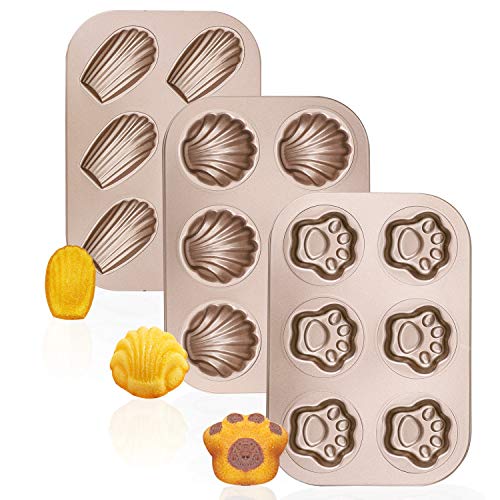
Beasea needs reading closely before it goes in a basket. Its three pans are three different molds, described by the maker as banana, shell and cat paw, so one of the three bakes the shell shape a madeleine is named for. That is a reasonable thing to want and it is not a three pan madeleine set, and the size row, which says only six cavity, does not hint at any of it.
The One Listing That Converts Anything
Wilewir is the only one of these five that publishes a temperature figure, and it is also the only place on any of the five listings where a maker gives a reader both unit systems: minus 40 to 446 degrees Fahrenheit, with the Celsius pair printed beside it. The listing that will convert a temperature is the same listing whose size row carries no unit at all.
Washing splits the same way. Chicago Metallic states that the pan is dishwasher safe and advises hand washing to extend its life. Wilewir clears its molds for the microwave, the oven, the refrigerator and the dishwasher, and names warm soapy water for a hand wash. ZEENEEK, KEJJNYER and Beasea each say the pan is easy to clean and none of the three names a method.
Which One Fits Your Kitchen
The baker who measures in centimeters. ZEENEEK gives 26.5 by 18.5 by 2.2 centimeters with no conversion asked of you, plus the only steel thickness on this page at 0.8 millimeters and the only published weight at 1.45 pounds.
The baker who wants the figure stated twice. KEJJNYER repeats 39.5 by 22.5 by 1.2 centimeters in its first bullet as well as its size row, the only size figure here a maker writes out twice. Ignore its inch fields completely.
The baker who buys in inches and buys one pan. Chicago Metallic writes 15.75 inch by 7.75 inch into its own name. It is the only single pan on this page, and the only one whose published size is the whole purchase.
The baker trying mold shapes. Beasea sends three pans of six cavities in three shapes, with 10 by 7 inches in the title and nothing in the dimension fields. Expect one shell pan rather than three.
The baker who needs the freezer and the dishwasher. Wilewir states minus 40 to 446 degrees Fahrenheit, a cavity at 3.4 by 2.6 inches and a mold at 12.4 by 7.9 by 0.6 inches, all in bullets rather than fields.
What We Could Not Verify
Everything here comes from the makers’ own listings, and these are the questions those listings leave open.
- Which of ZEENEEK’s three centimeter figures is the height. The row gives 26.5, 18.5 and 2.2 and never labels any of them.
- What ZEENEEK’s 0.98 inch package figure measures. It matches none of the three centimeter figures the listing states.
- Whether Wilewir’s mold is 12.4 inches or 11.42 inches along one side. Its own bullet and its own dimension fields disagree.
- What Chicago Metallic is made of. Its bullets name heavy weight aluminized steel and durable carbon steel for the same pan.
- Any dimension field for Beasea, and any weight for four of these five. Only ZEENEEK publishes a weight.
- Whether ZEENEEK, KEJJNYER or Beasea will take a dishwasher. All three say easy to clean and none of the three names a method.