How the Five Compare on the Numbers
The live pages on this pool rank by set contents, by whether two thirds and three quarters cup are included, by what holds a set together in a damp cabinet, by which features go beyond accuracy, and by what each maker instructs about washing. All of those treat a measuring cup as a dry measure that lives in a drawer.
Read for heat instead and the pool splits in two. Eleven of the sixteen listings are nesting dry sets whose only heat statement is a dishwasher rating. The other five are vessels rated to be put into something hot, which in a kitchen short of sockets is the difference between melting butter in the cup you measured it in and finding another appliance.
What the table cannot tell you is the figure that would make the oven claims comparable: none of these five publishes a wall thickness, and only one publishes a temperature. A borosilicate cup, a tempered glass cup and a silicone cup can all be called oven safe and fail in completely different ways, and nothing in this pool gives you a basis to choose between them beyond the brand on the side.
What Each Cup Is Rated to Take
The Only Two Numbers on the Page
Zlyneco publishes the high figure: heat resistant up to 932F, on borosilicate glass described as crack-resistant and odor-proof. That is a material property rather than an instruction, and the listing never says how fast a change of temperature the glass will tolerate, which on glassware is usually what breaks it rather than the peak temperature itself.
Rubbermaid publishes the other number and it points the opposite way: a versatile -40 to 212 degrees Fahrenheit range. The high end is the boiling point of water, so this is a jug for hot liquids, cold storage and nothing beyond. It is also the only figure on this page with a low end, which matters if the cup goes into a freezer.
Three Makers Who Name Appliances and No Degrees
Pyrex, SWIGRANCE and OXO publish no temperature at all, and each names appliances instead. Pyrex is stated dishwasher, freezer, microwave and preheated oven safe. SWIGRANCE is stated microwave and oven safe and suitable for the dishwasher. OXO is stated microwave, fridge and freezer safe, and that is the whole list.
One word in that paragraph is doing more work than the rest. Pyrex says preheated oven, not oven, and never explains the condition. It is the only conditional appliance claim in this pool, and a buyer who reads it as equivalent to SWIGRANCE’s plain oven safe has lost the only qualification either maker offers.
Which Appliance Each One Lets You Skip
Melting Without a Second Pan
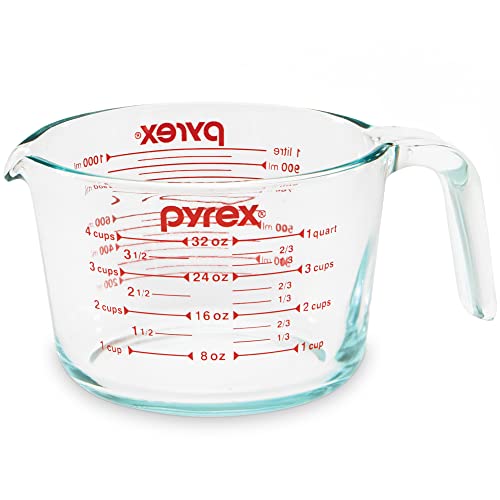
Pyrex writes the use case into its own bullet: needing to melt a cup of butter for a batch of cookies, put the cup in the microwave. That is a small saucepan and a burner replaced by a vessel you already had out, and on a 4 cup jug with a curved spout and easy-grip handles it is the argument for glass over steel.
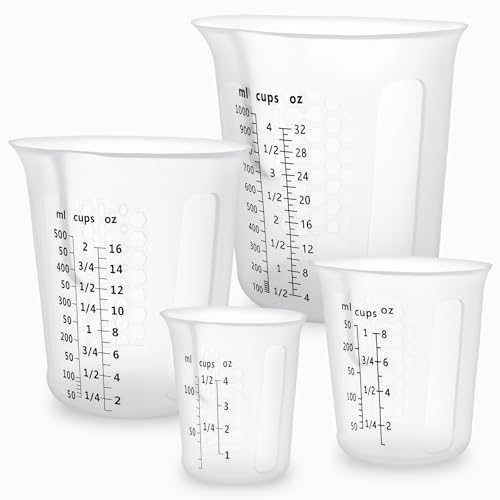
SWIGRANCE answers the same job from the other direction. Its silicone is stated ideal for quick and even melting of butter, chocolate, milk and candle melts, with a flat base for stability, a tip spout, and a body you can squeeze to get the last of it out. It publishes four cups, from 125 milliliters up to 1000, and states the large one is thickened so it holds shape when full.
The Cup That Replaces Nothing
Rubbermaid is on this page as the counter-example. It names a commercial dishwasher and no other appliance, and its published ceiling of 212 degrees Fahrenheit closes the question. What it offers instead is the build: break-resistant polycarbonate stated to withstand drops and spills, NSF certification that nothing else here claims, and 8 cup or 2 quarts of capacity in a clear body.
That trade is worth stating plainly, because it runs the length of this page. The two largest cups here, Rubbermaid at 8 cup and Pyrex at 4, are the ones with the weakest and the most qualified heat claims respectively, while the cup with the published 932F figure holds 2 cup at most. Capacity and heat tolerance pull against each other across all five.
Glass, Silicone and Polycarbonate
Two Borosilicates, a Tempered Glass and a Plastic
Zlyneco and OXO both publish borosilicate, described as crack-resistant and as shatter-resistant, and both publish a lid. Pyrex publishes tempered glass, which is a different formulation and is the reason its oven claim carries a condition. Those three are rigid, easy to read level, and heavy: Pyrex publishes 2.08 pounds, the heaviest of these five.
The other two are not glass at all. SWIGRANCE is food grade silicone, flexible by design, and SWIGRANCE publishes 0.58 pounds, the lightest of these five. Rubbermaid is break-resistant polycarbonate at 0.6 pounds. Both survive a drop that would end any of the glass cups, and neither can be read level as accurately as a rigid wall.
Where the Published Figures Do Not Hold
Two of these listings publish dimension fields that describe a box rather than a cup. Zlyneco’s read 12 by 7 by 7 inches, which is a carton for two cups measuring 250 and 500 milliliters. SWIGRANCE’s read 5.51 by 6.69 by 5.11 inches for four nested silicone cups. Neither is wrong as a package figure and neither tells you how much shelf a cup takes.
The same brand’s other listing shows what an unusable figure looks like. Pyrex also sells a two pack of 1 cup and 2 cup jugs whose published weight is 2.8 pounds inside a carton given as 1 by 1 by 1.27 inches, which works out denser than lead. That listing is not a pick here, and its 4 cup sibling publishes 8.65 by 9.88 by 4.88 inches with nothing implausible about it.
Which One Fits Your Kitchen
Wanting a figure rather than a promise. Zlyneco, the only listing here with a published ceiling of 932F, named for microwave, oven, refrigerator and top rack dishwasher, in two lidded borosilicate cups of 1 and 2 cup that nest together. One pound.
Melting in the cup and then baking. Pyrex, 4 cup tempered glass stated dishwasher, freezer, microwave and preheated oven safe, with a curved spout and grip handle. Note the word preheated, and that it is 2.08 pounds.
Getting every last drop out. SWIGRANCE, four silicone cups from 125 to 1000 milliliters, stated microwave and oven safe, squeezable, with three scales of markings and a thickened large cup. It publishes no temperature and weighs 0.58 pounds.
A jug that gets dropped. Rubbermaid, break-resistant polycarbonate at 8 cup or 2 quarts, NSF-Certified and commercial dishwasher safe, published -40 to 212 degrees Fahrenheit. It names no microwave and no oven, so it replaces no appliance.
Measuring, covering and reheating in one vessel. OXO, 2 cup shatter-resistant borosilicate with a silicone lid stated to seal liquids in, microwave, fridge and freezer safe. It names no oven, and hand washing is recommended.
What We Could Not Verify
Every item below was looked for across all five listings and is not published:
- Any temperature figure from Pyrex, SWIGRANCE or OXO, all three of which name hot appliances.
- What Pyrex means by preheated oven safe, and what happens in an oven that is not preheated.
- How fast a change of temperature Zlyneco’s 932F glass will tolerate.
- Whether Rubbermaid’s 212 degree ceiling permits microwave use, which its listing never mentions.
- A wall thickness from any of the three glass or silicone cups, so their heat claims cannot be compared.
- A cup dimension from Zlyneco or SWIGRANCE, both of which publish only a carton.