How the Five Compare on the Numbers
Storage is a dimensions question, so the row that should answer it is the size entry. Across these five that row holds three separate figures for three separate covers, a letter with a measured pair and a pack count, a bare count of sizes, a triple whose last figure has no unit, and one clean figure the maker’s own field disagrees with. Only one of the five is a straightforward size.
The deeper problem is that most of these listings are sizing more than one object. Four of the five describe a purchase that contains either several covers or a cover plus a second item, so a single figure in the size row cannot cover all of it. Only one of the five is a single cover sold on its own, and it is the only listing here whose weight figure describes one object.
What the table cannot tell you is which figure in a two-number row is the diameter and which the height. Two of these five publish figures in that row with no direction attached, and only one of those two writes a sentence that says which number is which. On the rest you are reading a row and hoping it was filled in by someone holding the product.
What the Size Row Is Actually Measuring
Three Covers, Three Figures, One Row
JYYHSF puts three figures in one size row: 8.5 IN, 10.5 IN, 12.3 IN, followed by Set of 3. Those are not three dimensions of one cover, they are the diameters of three covers in one box, and the row is the only place on the listing any of them appears. No bullet repeats a single one.
The dimension fields are empty, so there is no second source for any of it. The weight field reads 0.99 lb and covers all three covers together. The only other figure anywhere on the listing is a claim that the design collapses to about 1 inch thick, and it is written for the set rather than for a named size, so it is not clear which of the three it describes.
A Letter, a Pair, and a Pack Count
WVM fits three different kinds of information into one row: a size letter, a measured pair in brackets, and a count of what arrives, written as M(11″ x 3.26″)-Pack of 1. The pair is the useful part, and a bullet does say which is which: an 11 inch diameter and a 3.26 inch height. That sentence is what makes this row readable.
The dimension fields then undo the help. They put 3.26 in the width slot and 11.0 in the depth slot, which reverses what the bullet just told you, and the height slot carries 0.1 in. This is the one listing of the five sold as a single object, so its 0.31 lb is the only weight on this page that describes one cover. It collapses to 0.72 in and has a hanging hole.
Rows That Stop Short of a Size
A Count of Sizes Instead of a Size
RingsTown writes 6 Sizes in the size row, which is a count of sizes rather than a size. The title narrows it to a range, 10 inches down to 4.5 inches, and a bullet finally lists them all: 10 by 2.5 inches, 8.8 by 2.2, 7.8 by 2.0, 6.6 by 1.8, 5.7 by 1.4 and 4.5 by 1.1. That bullet is the real size entry on this listing.
The dimension fields were filed as a carton at 10.0 by 10.0 by 0.04 inches, and that last figure is a placeholder rather than a measurement: six rigid plastic covers whose own figures start at 1.1 inches cannot ship in a box four hundredths of an inch deep. The weight field reads 0.6 lb for all six. Storage is described as convenient stacking, with no figure attached.
A Triple Whose Last Figure Loses Its Unit
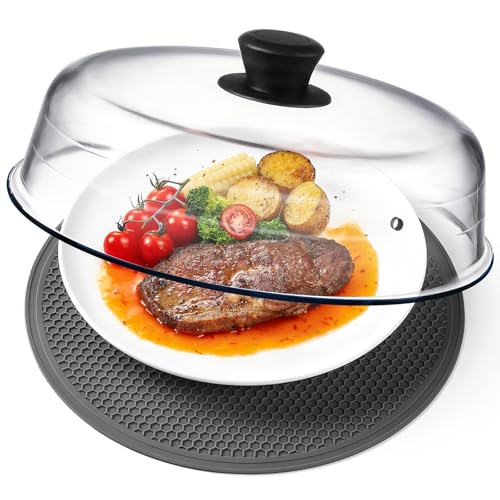
Snuvid writes 10″ x 10″ x 2.7 in the size row. The first two figures carry an inch mark and the third does not, which on a glass cover is the figure that decides whether it clears the roof of a microwave. A bullet does restore it, giving the cover size as 10 by 10 by 2.7 inches, so the unit was lost in the row rather than never stated.
The other figure on the listing belongs to something else. The same bullet gives a mat diameter of 12 inches, larger than any part of the cover, so the figure a reader notices first does not describe the cover at all. No dimension fields are published, and the 3.11 lb weight field covers the glass cover and the silicone mat together. No temperature figure is given.
Where the Listing Contradicts Itself
A Tenth of an Inch Between the Row and the Field
Saebume is the one listing of the five whose size row holds a single clean figure with a unit: 10.7 Inch. Its own dimension fields then publish 10.6. A tenth of an inch is not much, but it means the row and the fields are not the same measurement, and a reader has no way to tell from the listing which of the two was measured.
Its bullets are the only ones here that put a figure on what will fit inside. The cover is stated to fit plates up to 10.5 inches, the base plate including its handles is given an overall width of 12.24 inches, the folded height is 1.57 inches, and the heat ceiling is 464 F and 240 C. The 0.65 lb weight field covers the cover and the base plate together, so it is not one object either.
The Figures That Belong to Something Else
Three of these figures belong to something other than the cover they sit beside, and each is caught by another figure on the same listing. Saebume’s 12.24 inches is the base plate with its handles, not the cover, which the same bullet puts at 10.7 inches. Snuvid’s 12 inches is the mat, against a cover the bullet gives as 10 by 10 by 2.7 inches.
The third is WVM’s own fields, which put 3.26 in the width slot when its bullet calls 3.26 the height and 11 inches the diameter. In every case the correction is already on the page, written by the same maker, two sentences away from the figure it contradicts. That is the only reliable way to read these listings: find the second statement, and see whether the two agree.
Which One Fits Your Kitchen
Buying one cover and knowing its size. WVM. Its row gives a size letter and a measured pair, and a bullet names them as an 11 inch diameter and a 3.26 inch height. It collapses to 0.72 in, has a hanging hole, and weighs 0.31 lb.
Three sizes for three different plates. JYYHSF. The size row is the whole specification: 8.5 IN, 10.5 IN, 12.3 IN, Set of 3. Nothing else on the listing repeats any of them, and the 0.99 lb weight is all three together.
A cover for every bowl you own. RingsTown. Six covers arrive, listed in a bullet from 10 by 2.5 inches down to 4.5 by 1.1 inches, at 0.6 lb for the set. The size row says only 6 Sizes, so read the bullet.
Glass, and a mat to stand it on. Snuvid. The cover is given as 10 by 10 by 2.7 inches, with the mat at 12 inches, and the 3.11 lb weight field covers both. Note that the third figure in the size row has no unit on it.
A known plate size and a hot dish. Saebume. It states a fit for plates up to 10.5 inches, a folded height of 1.57 inches, a ceiling of 464 F and 240 C, and a dishwasher. Its row says 10.7 Inch while its field says 10.6.
What We Could Not Verify
Everything above is read off each maker’s own listing text. These are the things those listings do not establish, and this page does not fill them in.
- Which of the three JYYHSF diameters the one inch collapsed figure belongs to, since the claim is written for the set and not for a size.
- Any second source for the JYYHSF figures, whose dimension fields are empty and whose bullets repeat none of the three.
- A height for any of the six RingsTown covers beyond the bullet pairs, since its dimension fields were filed as a carton.
- Whether the Snuvid cover’s 2.7 is inches, since the size row omits the unit the first two figures carry.
- Whether the Saebume cover is 10.7 or 10.6 inches across, since the size row and the dimension field disagree.
- Any washing instruction at all for JYYHSF, which names no dishwasher and no hand wash anywhere in its title or bullets.