How the Five Compare on the Numbers
A rice paddle is a flat object with a handle, and in a cabinet with few things in it that is exactly its advantage: it lies down on a shelf and takes only its own thickness. Thirty seven listings sit in this pool and they compete on material and on length, neither of which says anything about the one figure that decides where the paddle goes.
These five publish third figures of 0.1 in, 0.79 in, 1.6 in and 2.5 in, plus one listing whose field says 0.1 in and whose own bullet says 0.70 inches. That is a twenty five to one spread on the same kind of tool, and it is the difference between a paddle that slides under a stack of bowls and one that does not.
What the table cannot tell you is where each third figure is measured. On a paddle with a curved bowl the thickness at the handle and the depth of the bowl are two different numbers, and no listing here distinguishes them. The Inomata figure of 2.5 in is almost certainly the bowl standing proud, and the Selmaryx figure of 0.1 in is almost certainly the blade edge, and neither listing confirms it.
The Thickness Is the Whole Storage Question
From a Tenth of an Inch to Two and a Half
Selmaryx publishes 0.1 in as the third figure on a 3.15 by 9.05 in silicone paddle. Yamaco publishes 0.79 in on a cypress paddle it states at 2.6 by 7.3 inches. EIKS publishes 1.6 in on a stainless paddle it states at 8 in long. Inomata publishes 2.5 in and no width at all.
Those four figures are a full order of magnitude apart for tools that all do the same job, and the pattern is not random. The two steel paddles publish the larger figures because a stamped steel bowl has a rise to it, while the silicone blade is close to flat. What the listings never say is whether the figure is the bowl or the handle.
One Listing Disagrees With Itself by a Factor of Seven
Snuviax publishes a height field of 0.1 in. Its fourth bullet states that the spoon measures 20 by 6.8 by 1.78 cm, given again as 7.87 by 2.68 by 0.70 inches. A 0.70 inch thickness and a 0.1 in thickness cannot both describe a stamped steel paddle, and the difference is not a rounding.
The bullet is the figure this page uses, because it is the maker’s own sentence, it appears in two unit systems, and it sits alongside two other figures that its own fields confirm at 7.87 in and 2.68 in. The field value of 0.1 in matches a value published by two other listings in this pool, which is the pattern of a default rather than a measurement.
What Else These Listings Cannot Keep Straight
A One Pack That Contains Two Paddles
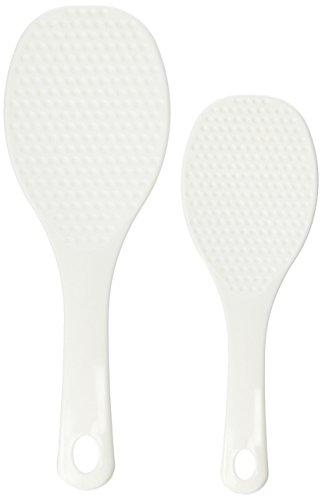
The Inomata size field reads 1 Pack. Its first bullet reads Set of 2 Plastic rice paddles, and its second gives two lengths, 7.5 inches and 6.25 inches. So the purchase is two paddles of different sizes, and its published 7.5 x 2.5 in field set can only describe one of them, presumably the larger.
Its title says Melamine and its own bullet says Plastic, which are not the same claim: melamine is a specific thermoset and plastic is a category. Neither statement is wrong and only one is useful. For a minimal cabinet the more relevant point is that one purchase here is two objects while the other four are one.
A Weight in Grams and No Field At All
Yamaco publishes no weight in its dimension fields and states 20g in a bullet. It is the most sparsely written listing of the five: five bullets giving a size, a weight, a material, the word unpainted, and a country of manufacture. There is no non stick claim, no washing instruction and no heat claim anywhere in it.
That sparseness is not the same as a gap in quality. Hinoki cypress, unpainted, made in Japan, at 2.6 by 7.3 inches and 20g is a complete description of a traditional wooden paddle. It is a gap for a buyer who wants to know whether it can go in a dishwasher, and the answer is not in the listing.
Material Decides Everything Else
Steel, Silicone, Cypress and Melamine
Snuviax and EIKS both state SUS304 stainless steel, and both publish the larger third figures here at 0.70 inches and 1.6 in. Selmaryx states a food grade silicone head on a beechwood handle. Yamaco states unpainted hinoki cypress. Inomata states plastic in a bullet and melamine in its title.
In a cabinet where paddles get stacked on and under other things, that ordering matters. Steel takes a mark and keeps working. Silicone takes a mark and shows it. Unpainted cypress absorbs whatever is around it, which is why the one listing that publishes no washing instruction is also the one made of bare wood.
Washing and What Each Maker Will Promise
Three of the five state dishwasher safe. Snuviax says the paddle can be rinsed with water or placed directly in the dishwasher. EIKS says water or a wet cloth, and that the paddles are dishwasher safe too. Inomata states dishwasher safe in a bullet of its own.
Selmaryx and Yamaco publish nothing about washing. On the Selmaryx that is odd, because a silicone head on a wooden handle is the exact combination where the answer is not obvious, and the listing goes out of its way to describe the beechwood handle without saying what water does to it. On the Yamaco, bare cypress, the silence is more expected and no more helpful.
Which One Fits Your Kitchen
A shelf with almost no gap. Selmaryx publishes 3.15 x 9.05 x 0.1 in and 0.17 lb, with a silicone head, a textured dot pattern, a beechwood handle and the only hanging hole on this page. It publishes nothing about washing.
Figures written down in two unit systems. Snuviax states 7.87 by 2.68 by 0.70 inches and again as 20 by 6.8 by 1.78 cm, publishes 0.19 lb, states SUS304 stainless steel and a dishwasher instruction. Use the bullet figure, not its 0.1 in field.
A traditional wooden paddle, described plainly. Yamaco publishes 2.56 x 7.28 x 0.79 in, states 2.6 by 7.3 inches and 20g, and names unpainted hinoki cypress made in Japan. It publishes no washing instruction and no non stick claim.
Sticky rice and a wave pattern. EIKS publishes 2.8 x 8 x 1.6 in and 0.25 lb in SUS304 stainless steel, with an evenly distributed wave point to stop rice clinging and a stated dishwasher option. It asks the most shelf gap of the four single paddles.
Two sizes in one purchase. Inomata publishes 7.5 x 2.5 in with no third figure and 0.07 lb, states two paddles at 7.5 inches and 6.25 inches long, dishwasher safe and made in Japan. Its size field says One Pack and its bullet says two.
What We Could Not Verify
These are the things I went looking for in the five listings and did not find.
- No listing says whether its third figure is the depth of the bowl or the thickness at the handle.
- Snuviax publishes 0.1 in in its field against 0.70 inches in its own bullet, a difference of a factor of seven.
- Inomata publishes a 7.5 x 2.5 in field set for a purchase its bullet says contains two paddles of different lengths.
- Inomata says melamine in its title and plastic in its bullet, and never reconciles the two.
- Selmaryx and Yamaco publish no washing instruction at all, and both combine a natural wood with something else.
- Yamaco publishes no weight field and states 20g in a bullet, with no non stick or heat claim anywhere.