How the Five Compare on the Numbers
Dough is the messiest thing a small tool has to deal with, and it dries into a cement that finds every joint and every texture. Five scrapers are compared here and only two of them state that the tool is dishwasher safe. Two more make a claim about the surface without naming a machine. The fifth describes a material, calls it odor resistant and moves on, which leaves construction to answer the question.
Three close alternatives were left out on purpose. SURDOCA and Ecavria make no cleaning statement at all despite both being PE plastic sets, and the Amazon Basics bench scraper is a near twin of the OXO here, a stainless blade in a nonslip handle with measurement marks and a dishwasher claim of its own. Running both would have printed one column twice.
What the table cannot tell you is how any of these behaves after a year of sourdough. None of these makers publishes a number of dishwasher cycles, a note on whether silicone stains from turmeric or tomato, or anything about the textured grip areas that three of the five are selling. Those textures are the part a brush has to reach, and no listing addresses them.
Three Listings Answer the Cleaning Question
Two Say Dishwasher Safe
OXO states dishwasher safe in four words and nothing else, which for a stainless blade in a molded handle is the statement that matters. KitchenAid goes further and names both tools: the bowl scraper and the pot scraper are both dishwasher safe, which is worth stating separately because they are different materials, silicone and nylon.
KitchenAid is also the only one of these five that publishes heat figures, 400 degrees F for the silicone and 450 degrees F for the nylon. A dishwasher does not approach either, so those numbers are about pans rather than washing, but they are the only evidence in the pool that either material has been rated for temperature at all.
Two Describe a Surface Instead
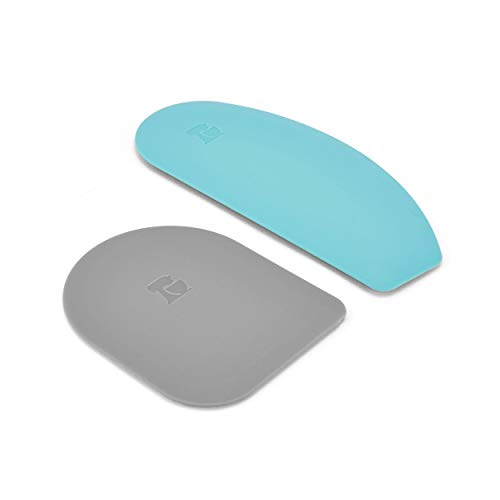
SAPID heads a whole bullet Durable, Easy to Clean, and unlike the two dishwasher claims it names a method: the silicone is super easy to clean in warm soapy water. The rest of that bullet is about the counter rather than the tool, since it credits the scraper with reducing prep time and food waste and with protecting the countertop from scratches as you scrape dough off it.
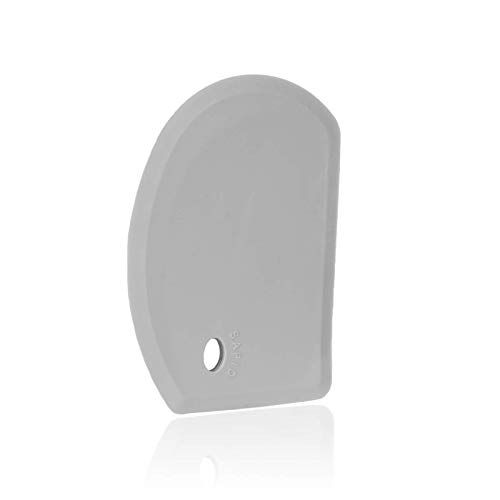
PVKRIO is the most specific of the five without mentioning a machine. Its wording is that the smooth plastic surface helps reduce buildup and rinses clean quickly after use. For a single piece of flexible PE with no handle and no joint, rinsing is a complete answer, and the listing is describing the real reason rather than borrowing a dishwasher claim.
The Seam Is Where Dough Lives
One Piece, No Joint
PVKRIO is a single sheet of flexible PE plastic published at 4.7 by 3.7 inches, with a straight edge for dividing and a curved edge for batter. There is no handle fitted to a blade and no second material bonded to a first, so there is nowhere for dough to get into that a rinse cannot reach. That is the strongest cleaning argument on this page and the listing makes it in one line.
The trade is everything a handle gives you. A flat sheet has no leverage for chopping through a dense dough and no rigid straight edge for scooping a chopped pile off a board. PVKRIO sells five pieces to a set, which addresses quantity rather than rigidity, and it publishes no weight at all.
Silicone Over Steel, and a Handle Over a Blade
SAPID is the interesting case. Its listing states that the scraper is composed of a stainless steel sheet and premium silicone, with food grade silicone on the outside, and it argues the steel gives it a longer service life than an all plastic scraper. That is a fair point about strength, and it also means two materials meet somewhere inside the tool.
The listing says the silicone is the outside, which reads as the steel being fully enclosed, and if that is right there is no seam to clean. It does not say so explicitly. OXO and Boorika have the other kind of joint, a metal blade fixed into a handle, which is visible, reachable and the place a bench scraper collects flour paste.
Grip Texture Against Cleaning
Every Maker Sells a Non Slip Surface
Three of these five name a non slip feature and they are all textures. OXO calls it a soft comfortable non slip grip, PVKRIO a textured grip area that gives control when your hands are wet, floured or sticky, and Boorika a non slip handle for prolonged baking sessions. SAPID relies on the silicone body itself, and KitchenAid names no grip feature at all.
Those textures are the point of the tools and they are also the problem. A surface designed to hold onto a wet, floured hand is a surface that holds onto wet flour, and a soft overmolded grip has a boundary where it meets the harder part underneath. Neither OXO nor Boorika says anything about cleaning that boundary.
What No Maker Spells Out
Between them the five give three kinds of answer and no detail at all. OXO and KitchenAid name the machine, SAPID names warm soapy water, PVKRIO says the smooth surface rinses clean quickly, and Boorika says nothing about washing. Not one recommends a brush, warns against soaking, or says whether dough should come off wet or be left to dry and flake away.
Boorika comes closest to a durability claim with resisting rust, deformation and odors, and odor resistance is a cleaning claim in disguise: it is what a maker says when a material has held a smell in the past. It gives no figure and names no test, so it sits with the rest of the adjectives here.
Which One Fits Your Kitchen
The baker who wants it in the machine. KitchenAid states both tools are dishwasher safe, and it is the only listing publishing heat figures, 400 degrees F for the silicone scraper and 450 for the nylon. Two tools, 0.38 pounds for the pair, and no textured grip to scrub.
The baker cutting dense dough. OXO is a rigid stainless blade in a molded handle at 4 by 6.25 by 1.75 inches with 1 inch markings, stated dishwasher safe. Accept that the blade to handle joint is a place flour paste will collect.
The baker who rinses and moves on. PVKRIO is one piece of flexible PE at 4.7 by 3.7 inches, five to a set, and the listing says the smooth surface reduces buildup and rinses clean. There is no joint anywhere in it.
The baker working out of a bowl. SAPID wraps food grade silicone around a stainless steel sheet at 5.98 by 4.3 inches, claims great flexibility with an arc that fits a bowl, and is the only pick that says it protects the counter from scratches.
The baker worried about smells. Boorika is the only listing here claiming resistance to odors as well as rust and deformation, in a stainless and plastic set published at 4.5 by 6 inches. It states no piece count, no weight and no dishwasher position.
What We Could Not Verify
These are the figures and statements we went looking for in the manufacturer listings and could not find. Nothing below was estimated, and nothing on this page was measured by us.
- Whether the SAPID, PVKRIO and Boorika tools can go in a dishwasher, which none of the three addresses.
- Any instruction for getting dough off once it has dried on, which none of the five addresses.
- Whether the SAPID steel sheet is fully enclosed by the silicone, which the listing implies without stating.
- How to clean the textured non slip grips that three of these five are selling, which no maker mentions.
- A published weight for the PVKRIO set and the Boorika set, and a piece count for the Boorika.
- Any stain or odor figure, dishwasher cycle count or test behind the Boorika odor resistance claim.