How the Five Compare on the Numbers
A fermentation weight is only ever lifted with a wet hand, out of brine, often a week into a ferment when you want to push the cabbage back down. So the sentence worth ranking by is not what shape the handle is. It is what each maker promises about a wet hand, and whether it tells you what to do when that promise does not hold.
CREASKING says easy to grab even with wet, slippery hands, and adds no fumbling and no tools. MEOFIENK says easy to insert and remove even with wet or slippery fingers. Cedilis says easier and safer with wet hands. JILLMO says easier to place, adjust and lift out even when your hands or the glass are wet. Elementi is the only one to admit the grip can fail, and the only one with a fallback.
Two weight fields on this page should not be used. CREASKING publishes 12 pounds for a two pack of discs it states at 10 to 14 ounces each, which is a figure in the wrong unit or the wrong box. Elementi publishes 0.4 pounds for two weights it calls thick and heavy, which comes to about three ounces each and is well below everything else here. In both cases the maker’s own sentence is the better source and the field is set aside.
What a Wet Hand Is Promised
Four claims, one admission
Four of these five make the same claim in slightly different words, and all four are worth having because they tell you the maker thought about the moment that matters. CREASKING is the most specific about when: easy to grab even with wet, slippery hands, with no fumbling and no tools, mid ferment. MEOFIENK and Cedilis both name wet or slippery fingers directly.
Elementi is the one that starts from the problem instead of the solution. Its bullet opens by stating that fermentation weights can be slippery, says that is why it uses an easy grip handle, and then adds that if that fails, or if the weight has gone too deep in the jar, it can be retrieved with a fork. No other listing on this page admits a failure mode or offers a route out of it.
Why the fallback matters more than the adjective
Every one of these handles will be wet and covered in brine. The claims cannot be compared because none of the five publishes a grip figure, a texture depth or a knob height, so all five adjectives are equally unverifiable. What can be compared is whether the listing has thought past the ideal case, and only one of them has.
The counter argument is that a weight you need a fork for is a weight whose handle is not working, and Elementi is the only pick here that effectively concedes that. CREASKING answers the same worry differently by stating no tools are needed at all. Both are honest; they just put the emphasis in opposite places.
The Shapes, and What They Imply
Grooved against raised
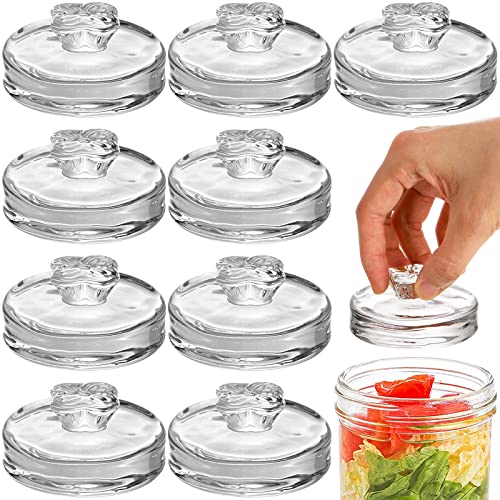
CREASKING uses a grooved handle with a wavy dot texture, which is a recess you hook a finger into plus a surface that resists slipping. JILLMO uses a raised handle it calls easy lift, which is the opposite approach: something standing up to pinch. Cedilis uses a dotted knob and credits enhanced friction for the grip rather than the shape alone.
MEOFIENK and Elementi both say ergonomic and easy grip without naming a shape, which leaves the reader with a photograph and an adjective. For a page about handles that is the weakest form of documentation here, although Elementi makes up for it with the only published fallback and the clearest material statement.
Which jar each handle has to come out of
The handle has to clear the jar mouth, so the jar is part of the question. MEOFIENK publishes a 3.7 inch weight for 3.8 inch gallon jars, a tight fit by design. CREASKING publishes no diameter but states that it suits large jars with an inner mouth over 3.5 inches, which it also gives as 90 millimeters.
JILLMO states 1 gallon wide mouth jars without a diameter. Cedilis publishes 2.75 inches by 0.8 inches and Elementi 2.7 inches, both for standard wide mouth jars. A 2.7 inch disc in a standard wide mouth jar leaves room for fingers; a 3.7 inch disc in a 3.8 inch mouth does not, which is exactly when a good handle earns its place.
Mass, Pack Size and Cleaning
How heavy one weight is
Four of the five publish a mass for a single weight and they split into two groups. CREASKING at 10 to 14 ounces, MEOFIENK at 12 to 13 ounces and JILLMO at 11 to 13 ounces are all gallon jar weights, and all three note that the figure varies because the glass is handmade. Cedilis at 7 ounces is a standard wide mouth disc.
Elementi publishes no per weight mass at all, only 0.4 pounds for the pair, which is the figure this page has already set aside. For a reader choosing on handling, mass is the other half of the story: a 14 ounce disc on a wet handle is a different proposition from a 7 ounce one, and heavier is harder to hold and better at its job.
Pack sizes and the sink
Cedilis is a nine pack, which equips far more jars than anything else here and is the only pick that makes sense for someone running several standard jars at once. CREASKING, JILLMO and Elementi are all two packs, with CREASKING explaining that two lets you run two batches or keep a spare. MEOFIENK is three.
On cleaning, four of the five say something. Elementi is the most specific, clearing top rack dishwashing or hand washing. Cedilis and CREASKING both state dishwasher safe. JILLMO says easy to rinse clean and that the glass will not absorb colors or flavors. MEOFIENK is the one that publishes no cleaning instruction in either direction, on a 3.7 inch weight for a 3.8 inch jar.
Which One Fits Your Kitchen
You reach into the jar mid ferment. CREASKING states easy to grab with wet, slippery hands, no fumbling and no tools, on a grooved handle with a wavy dot texture, two weights of 10 to 14 ounces for jars with an inner mouth over 3.5 inches, dishwasher safe. Ignore its 12 pound weight field.
Your jars are gallons and you run three. MEOFIENK publishes a 3.7 inch weight for 3.8 inch gallon jars, three to a pack at 12 to 13 ounces each, with an ergonomic handle for wet or slippery fingers. It publishes no cleaning instruction.
You have a shelf of standard jars. Cedilis gives nine weights at 2.75 inches by 0.8 inches and 7 ounces each, with a dotted knob it credits for friction, in soda lime glass that is dishwasher safe.
You want something standing up to pinch. JILLMO uses a raised easy lift handle and states placing, adjusting and lifting with wet hands or wet glass, two weights of 11 to 13 ounces for 1 gallon wide mouth jars at a published 2 pounds.
You want a plan for when it slips. Elementi names the problem first, offers an easy grip handle, and then tells you a fork will retrieve a weight that has gone too deep. Soda lime glass at 2.7 inches, cleared for top rack washing or by hand.
What We Could Not Verify
These are the things a handle would be judged on and no listing here publishes.
- Any knob height, groove depth or grip figure, on any of the five, so five wet hand claims cannot be compared.
- A handle shape for MEOFIENK and Elementi, both of which use an adjective instead.
- A diameter for CREASKING and JILLMO, both of which name a jar rather than a figure.
- A per weight mass for Elementi, whose only figure is 0.4 pounds for the pair.
- Why CREASKING publishes 12 pounds for two discs it states at 10 to 14 ounces each.
- Any cleaning instruction from MEOFIENK, and any note on the CREASKING grooved recess beyond dishwasher safe.