How the Five Compare on the Numbers
A holiday baking week is not one kind of dough. It is rolled cookies, a pie crust, something laminated if you are ambitious, and usually a sheet of fondant over a cake. So the useful question for this pool is what each maker says its pin is actually for, and the answers are not interchangeable: three of these five sell themselves as fondant and decorating tools and one is the only listing to name laminated pastry at all.
The counts differ too. One listing names nine separate uses and one names five. That is not a specification in the strict sense, but on a tool with identical ring sizes across most of the pool it is the clearest signal any of these makers gives about who the pin was designed for.
Four of these five publish the same four ring sizes, 1/16, 1/8, 1/4 and 3/8 inch, so the ring set does not separate them the way it looks as though it should. Two of the four disagree about what 1/8 inch is in millimeters, giving 3 mm and 4 mm, and the fifth publishes five circumference options with no figure for any of them.
Which of These Are Sold as Decorating Tools
Three Listings Call Themselves Fondant Rollers
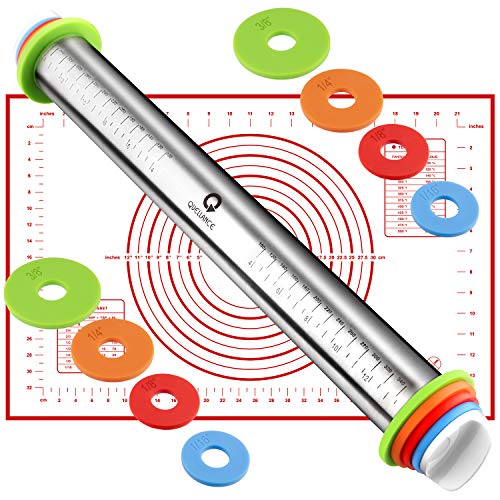
BIDFUL puts fondant in its own title, describing the pin as a fondant roller for decorating alongside cookie and pastry work, and mentions embossing too. QUELLANCE calls itself a fondant rolling pin in two separate bullets. Geesta names French fondant among its uses. That is three of the five positioning themselves at least partly as cake decorating tools rather than bread tools.
AMUZHI and PEASUG never use the word. AMUZHI aims at wrappers and laminated pastry, PEASUG at pancakes, noodles and wonton wrappers, and both read as savory dough tools. Nothing about their construction rules out fondant, but a buyer choosing a pin for a decorated cake has three listings here that say so and two that do not.
What Fondant Needs From a Ring Set
Rolled fondant wants an even sheet at the fine end of the range, and all three of the decorating listings publish that end as 1/16 inch. BIDFUL calls it 2 mm and QUELLANCE calls it 2 mm as well, so on the finest setting the two agree even though they diverge one step up. That is the setting a fondant sheet is rolled at and it is published on four of these five.
Geesta is the exception and it is a real problem for this use. It publishes five circumference options with each ring marked on its side and no thickness figure anywhere in the listing, so the pin that names French fondant is also the one where you cannot know in advance what its finest setting is. The rings are stated dishwasher safe, which fondant sugar makes worth having.
The Doughs Each Maker Names
From Wonton Wrappers to Puff Pastry
AMUZHI is the only listing in the pool that names laminated pastry, stating croissants, pie crusts and puff pastry, and it pairs that with the one technique note anywhere here: put the steel pin in the fridge for 30 minutes before rolling butter based doughs. For holiday baking that is the most specific advice any of these makers offers.
PEASUG names the widest savory spread, from pancakes and bread through pies, noodles and cookies to wonton wrappers, on a seamless one piece steel barrel. BIDFUL names nine uses across both halves of the kitchen, from pizza and dumplings to fondant and embossing, which is the longest list in the pool and the least specific because of it.
The Two Listings Left Out, and Why
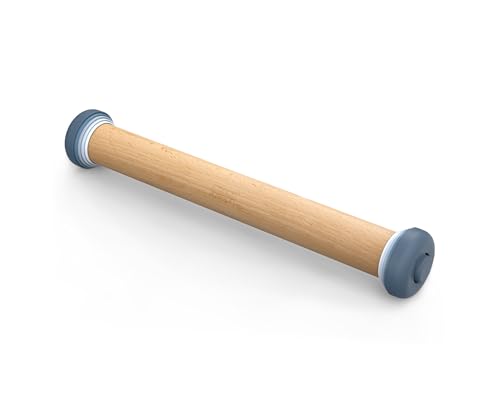
Joseph Joseph names three uses and stops: biscuit dough, pizza bases and pastry sheets. It is a well documented beech pin with five thicknesses published in millimeters and inches, and on a page about what each maker says the pin is for, three named uses is the least to work with in the pool.
Folksy Super Kitchen names one, a flour cake, and its own bullets name two different steel grades for the same pin, 18/8 and 304. It publishes five silicone ring sizes in millimeters, which is genuinely useful, but the listing says almost nothing about what to roll with it. Neither pin is bad and neither answers this page’s question.
Handle Shape and Weight Over a Long Session
One Pin Has No Handles
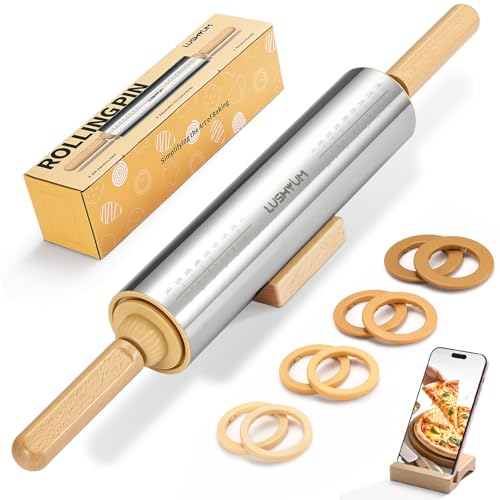
Geesta is a French style pin, which means a tapered barrel you grip directly rather than handles on axles, and its listing adds what it calls a handle press design. Bakers who roll a lot tend to prefer that shape because your palms sit on the dough side of the pin and pressure is easier to place, and it is the only pin in this pool built that way.
The other four are conventional handled pins. AMUZHI adds threaded end caps that let the whole thing come apart, which is unusual and useful when sugar or butter gets into a joint. PEASUG goes the other way and states a seamless one piece design, so there is no joint at all and nothing to unscrew.
What Each One Weighs in the Hand
Four of the five publish a weight and the spread is wide: 1.0 lb for the AMUZHI, 1.1 lb for the PEASUG, 1.23 lb for the QUELLANCE and 2.64 lb for the Geesta teak pin. Over an afternoon of cookie dough that is a real difference, and it cuts both ways: a heavier pin does more of the work and a lighter pin tires you less.
BIDFUL publishes no weight at all, which on a beech pin is the one figure worth having, since its own argument is that wood does not conduct heat and keeps dough cooler than a metal pin. The Geesta figure of 2.64 lb should also be read against its dimension fields, which give 0.5 by 23.0 inches and cannot describe a pin.
Which One Fits Your Kitchen
The week that covers everything. BIDFUL names nine uses, from pizza and dumplings to fondant and embossing, on a beech barrel of about 17 inches with four rings at 1/16, 1/8, 1/4 and 3/8 inch. Wipe it with a warm damp cloth and do not soak it.
The butter pastry afternoon. AMUZHI is the only listing naming croissants and puff pastry, and the only one with a technique note: chill the 430 steel barrel for 30 minutes first. Four color coded ring pairs, a 17 inch etched ruler in two units, and 1.0 lb.
The cake that needs a fondant sheet. QUELLANCE calls itself a fondant rolling pin and supplies a measuring mat to roll on, with four ring sizes from 1/16 to 3/8 inch on a 17 inch 430 steel barrel at 1.23 lb.
The baker who rolls from the palms. Geesta is the only handle free French style pin here, in teak with a 23 inch published length and 2.64 lb, five rings each marked on the side and stated dishwasher safe. It publishes no thickness figures.
The wrappers and the thin noodles. PEASUG names wonton wrappers, noodles, pancakes, bread, pies and cookies, on a seamless one piece steel barrel of 17 inches at 1.1 lb, with four rings at 1/16, 1/8, 1/4 and 3/8 inch and no joint to clean.
What We Could Not Verify
These are the figures and statements we went looking for in the manufacturer listings and could not find. Nothing below was estimated, and nothing on this page was measured by us.
- A thickness figure for any of the five Geesta rings, which are described only as circumference options.
- A published weight for the BIDFUL pin, the only pick without one.
- Whether the two steel pins that never mention fondant are suitable for it, which neither addresses.
- What the Geesta wooden holder is, or whether it is supplied, since that sentence is cut off.
- Why BIDFUL and PEASUG call 1/8 inch 3 mm while QUELLANCE calls it 4 mm.
- Whether any of these pins may be chilled, apart from the one listing that recommends it.