How the Five Compare on the Numbers
Sixteen coffee scales sit on this page’s fact sheet, and the five below were chosen on one test: does the listing say what its timer actually does. A scale that prints the word timer in a feature list and stops there cannot be ranked on an espresso routine, and neither can a pocket scale sold for weighing out beans. What is left is five listings that describe theirs.
The five below all publish a timer, and that is where the similarity ends. One publishes a water flow rate. One publishes two timekeeping modes. One publishes a count up and a count down. Two publish the number of minutes after which the scale turns itself off, which on an espresso machine is the difference between a working scale and a dark one.
What the table cannot tell you is how quickly any of these settles, which is the property a shot scale lives or dies on. BAGAIL says it stabilizes faster and responds sensitively, Greater Goods says a rapid refresh rate responds instantly, and neither attaches a figure to the claim. No listing on this page publishes a refresh interval, a settling time or a response figure of any kind, so every speed claim here is a sentence rather than a specification.
What Each Timer Is Actually Said to Do
One Flow Rate, Two Modes, and One Count Down
TIMEMORE is the only pick that publishes a water flow rate alongside the timer, which is the one number on this page that an espresso routine uses directly rather than by inference. Maestri House publishes two built in timekeeping modes without naming them. Greater Goods publishes both a count up and a count down and ties them to bloom, extraction and shot timing, which is the most specific description of a timer on this page.
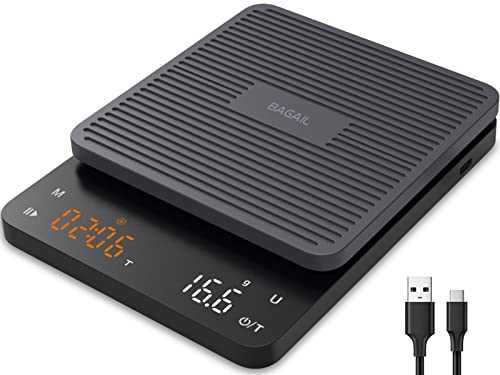
BAGAIL calls its timing automatic and says it exists to help follow a brew recipe exactly. WISHSOM says its timer tracks brewing time and weight together. Both are timer claims that would suit any brewing method, which is the point: two of these five publish a timer that has been thought about for espresso, and three publish a timer.
The Two Scales That Publish When They Switch Off
TIMEMORE states that it shuts down automatically after 3 minutes of standby, and defines standby as no change in the measurement. That is one of only two auto off figures on this page, and it is an unusual thing to publish because it is easy to read as a fault. It is the opposite. A scale that turns off during a slow ritual is a common frustration, and this is the one listing that tells you where its limit is.
Maestri House publishes the other, a sleep mode after 5 minutes of inactivity. Greater Goods names an auto-shutoff and WISHSOM an automatic sleep mode, and neither attaches an interval to it. BAGAIL says nothing at all about switching off, which does not mean it stays on. It means that if the scale goes dark between weighing the dose and pulling the shot, no buyer could have known in advance. On a daily espresso routine, with pauses for grinding and distribution, that gap in the data is the one most likely to be felt.
Power, and What Happens on the Counter
Rechargeable Against Three AAA Cells
Three of these five carry a built in battery. TIMEMORE publishes 1600 mAh and up to 10 hours of life. BAGAIL publishes 600 mAh, a full charge in 3 hours, and 30 days of use at ten minutes a day. Maestri House publishes 500 mAh, up to 90 days on a charge and a USB-C cable in the box. Those are three different ways of describing endurance, and only BAGAIL’s converts into a usage pattern a buyer can check against their own.
Greater Goods and WISHSOM both run on 3 AAA cells, and both state that the cells are included. Neither publishes a battery life figure, which for a scale on a daily routine is the same gap the rechargeable pair fill with a milliamp hour number. A cell scale never needs a cable near an espresso machine, and it also never tells you it is fading, which shows up as drift rather than as a dead display.
Glass, Acrylic, Silicone and ABS
Every one of these surfaces will be hit by water and coffee daily. Maestri House publishes borosilicate glass. TIMEMORE publishes acrylic and says the dial surface is waterproof, which is a careful way of not claiming the whole scale is. Greater Goods publishes a heat resistant silicone cover that is dishwasher safe. BAGAIL publishes an ABS platform with a removable silicone part and a note that four plugs must be taken out from under the platform before first use.
WISHSOM publishes no material for its surface at all, which is the one substantive omission among these five. What none of them publishes is an ingress rating, so waterproof here means whatever each maker means by it, and a scale that sits under a portafilter is going to find out. Greater Goods is the only one whose cover is stated dishwasher safe, while BAGAIL’s silicone pad is removable and Maestri House’s is detachable.
Where the Published Figures Stop Agreeing
WISHSOM Publishes a Scale 5.12 Inches Tall
WISHSOM’s dimension fields read 5.12 by 7.09 by 5.12 in. Its own first bullet says the platform is 5.2 by 5.0 in and the overall size is 7.2 by 5.2 by 1.2 in. A coffee scale is not 5.12 in through, and the repeated 5.12 is the width appearing twice rather than a height. The maker’s sentence is used in the table above and the field is recorded beside it, unchanged.
This matters more than it looks on an espresso page, because the figure that decides whether a scale sits on a drip tray is exactly the one the fields got wrong. Taking the maker’s own line, WISHSOM is 1.2 in tall, which is close to BAGAIL’s 1 in and Greater Goods’ 1.1, and nothing like the 5.12 the listing also publishes.
Two Weights for One Scale, and One Missing Size
Maestri House publishes 0.73 lb in its field and says it weighs just 0.75 pounds in its own sentence. The gap is small and the page records both rather than choosing, because there is no way to tell which is the scale and which is the scale in its box. Its dimensions, 4.13 by 4.13 by 0.78 in, appear identically in both places, which is the strongest agreement on this page.
TIMEMORE publishes no dimensions at all, in any field or any sentence, on a scale whose own listing calls it ultra compact and low profile. It also publishes 1.26 lb, which is more than any other pick here, and the two facts together are the whole problem: a heavy scale with no published size is the one purchase on this page that cannot be planned around.
Which One Fits Your Kitchen
Dialing in a shot by flow rate. TIMEMORE, the only pick that publishes a water flow rate with its automatic timer, at 0.1 g precision up to 2 kg, 1600 mAh and 10 hours. It also tells you it sleeps after 3 minutes of standby, where Maestri House states 5.
Sitting on a small drip tray. Maestri House, published at 4.13 by 4.13 by 0.78 in and 0.73 lb, in borosilicate glass, with two timekeeping modes, three units and a 500 mAh battery charged over USB-C.
Timing a bloom and a shot the same way. Greater Goods, with a count up and a count down, 0.1 g precision, six units, a 5.25 by 5.25 in weighing area under a dishwasher safe silicone cover, and 3 AAA cells in the box.
Knowing how long a charge lasts. BAGAIL, the one listing that turns its battery into a usage figure: 600 mAh, 3 hours to charge, 30 days at ten minutes a day, on a 6.7 by 5.1 by 1 in platform of ABS with removable silicone.
A wide platform on ordinary batteries. WISHSOM, 0.3 g to 3000 g at 0.1 g, a stated 5.2 by 5.0 in platform in a body the maker puts at 7.2 by 5.2 by 1.2 in, on 3 AAA cells, at 0.64 lb.
What We Could Not Verify
Every figure above is from the maker’s own listing text. These are the things we went looking for and could not source in any of the five.
- Not one listing publishes a refresh interval or a settling time, so the response claims that matter most on an espresso scale cannot be compared at all.
- Only TIMEMORE and Maestri House publish an auto shutdown figure, 3 minutes and 5. Two more name the behavior with no interval, and one says nothing at all.
- Greater Goods publishes no weighing range, so one of the five cannot be placed on that row at all.
- TIMEMORE publishes no dimensions in any form, which on a scale that has to fit beside a group head is the most useful figure it could give.
- WISHSOM’s fields say 5.12 in through where its own sentence says 1.2, and the listing publishes no material for the weighing surface.
- No listing publishes an ingress or water resistance rating, so the waterproof wording on two of these five cannot be checked against anything.