How the Five Compare on the Numbers
Seven label sets are on the fact sheet and two are left off. Talented Kitchen publishes a 157 piece vinyl set and a weight of 3.0 lb, which cannot be right for a sheet of stickers and is the only weight in the whole pool. Aixoom publishes a size of 8.5 by 11 inches, which is the backing sheet rather than a label, and neither listing says anything about getting a label off again.
A trailer galley is a humid cupboard that moves, and the contents change every trip. So the specifications that matter are what the label is made of, whether it survives moisture, and whether it comes off cleanly when the jar gets refilled with something else. Four of these five publish a vinyl or waterproof material. One publishes paper.
The material row is the one to read first, because everything else follows from it. Hebayy is the only pick made from what its own listing calls formulated paper, and it is also the only one rated by its maker for a dishwasher, a microwave, a fridge and a freezer. Those two facts sit oddly together and the listing does not reconcile them. What no row can show is how long any of these adhesives hold, because not one of the seven listings publishes a service life, a temperature range or a surface it will not stick to.
What Humidity Does to a Label
Four Are Vinyl and One Is Paper
VITEVER and LOPURO both publish matte white vinyl and both make the strongest claims: VITEVER says totally waterproof and tear resistant, LOPURO says the material resists moisture and humidity specifically. CHUBBIEE publishes vinyl and goes out of its way to say it is not standard paper, adding that the labels are safe to wipe down. Kuocodall says waterproof and durable without naming the material at all.
Hebayy publishes formulated paper with a high quality glue. Paper with a coating can hold up better than the word suggests, and the maker rates it for a dishwasher and a freezer, but in a cupboard that sweats when the heating goes on and dries out when it does not, the material is the specification you are betting on. Nothing in the listing says what the formulation is.
What Waterproof Actually Says
Four of the five say waterproof and one says water and oil resistant, and none of them publishes a test, a rating or a duration behind the word. The strongest wording here is VITEVER’s totally waterproof, and the most specific is LOPURO naming humidity rather than water, which is the right distinction for a cupboard in a trailer where condensation is constant and spills are rare.
Oil is the other half of the problem and only Hebayy raises it, saying the stickers are water and oil resistant. A galley shelf collects a film that water never does, and it is the film that lifts a corner. So the label set with the least durable material is the only one whose listing names the thing that actually gets under it, which is not much help to a buyer choosing between them.
Coming Off Again Without a Mess
Repositionable Is Not the Same as Removable
All five claim a clean removal and two go further. VITEVER says removable and repositional with no residue left, and LOPURO says removable and repositionable. That extra word is the one that matters in a small kitchen, because it claims the label can be lifted and stuck down again rather than simply peeled off and thrown away. Kuocodall says removes easily without residue, which is the peel and discard version.
CHUBBIEE describes its easy peel technology and gives the reason directly: change an expiration date or switch an ingredient and the label comes away without a gummy mark. Hebayy says the glue keeps the reminder tight and peels off without a sticky stain. None of the five says how many times a label can be moved, or whether it still sticks after the first removal, which is what repositionable ought to mean.
Writable Beats Preprinted When the Stock Changes
Three of these are preprinted sets with a fixed vocabulary: VITEVER publishes 279 printed names out of 308 labels, LOPURO and Kuocodall both publish 183 common pantry items. All three ship a catalog page so a name can be found quickly, which with several hundred labels in a pack is a real convenience rather than a selling line.
The other two leave the writing to you. CHUBBIEE ships 64 blank vinyl labels in two sizes and Hebayy ships a roll of 500 blanks, recommending a ball pen or a permanent marker. For a trailer that gets restocked from whatever shop is nearby, a blank label is worth more than a beautiful printed one for an ingredient you did not buy. The preprinted sets answer a different question, which is how a shelf looks.
Counts, Sizes and What Fits a Small Jar
One Size, Two Sizes or Three
Kuocodall publishes a single size, 2.5 by 2.5 inches, for all 288 labels. VITEVER publishes three shapes and sizes, with 252 of its labels in the 2.5 by 2.5 inch square and smaller ones at 1.6 by 1.6 inches. LOPURO pairs 2.5 by 2.5 inch name labels with 1.1 by 0.6 inch date labels. CHUBBIEE publishes 3.54 by 0.98 inches and 1.67 by 0.98 inches, which are strips rather than squares.
Shape matters more in a trailer than in a house, because galley storage runs to narrow jars, tall canisters wedged into a locker and containers chosen to fit a specific gap. A 2.5 inch square needs a flat face that wide. CHUBBIEE’s long thin strips and Hebayy’s 2.4 by 1.2 inch ovals will go around a curve that a square will not sit flat on.
Five Hundred Blanks Against 279 Names
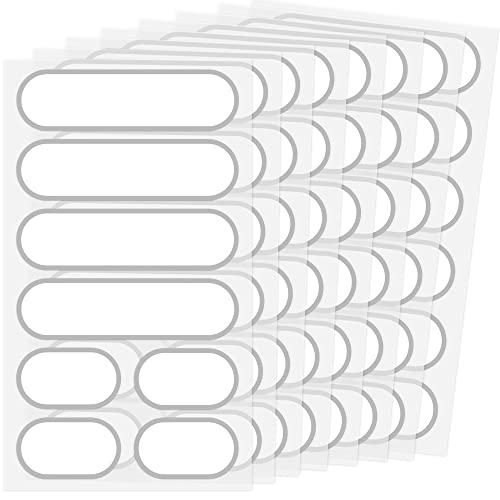
Hebayy publishes the largest count at 500, all blank, supplied on a roll with a perforation line so they tear off one at a time. That is a different object from a sheet: a roll takes up less of a small drawer and does not get bent. VITEVER publishes 308, LOPURO 300, Kuocodall 288, and CHUBBIEE 64, which is the smallest pack here by a wide margin.
Count is the specification that flatters a listing most and tells you least. A preprinted set of 300 might contain twenty names you will ever use, and 64 blanks will label every container in a trailer twice over. Read the breakdowns instead: 96 of LOPURO’s 300 and 96 of Kuocodall’s 288 are expiration date labels rather than names.
Which One Fits Your Kitchen
The most printed names on a shelf. VITEVER, 279 printed names in a pack of 308, in matte white vinyl stated totally waterproof, removable and repositional. Three shapes, with 252 of them in the 2.5 by 2.5 inch square.
Tracking how long something has been open. LOPURO, 300 labels in matte white vinyl that names humidity directly, pairing 2.5 by 2.5 inch name labels with 96 date labels of 1.1 by 0.6 inches, removable and repositionable.
One size and nothing to think about. Kuocodall, 288 labels all at 2.5 by 2.5 inches, 183 printed names plus 9 blanks and 96 date labels, with an alphabetical catalog. It never names the material it is made from.
Restocking from whatever shop is nearby. CHUBBIEE, 64 writable vinyl labels in two strip sizes, 3.54 by 0.98 inches and 1.67 by 0.98 inches, stated fully waterproof with a residue free peel for changing contents.
A roll in a drawer that never runs out. Hebayy, 500 blank ovals at 2.4 by 1.2 inches on a perforated roll, the only pick rated by its maker for a dishwasher, microwave, fridge and freezer. It is also the only one made of paper.
What We Could Not Verify
Every figure above comes from the maker’s own listing text. These are the things we went looking for and could not source in any of them.
- No listing publishes a temperature range for the adhesive, which in a vehicle that bakes in summer and freezes in winter is the figure that decides everything.
- Not one of the five says how many times a repositionable label can actually be moved before it stops sticking.
- Kuocodall never names its material, saying only that it is waterproof and durable, where three other picks name vinyl.
- Hebayy states formulated paper and also rates the labels for a dishwasher and a freezer, and nothing in the listing reconciles the two.
- No listing publishes a surface the labels will not hold on, and textured plastic is the common one in a trailer galley.
- VITEVER publishes 279 printed names in a pack of 308 and never says what the remaining labels are.