How the Five Compare on the Numbers
Eight listings sit on the fact sheet and three are not on this page. Chemex names no steel anywhere in its listing and is the only brewer in the pool with none. Unbreakable names a double stainless filter and never says what the steel is. Yopinmall names a stainless steel mesh filter in a sentence copied word for word from the Bodum listing, down to the aromatic oils and the subtle flavors.
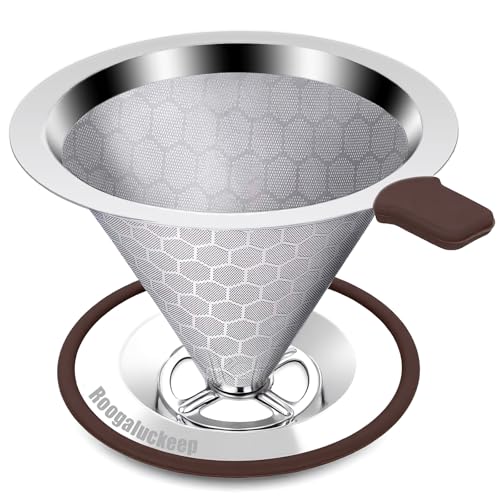
What decides this page is where the steel actually sits. On Roogaluckeep the whole brewer is steel. On Cosori, AGOGO and Bodum the steel is the filter and the vessel is glass. On Melitta the steel is the carafe and the coffee runs through paper in a plastic cone, which makes the one listing with stainless steel in its title the one with no steel in the brewing path.
The table cannot tell you how fine any of these filters are except one. Roogaluckeep publishes 600 mesh, and nothing else here publishes a mesh count, an aperture or a wire gauge. Two layers of 304 and dual layers of 304 are construction claims rather than filtration figures, and a permanent mesh described as new and improved gives no number at all. The Cosori width field, 2.16 in, cannot belong to a decanter the same listing says holds 34 ounces.
Where the Stainless Steel Actually Is
One Brewer Made of Nothing Else
Roogaluckeep is the only pick where steel is the whole object. The listing states it is made entirely from food grade 304 stainless steel with zero plastic parts that touch the coffee, and calls itself a one piece design with no assembly required. At 0.16 lb it is by far the lightest thing on this page, and it is also the only pick with no vessel of its own.
That is the trade. It sits on a mug, and the listing states it fits most standard mugs with a 2.5 to 3.5 inch rim diameter, which is the only fit figure published by any listing in this pool. It brews 1 to 2 cups. If a carafe is wanted, this is the wrong tool, and the maker does not pretend otherwise.
Three Steel Filters in Glass Brewers
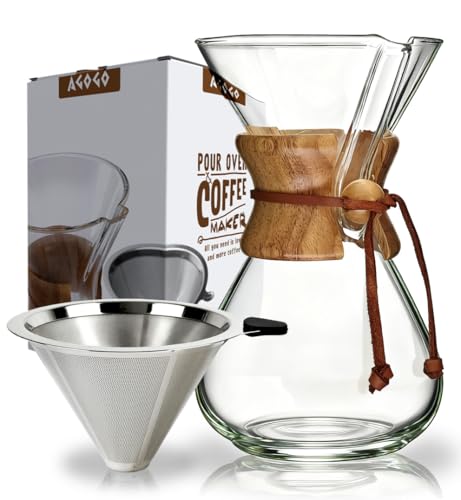
Cosori, AGOGO and Bodum all put steel in the same place, in the cone, and glass underneath it. Cosori publishes dual layers of 304 stainless steel. AGOGO publishes two layers of 304 and adds a claim no one else makes, that there is no middle layer, which is a direct shot at filters that put a coarse mesh between two fine ones. Bodum names steel and no grade.
The glass is described differently in each. AGOGO gives 3.3 mm and says the glass takes boiling water and refrigerator cold. Cosori says its decanter can be warmed on the stove on a low flame. Bodum calls its borosilicate single wall with a cork band, which is the only one of the three that tells you the carafe will not hold heat for long.
The One Where the Steel Is the Carafe
Stainless Steel in the Title, Paper in the Cone
Melitta is on this page because it inverts the question. Its title carries the words stainless steel carafe, and that is exactly what the steel is: a 42 ounce thermal carafe holding 6 cups. The brewing cone above it is heavy duty plastic, stated BPA free and top rack dishwasher safe, and the coffee passes through a Melitta paper cone filter on its way down.
So the pick with the most stainless steel by weight has none of it in contact with the brew. For a buyer who wants steel because paper strips the oils out, this is the opposite of what they asked for. For a buyer who wants steel because glass breaks, it is the only answer here, and the only carafe on the page that cannot shatter.
What Steel Instead of Paper Actually Changes
Three of these five listings make the same argument in almost the same words. Bodum says its permanent steel mesh helps extract the coffee’s aromatic oils and subtle flavors instead of them being absorbed by a paper filter. Cosori says dual layers of 304 allow fine oils to infuse into the coffee. Roogaluckeep says paper filters absorb the deep flavor notes and that there is no sediment in the cup.
None of them publishes anything measurable behind that. There is no figure for oil retention, no particle size and, except on Roogaluckeep, no mesh count. The claim is consistent across three brands and three price categories and it is still a claim, so it is recorded here as what the makers say rather than as something the specifications establish.
Grades, Layers, and What Is Not Said
Three Listings Name 304 and Two Do Not
Roogaluckeep, Cosori and AGOGO all name 304 stainless. Bodum names stainless steel with no grade at any point, and Melitta names a stainless steel carafe with no grade either. Naming the grade is not proof of anything on its own, but it is the difference between a specification and an adjective, and two of these five listings stop at the adjective.
Layer counts run the same way. AGOGO states two layers of 304 and specifies that there is no middle layer. Cosori states dual layers. Roogaluckeep states a mesh count of 600 and precision spiral ribs rather than a layer count. Bodum states a permanent mesh described as new and improved, without saying what it was improved from or in what respect.
Cleaning Is Where the Steel Page Gets Vague
A permanent filter has to be cleaned after every brew, and the listings are least specific exactly there. Cosori states that the decanter and filter are both dishwasher safe and that the wooden sleeve and its tie are wiped with a cloth. Bodum says dishwasher safe without naming which parts. Melitta names its cone and lid as top rack dishwasher safe, which covers the plastic rather than the steel.
AGOGO supplies a cleaning brush and a towel and calls that a cleaning kit, which is a tool rather than an instruction. Roogaluckeep says only that it has no fragile parts, and never states whether 600 mesh steel can go in a dishwasher at all. On the one specification that decides how long a metal filter keeps working, this pool is close to silent.
Which One Fits Your Kitchen
Coffee that touches nothing but steel. Roogaluckeep, made entirely of food grade 304 with a 600 mesh filter and spiral ribs, stated zero plastic in contact with the brew, one piece at 0.16 lb, sitting on any mug with a 2.5 to 3.5 in rim.
A full carafe and no paper to buy. Cosori, a 34 ounce borosilicate decanter the maker says can be warmed on a low flame, with a dual layer 304 filter, measuring spoons, and both decanter and filter stated dishwasher safe.
The most specific filter claim on the page. AGOGO, two layers of 304 stated with no middle layer, under a wood neck carafe in 3.3 mm glass at 34 ounces, arriving with paper filters, a cleaning brush and a towel as well.
A steel filter with the cup size spelled out. Bodum, 34 ounces given as 8 cups of 4 oz each, a permanent stainless mesh, single wall borosilicate with a cork band, published at 8 by 5.62 by 6.5 in and 1.21 lb, stated dishwasher safe.
Steel that keeps the coffee hot rather than filtering it. Melitta, a 42 ounce stainless steel thermal carafe holding 6 cups, with a plastic brewing cone, a top rack dishwasher safe lid and paper cone filters supplied to start with.
What We Could Not Verify
Every figure above comes from the maker’s own listing text. These are the things we went looking for and could not source in any of them.
- Only Roogaluckeep publishes a mesh count, so how fine the other three steel filters are cannot be compared at all.
- Bodum and Melitta name stainless steel without naming a grade, so what their steel is remains unstated.
- Not one listing states whether its steel filter can go in a dishwasher by itself, which is the thing that decides how long a permanent filter lasts.
- Three listings claim that steel keeps oils that paper absorbs, and none of the three publishes a figure of any kind behind that claim.
- Bodum describes its mesh as new and improved without saying what changed or what it replaced.
- Cosori publishes 2.16 in across a decanter it also says holds 34 ounces, and gives no dimensions in words, so its real footprint is unknown.