How the Five Compare on the Numbers
Sixteen listings sit on the fact sheet for this pool, and the five here are the ones with enough published text to compare. Fat Daddio’s publishes a single line of feature text and nothing else, so there is no cleaning claim, no bearing description and no material to place. Winco publishes a stainless steel display stand with easy assembly and no rotation claim of any kind, and hvominxs publishes a turntable inside a kit whose figures describe the icing smoother rather than the plate.
What decides a turntable used several times a week is not the plate. It is what happens after the cake comes off, and these five answer that very differently. One tells you outright not to put it in water. Two argue that stainless steel is the reason theirs wipes clean. One publishes guide lines printed on the surface, and one publishes a way to stop the plate turning.
The table cannot tell you how a bearing ages, which is the property that decides whether a turntable is still worth using in a year. Four of the five name the bearing and none publishes a load rating, a service life or anything about whether it can be re greased. It also cannot reconcile himaly’s two materials or its two weights, and it cannot tell you why the one pick with a brake is the one pick that never mentions a bearing.
What Happens After the Cake Comes Off
The One That Says Do Not Submerge It
Ateco publishes the clearest cleaning instruction of these five and it is a restriction: wipe with a damp cloth, do not submerge in water. On a turntable used for everyday prep that is the single most consequential line on any of these five listings, because buttercream gets under the plate and around the base, and a tool that cannot go in the sink has to be cleaned around instead.
It is also the most honest. An aluminum base with steel ball bearings inside it is exactly the construction you would not want to flood, and Ateco is the only maker here that says so. The others describe themselves as easy to clean and leave the buyer to guess whether that includes a sink, a dishwasher, or a cloth.
Two Listings Argue From the Material
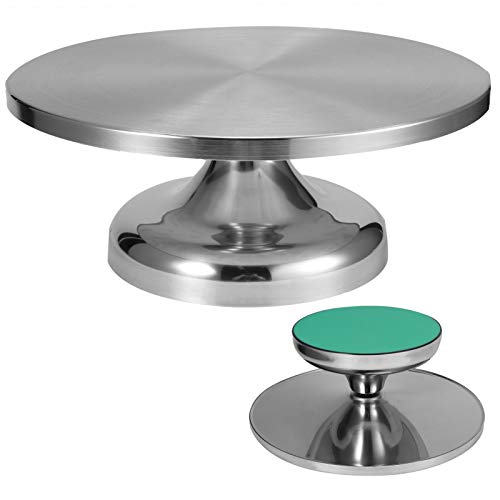
himaly and TOTITOM both make the same case in nearly the same words: both the plate and the stand are stainless steel, so they are easy to clean no matter how much cream is left on the surface. TOTITOM names 304 stainless throughout and himaly names stainless steel for the plate and the stand while also describing heavy aluminum alloy in its second bullet.
Neither of them says what happens if the assembly goes under a tap, which is the same gap Ateco fills with a warning. RICCLE and Kootek simply call themselves easy to clean, RICCLE adding that decorating is a breeze and Kootek noting that the plate suits decorating tips and icing spatulas, which are not included. Between the five, one instruction and four adjectives.
Turning, Stopping, and Guiding the Hand
Four Bearings and One Brake
Ateco, RICCLE, Kootek and himaly all name a bearing. Ateco and RICCLE specify stainless steel balls, RICCLE calling them hidden, Kootek calling its own hidden without naming the metal, himaly naming stainless steel and describing the bearing as flexible. TOTITOM names no bearing at all and instead publishes the one thing none of the others do, a plate that can be fixed in place when it is not wanted to spin.
For everyday prep that trade is real. A brake matters when a cake is being lifted on or off, or when a side is being scraped and the plate should not move. A named bearing matters every other minute. What nobody publishes is how much either arrangement will take, since none of the five gives a weight capacity for the plate.
The Only Plate With Lines On It
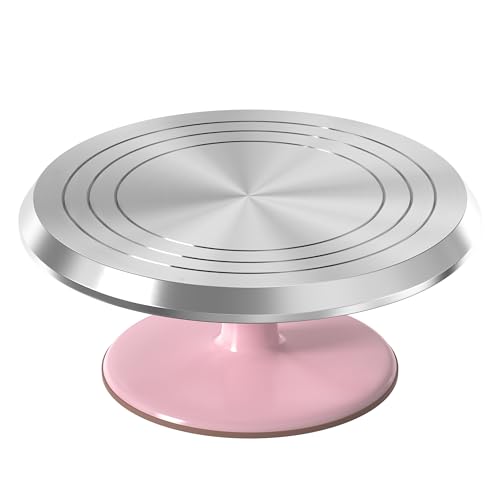
RICCLE publishes guiding lines on the surface of its 12 in plate, which is the only positioning aid anywhere on this page. Centering a cake by eye is the first thing that goes wrong in an everyday routine, and it is the sort of detail that never appears in a specification table because it is printing rather than engineering.
Everything else about RICCLE is close to Kootek: aluminum alloy, a non slip rubber surface, hidden steel bearings, 5.05 lb against Kootek’s 5.2, and a field height of 3.7 in against 3.77. The two are near enough to be the same casting, and the lines are the one published difference that would change how a decorating session feels.
Where the Published Figures Stop Agreeing
himaly Publishes 2 Pounds and 2000 Grams
himaly’s weight field reads 2 lb. Its second bullet says the stand is constructed with heavy aluminum alloy at N.W 2000g. Those are not the same quantity, and they are not close. The same bullet sequence then calls the stand premium stainless steel twice, after introducing it as aluminum alloy, so the listing disagrees with itself about the metal as well as about the mass.
This page quotes both figures and builds nothing on either. What can be relied on from himaly is what its dimensions agree on: 12.2 in across, 7 in for the base and 5.3 in high, published identically in the fields and in the maker’s own line. Those three numbers are the most internally consistent set on this page, which is an odd thing to say about the listing that also contains its worst contradiction.
Ateco Publishes a 4 Inch Height and a 5 Inch Field
Ateco’s own sentence says the turntable measures 12 inches in diameter and stands 4 inches high. Its dimension field says 5. One of those includes something the other does not, most likely the base, and the listing does not say which. For a tool that sits on a counter under a cake, an inch of standing height changes how a scraper is held.
TOTITOM has a smaller version of the same problem, publishing 12 in in its bullets and 11.8 in its size field for the same plate. It also publishes 7.78 lb with no dimensions at all, which makes it the heaviest thing on this page and the one whose footprint cannot be checked. A 304 stainless plate that heavy is the reason it does not need a bearing claim to feel stable, and it is also the reason it will not be moved off the counter often.
Which One Fits Your Kitchen
A plate that gets washed after every cake. None of these five, on the published evidence. Ateco is the only one that tells you where the limit is, wipe with a damp cloth and do not submerge, and knowing that is worth more than four listings calling themselves easy to clean.
Centering a cake without measuring. RICCLE, the only pick with guiding lines printed on its 12 in aluminum plate, on hidden stainless steel ball bearings, at 5.05 lb with a field height of 3.7 in.
A plate that stays put when you want it to. TOTITOM, 304 stainless steel turning both ways and fixable in place, at 7.78 lb. It publishes no dimensions, so measure your own counter space first.
A stand from a maker that publishes its limits. Ateco, the #615, aluminum base and plate with stainless steel ball bearings and a silicone cap underneath, 12 in across, 4.8 lb, and a clear instruction about water.
Everyday decorating on a budget of space. Kootek, 12 in of aluminum alloy on hidden ball bearings with a non slip surface and rubber feet, 5.2 lb, 3.77 in high in its fields. Decorating tips and spatulas are not included and the listing says so.
What We Could Not Verify
Every figure above is from the maker’s own listing. These are the things we went looking for and could not source in any of the eight.
- No listing publishes a weight capacity for the plate, so how heavy a tiered cake any of these will carry is unstated everywhere.
- Four of the five call themselves easy to clean and only Ateco says what that means, leaving three turntables with no washing guidance at all.
- himaly publishes 2 lb in its weight field and 2000 g in its own text, and names both aluminum alloy and stainless steel for the same stand.
- Ateco publishes 4 in high in its sentence and 5 in its fields, and does not say which figure includes the base.
- TOTITOM publishes no dimensions of any kind, on the heaviest turntable here at 7.78 lb.
- None of the five says whether a bearing can be serviced or re greased, which is what decides a turntable used weekly for years.