How the Five Compare on the Numbers
Fifteen listings are on this fact sheet and ten are left off. Two are worth naming. ANTOPY is not a mat at all: it is a stainless steel dish rack with 12 slots and a detachable cutlery holder, so setting its footprint beside a flat sheet would compare nothing. Umbra pairs a plastic drainer tray with a microfiber mat, publishes one weight for the combination that cannot cover both parts, and publishes two different sizes that its own listing never reconciles.
The five that remain split into two objects that share a name. Three are silicone: a ribbed sheet 0.1 inches thick that holds dishes above the water and lets it run off. Two are microfiber: a pad that soaks the water up and then has to be washed and dried itself. Everything else on this page follows from that difference.
Look at the cleaning row against the material row. The three silicone mats all go in the dishwasher, which means the mat is cleaned by the machine that is already running. The two microfiber pads are laundry: Hydro2Go states machine and hand washing and Jxiwfvl specifies cold water. What no listing publishes is how quickly a wet microfiber mat dries out on a counter, which is the thing that decides whether it smells by Wednesday.
Soaking It Up or Letting It Run Off
Two Microfiber Pads and What They Hold
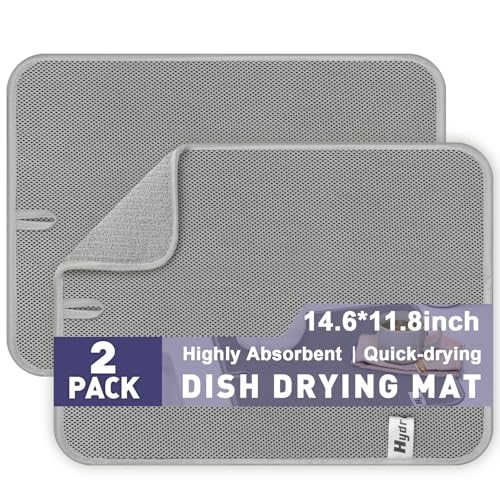
Hydro2Go publishes the only absorbency figure among these five: up to four times its own weight in water, on pads of 14.6 by 11.8 inches, two in the pack, weighing 0.2 lb together. It also publishes thick padded cushioning for glassware and a built in hanging loop so the mat can dry vertically, which is the practical answer to the problem microfiber creates.
Jxiwfvl publishes 15.74 by 11.8 inches, a non slip backing and a reversible design, and no weight at all. Being reversible is a genuine advantage on an absorbent mat because one side can dry while the other works. Neither microfiber listing publishes a thickness, so how much water either will take before it stops absorbing is not answerable from the figures.
Three Silicone Sheets and Where the Water Goes
COPLIB publishes 15.8 by 13 inches at 0.1 inches thick and 0.5 lb, with a raised ribbed surface that elevates glasses, and it rolls up or folds flat for a drawer. MeimeiDe publishes 15.7 by 12.6 inches, also 0.1 inches thick, at 0.7 lb. MODENGKONGJIAN publishes 12 by 6 inches, the smallest mat here, at 0.22 lb.
All three are non absorbent by design, which MeimeiDe states outright as the difference from a fabric pad. The water sits on the counter under the ribs rather than in the mat, so the mat stays clean and the counter gets wet. That is the trade nobody advertises: silicone moves the problem rather than solving it, unless the mat has somewhere to send the water.
The One Mat That Sends Water to the Sink
Diagonal Ridges and an Extended Lip
MeimeiDe publishes the only drainage design among these five. Diagonal ridges across the surface guide water toward an extended lip at one edge, and the lip is made to overhang the sink so the water runs straight in. On a silicone mat that is the missing piece, because it is the difference between a dry counter and a puddle that has to be wiped later anyway.
It costs something. At 0.7 lb MeimeiDe is the heaviest of the four that publish a weight, on a mat only 0.1 inches thick, which suggests a denser silicone than the others use. It also has to be positioned with the lip at the sink rather than anywhere on the counter, which a plain ribbed sheet does not.
Heat, and What It Is Really For
MODENGKONGJIAN publishes 450 F, the only heat figure among these five, and it is the reason the smallest mat here is worth a column. A 12 by 6 inch silicone sheet rated to 450 F is a trivet that also drains, and the listing says exactly that, listing use as a fridge liner, a sink mat, a heatproof mat and a pet bowl mat.
COPLIB and MeimeiDe both claim heat resistance without a figure. COPLIB goes furthest on alternative uses, naming a trivet, a countertop protector and a spot under a coffee maker or bottle drying rack. The two microfiber pads publish no heat resistance at all, which is correct rather than an omission: a wet fabric pad is not what you put a hot pan on.
Size, Storage and Staying Put
From 12 by 6 Inches to 15.8 by 13
The published footprints are closer than they look. COPLIB at 15.8 by 13 inches, MeimeiDe at 15.7 by 12.6 and Jxiwfvl at 15.74 by 11.8 are all within an inch and a quarter of each other on both figures. Hydro2Go is a step down at 14.6 by 11.8 inches. MODENGKONGJIAN is genuinely different at 12 by 6 inches, which is a draining board for a mug and a plate rather than a load of washing up.
All three silicone mats publish 0.1 inches of thickness, which is what makes them rollable, and neither microfiber pad publishes one at all despite thickness being the whole point of a padded mat. Hydro2Go describes thick padded cushioning to protect glassware and gives no figure for it.
Rolled, Folded or Hung
COPLIB publishes the most storage options: it rolls up or folds flat for any drawer. MeimeiDe folds. Hydro2Go publishes a built in hanging loop, which on an absorbent mat is more important than compactness, because a folded wet microfiber pad stays wet. Jxiwfvl folds neatly and also asks to be hung to dry for best results.
On staying put, the two microfiber listings and MODENGKONGJIAN publish something and two do not. Jxiwfvl publishes a non slip backing, MODENGKONGJIAN a non slip thickened surface, and MeimeiDe describes a stable resting surface for glasses rather than a grip on the counter. COPLIB publishes nothing about slipping on a wet worktop.
Which One Fits Your Kitchen
Water that ends up in the sink. MeimeiDe, a silicone mat of 15.7 by 12.6 inches at 0.1 inches thick and 0.7 lb, with diagonal ridges that guide water to an extended lip made to overhang the sink. Dishwasher safe and it folds.
The most drying space that rolls away. COPLIB, food grade silicone at 15.8 by 13 inches and 0.5 lb, with raised ribs to elevate glasses, rolling up or folding flat, and doubling as a trivet or countertop protector.
A pad that takes the water with it. Hydro2Go, microfiber at 14.6 by 11.8 inches, two pads at 0.2 lb for the pair, publishing absorbency of up to four times its weight, thick padding for glassware, and a hanging loop to dry it.
Two sides and a grip. Jxiwfvl, reversible microfiber at 15.74 by 11.8 inches with a non slip backing, hand or machine washed in cold water and hung to dry. It publishes no weight and no thickness.
A mug, a plate and a hot pan. MODENGKONGJIAN, food grade silicone at 12 by 6 inches and 0.22 lb, rated to 450 F, the only heat figure here, and named for use as a fridge liner, sink mat or pet bowl mat.
What We Could Not Verify
Every figure above comes from the maker’s own listing text. These are the things we went looking for and could not source in any of them.
- Neither microfiber pad publishes a thickness, despite padding being the reason to choose one over silicone.
- No listing says how long a wet microfiber mat takes to dry on a counter, which is what decides whether it starts to smell.
- Only MODENGKONGJIAN publishes a heat figure, at 450 F, while COPLIB and MeimeiDe claim heat resistance with no number.
- Jxiwfvl publishes no weight at all, and no listing publishes how much water any mat holds except Hydro2Go’s four times its own weight.
- Only MeimeiDe publishes a drainage route, so on the other two silicone mats the water simply sits on the counter under the ribs.
- COPLIB publishes nothing about slipping, on a silicone sheet 0.1 inches thick that lives on a wet worktop.