How the Five Compare on the Numbers
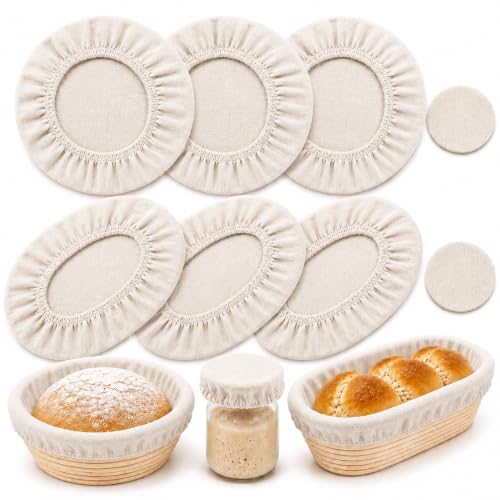
Two listings on this fact sheet are near twins of picks on this page and were left off. YUANSHAO is the twin of the SECOAT, a bag of 100 non woven liners, and the two describe the same product in opposite terms, so one of them is enough here. BEABOO sells the same eight piece configuration as the Kemoterner, six 10 inch liners in three round and three oval plus two jar covers.
What decides a liner you use every week is whether it is washed and put back or thrown away, and the pool disagrees with itself about that. SECOAT calls its 100 liners disposable in one bullet and offers a fresh liner at any time in another. YUANSHAO, describing the same kind of product, calls its 100 reusable or optional for replacement. Both cannot be the plan.
The two figures in that weight row that can be compared are Koackl at 0.19 lb for six 9 inch cotton liners and Mozeat Lens at 0.13 lb for two 10 inch linen ones, which says more about the cloth than about the count. SECOAT publishes 0.57 lb for a hundred non woven sheets. Kemoterner and Boao publish no weight at all, so on two of these five the fabric weight cannot be inferred even indirectly.
Washed and Put Back, or Thrown Away
Only Two Listings Say How to Wash One
Koackl gives the fullest instruction of these five and it is the reason to choose it for weekly baking: the liners are machine washable, you shake off excess flour, wash on a gentle cycle and air dry, and they remain soft and ready for the next bake. That is a maintenance routine rather than a claim, and it is the only one written down here.
Kemoterner gives a shorter version, saying to wash the liners before first use and after baking as needed, and calls the reusable fabric design suitable for regular sourdough baking and everyday fermentation. It does not name a machine, a cycle or a drying method. Between them those two listings are the only ones of the five that treat washing as part of using the product.
Two More Say Reusable and Stop
Boao states that its liners are soft and durable, reliable and reusable, made from untreated flax linen and fabric without dye or harmful substance, and gives the only liner dimension stated in words here, 10 by 3.15 inches or 25 by 8 cm, where Mozeat Lens publishes 9.8 by 9.8 inches in its fields instead. What it never says is how the cloth is washed, only that it is washable, which on untreated linen with dough dried into it is the whole question.
Mozeat Lens is the same case with one extra advantage. It states the cloths are reversible, so each of the two liners has a second face, and presents itself as an end to disposable plastic wrap and foil. It publishes 0.13 lb and no washing instruction of any kind, which for a product sold as the durable alternative is a curious omission.
Where the Pool Contradicts Itself
A Hundred Liners, Called Disposable and Reusable
SECOAT is the clearest statement of the other approach and it does not agree with itself. Its final bullet reads that the set of 100 banneton liners is designed with non stick dough technology and calls them disposable banneton basket liners. An earlier bullet says the large quantity of 100 lets you replace them at any time so you always have a fresh liner.
YUANSHAO, which is not on this page, sells the same kind of 100 pack and describes it as reusable or optional for replacement at any time. So two listings for functionally the same non woven liner reach opposite conclusions about whether it survives a bake. Neither publishes a number of uses, and the page treats both as claims rather than facts.
What a Non Woven Liner Buys and Gives Up
SECOAT states the real case for the format: flexible enough to fit a variety of bread baskets, stretching to fit bannetons up to 21 inches in diameter, food grade and BPA free, with a no fluff design and good breathability. It also doubles as a transparent bread proofing cover so the dough can be watched without lifting anything.
What it gives up is texture. Koackl builds its entire case on a dense cotton with a textured finish that creates a natural easy release surface once dusted with flour, which is the thing a smooth film cannot do. So the choice is between a surface that helps the loaf release and a sheet that never sticks in the first place, and both are published as claims with no test behind either.
Fit, Shape and How Often You Are Washing
Nine Inches, Ten Inches, or Elastic
Koackl is the only 9 inch pick and states it fits standard round proofing baskets with less wrinkling or slipping. Kemoterner, Boao and Mozeat Lens are all 10 inch. SECOAT sidesteps the question with elasticity, stretching to 21 inches, which makes it the only pick that will fit a basket whose rim has not been measured.
Shape is the other divide. Kemoterner is the only pick here that includes oval liners, three of its six, which matters because a batard basket is oval and a round liner creases into it. Koackl, Boao and Mozeat Lens are round only. SECOAT stretches over any shape, which is the second real advantage of elastic over cut cloth.
How Much Laundry a Purchase Creates
Two liners is not enough for a week of baking if they are washed between bakes, which is the Mozeat Lens position, softened only by the cloths being reversible. Six liners, as supplied by Koackl, Kemoterner and Boao, is a week of loaves with a single wash at the end of it, which is the arrangement that fits weekly use best.
A hundred non woven liners removes laundry from the question entirely and replaces it with a bag to keep and eventually to refill. Whether that bag lasts a hundred bakes or a hundred uses is not published anywhere in the SECOAT listing, and its own two bullets point in different directions on the point.
Which One Fits Your Kitchen
A liner with a real washing routine. Koackl, six 9 inch liners in dense cotton with a textured finish, machine washable on a gentle cycle and air dried, stated to stay soft for the next bake, published at 0.19 lb.
Round and oval baskets from one purchase. Kemoterner, six 10 inch liners in three round and three oval plus two sourdough jar covers, in a textured linen cotton blend, washed before first use and after baking as needed.
The liner size stated in the maker’s own words. Boao, six 10 inch round liners in untreated flax linen and fabric, published at 10 by 3.15 inches or 25 by 8 cm, stated reliable and reusable with no washing method given.
Two cloths with two faces each. Mozeat Lens, two reversible 10 inch liners in untreated flax linen and cotton at 0.13 lb, presented as a replacement for disposable wrap. It publishes no washing instruction at all.
No laundry, and a contradiction to read. SECOAT, 100 non woven liners stretching to 21 inches, food grade and BPA free at 0.57 lb, doubling as a transparent proofing cover. Its own bullets call them both disposable and replaceable at any time.
What We Could Not Verify
Every figure above comes from the maker’s own listing text. These are the things we went looking for and could not source in any of them.
- SECOAT calls its 100 liners disposable in one bullet and a fresh liner at any time in another, and never says how many bakes one survives.
- Boao states only that the cloth is washable and Mozeat Lens says nothing about washing at all, so neither publishes a method for untreated linen.
- Kemoterner and Boao publish no weight at all, so their fabric weight cannot be compared with the others even indirectly.
- Boao states 10 by 3.15 inches and Mozeat Lens publishes 9.8 by 9.8 inches in its fields, so on the other three the cloth’s own size is unstated.
- Not one of the five publishes a fabric weight, a thread count or a thickness, which is what actually decides how much moisture a liner takes.
- No listing gives a fit tolerance, so there is no published margin either side of the stated 9 or 10 inches.