How the Five Compare on the Numbers
Seventeen listings sit on the fact sheet for this topic and only five of them publish a weight for a refrigerator egg container. Those five are this page. Four more containers publish none at all, including a 21 slot tray with a built-in handle and a two layer rolling holder that publishes the slope its eggs run down. Eight of the seventeen are stainless egg cups for a single soft boiled egg, which are light because they are something else entirely.
Reading the five weights next to the five capacities is the useful exercise, because they do not track each other. The lightest container holds twelve eggs. The third lightest holds 32. The two heaviest hold fourteen each. Two of the five weights are hard to accept at all, which is worth saying before any of them is used to choose between products.
What the table cannot tell you is how much of each weight is the container and how much is the lid, because no listing here separates them, and two of the five publish a figure for a pack rather than for one holder. On a fridge shelf that is not an academic point: a light container with a heavy lid behaves differently from an even one when you take the top off with one hand and a carton of milk in the other.
The Light End, and What It Costs
Half a Pound for a Dozen
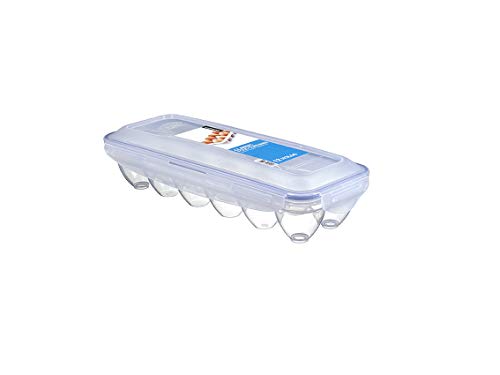
LocknLock publishes 0.55 lb and twelve eggs, and its dimension fields at 12.6 by 4.72 by 2.95 inches describe a genuinely low profile container. Under 3 inches high means it uses a shelf without wasting the space above it, and at just over half a pound it can be moved with the same hand that is holding something else, which is the practical argument for a light container.
It is also the most permissive listing here on cleaning, stated suitable for microwave, dishwasher and freezer, and named for camping as well as a refrigerator. The cost is that it publishes almost nothing else. Four short bullets, no material named, no lid or handle described, no mechanism. If the weight is the specification you care about, this is the listing that answers you and stops.
Three Quarters of a Pound and No Bullets At All
mDesign publishes 0.75 lb for the same stated twelve eggs and its dimension fields read 4.25 by 12.25 by 3.0 inches, so it sits at almost exactly the same height on a shelf. From its title it is a stackable covered tray with a lid and a handle. From its fields it is that size and that weight. That is the whole listing: there are no feature bullets on it whatsoever.
On a page about weight that is oddly workable, because weight and size are the two things it does publish. It is also a warning about what a low weight alone tells you. There is no material, no cleaning instruction, no seal, no construction detail and no guarantee, so the 0.75 lb is a fact floating free of everything that would let you interpret it.
The Best Ratio in the Pool
Thirty Two Eggs at a Pound and a Quarter
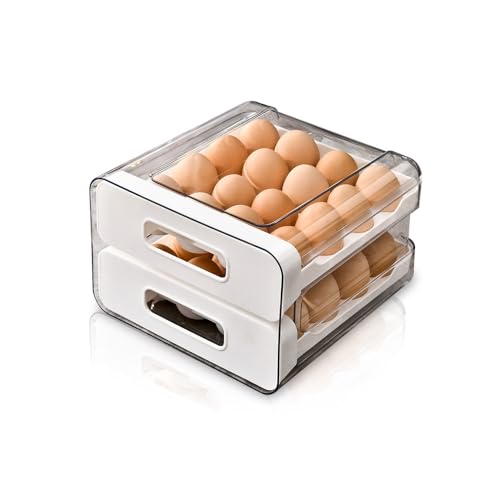
Koja is the standout on this axis. It states 32 eggs and publishes 1.25 lb, which is the most capacity for the least weight anywhere in these seventeen listings, and it achieves it with two sliding drawers rather than a single deep tray. The drawers mean eggs come out without lifting the container down, and the tray is removable so the inside can be washed.
It is clear BPA free plastic, stackable, and its enclosed drawers are stated to protect eggs from odors, moisture and breakage. The figure not to trust is its size: the dimension fields read 21.0 by 22.5 by 14.5 inches, which would be a cupboard, and the size field reads Large. So the weight and the capacity are usable and the footprint is unknown, which on a full shelf is the awkward gap.
Why a Mechanism Need Not Be Heavy
Koja carries two sliding drawers at 1.25 lb. theaoo carries a rolling tray and publishes 3.04 lb for two holders. Both have moving parts, and the weight difference between them is far larger than the mechanism can account for. A drawer is two runners and a face. A rolling base is a molded slope and a tray. Neither is heavy in itself.
That is the argument for reading a light container as competent rather than flimsy in this category. Nothing here is structural: an egg container holds a pound or two of eggs and does not span anything. The weight is molding thickness and lid material, and 1.25 lb with two drawers suggests a maker that molded exactly as much plastic as the job needed.
The Heavy End, and Two Figures to Read Twice
Two Rolling Holders at Three Pounds
theaoo is the most interesting design in this pool and the heaviest per container on this page. The rolling base brings the next egg forward, and the inner tray pulls out on its own so a refill does not need the lid off or anything stacked on top moved. Each holder is stated for 12 to 14 eggs, the top is see-through, and the listing quotes a design patent number.
It publishes 3.04 lb for the pair and it is emphatic about cleaning: wash by hand, not dishwasher safe, in capitals. Its dimension fields describe the carton for two at 6.3 by 12.8 by 2.94 inches, so no single holder size is published. Three pounds for two empty plastic trays is still a lot, and nothing in the listing separates one holder from the other.
Three and a Third Pounds for Fourteen Eggs
Dial Industries is the figure this page declines to use. It publishes 3.3 lb for a single fourteen egg plastic container with a lid, which is more than theaoo publishes for two complete rolling holders and roughly six times what LocknLock publishes for twelve eggs. It is also the listing that publishes three different sizes: 4.4 by 15 by 4.5 inches in its size field, 4.5 by 15 by 3 inches in a bullet, and 15.0 by 4.5 by 3.0 in its dimension fields.
What it does give, alone among these five, is a guarantee: a stated one year manufacturer’s defect warranty, alongside a strong stacking cover, a handle and a BPA free claim. Where a listing’s weight and its three sizes all disagree with each other, the warranty is the most reliable thing on it, and this page quotes the bullet size and leaves the weight where it found it.
Which One Fits Your Kitchen
A shelf where every ounce and inch counts. LocknLock, 0.55 lb and twelve eggs at 12.6 by 4.72 by 2.95 inches, under three inches tall, and the only pick rated for microwave, dishwasher and freezer alike.
The most eggs for the least container. Koja, 32 eggs stated at a published 1.25 lb, with two sliding drawers and a removable tray. Its published footprint cannot be right, so measure your shelf first.
A plain covered tray and nothing to learn. mDesign, twelve eggs at 0.75 lb and 4.25 by 12.25 by 3.0 inches, stackable with a lid and a handle. Accept that the listing publishes nothing else at all.
Buying eggs by the flat. theaoo, two rolling holders at 3.04 lb for the pair, each stated for 12 to 14 eggs, with an inner tray that pulls out to refill. Hand wash only, and the listing says so in capitals.
Wanting something guaranteed. Dial Industries, fourteen eggs with a strong stacking cover, a handle and a stated one year warranty on defects. Use its bullet size of 4.5 by 15 by 3 inches and ignore its weight.
What We Could Not Verify
Every figure above comes from the maker’s own listing text. These are the things we went looking for and could not source in any of them.
- Four egg containers in this pool publish no weight at all, so they cannot be compared on this axis.
- Dial Industries publishes 3.3 lb for a fourteen egg plastic tray and nothing explains the figure.
- mDesign publishes no feature bullets, so its material, cleaning and construction are all unstated.
- Koja publishes dimension fields of 21.0 by 22.5 by 14.5 inches, which cannot describe the container.
- No listing separates the weight of the lid from the weight of the container underneath it.
- Neither two pack publishes a weight for a single holder, only for the pack.