How the Five Compare on the Numbers
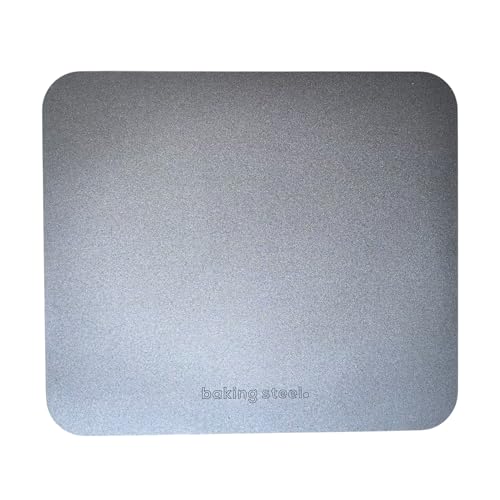
A small batch session asks two questions of a pizza steel: how much plate you have to lift in and out of a hot oven, and how much heat that plate is holding when the second bake goes in. The five here answer both differently. Published weight runs from 10.57 pounds on the ROCKSHEAT plate to 24.47 pounds on the VEVOR, and the surface the makers quote runs from 11.8 by 11.8 inches up to 16 by 16 inches.
Thickness is the figure behind that spread. Four of the five sit at or near a quarter inch, with height fields of 0.24 inch on the ROCKSHEAT and the Baking Steel and 0.25 inch on the Duvecfoi and the ThermiChef. The VEVOR is the only 3/8 inch plate of the five, and that extra material accounts for most of the gap between its 24.47 pounds and the 10.57 pounds of the lightest plate here.
What the table cannot tell you is how any of these plates behaves once the oven door shuts. Nobody here has baked on them, and only ThermiChef publishes a preheat instruction, so the recovery time between a first and a second pizza is not a published figure for any of the five. The conductivity multiples are the makers’ own comparisons against ceramic with no stated baseline, which makes them impossible to line up against each other.
Thickness Against Weight
The quarter inch group
Four plates cluster around a quarter inch, and the differences between them are about area rather than material. The ROCKSHEAT covers 11.8 by 11.8 inches and publishes 10.57 pounds. The Duvecfoi covers 13 by 13 inches at 10.78 pounds, so a wider surface costs about two tenths of a pound. That is a smaller step than the numbers suggest, and it is the one place in this group where more area is close to free.
Above that, area starts to cost real weight. The Baking Steel publishes 15 pounds across 14 by 16 inches and the ThermiChef publishes 17.6 pounds across 16 by 16 inches, both at the same nominal thickness. For a small batch project that runs two or three bakes, the question is whether you want the extra area for a larger pizza or would rather carry seven pounds less each time the plate comes out.
The 3/8 inch plate
The VEVOR is the only plate here that leaves the quarter inch group, and its listing is the only one that names 3/8 inch in the text. It publishes 24.47 pounds across a 16 by 14.5 inch surface, which is less area than the ThermiChef at seven pounds more weight. All of that difference is material sitting under the dough rather than surface beside it.
VEVOR describes the plate as having 20x higher heat conductivity and 2x the heat capacity of a ceramic stone. Conductivity is a property of the steel and does not change with thickness, so the figure that actually separates this plate from the others is the heat capacity, which is the one a batch of pizzas draws down. Neither the multiple nor its ceramic baseline is published in absolute terms.
Fitting the Plate to a Home Oven
Footprint and rack depth
ThermiChef is the only maker of the five that tells you to check the oven before ordering. Its listing asks you to measure the interior depth, says the 16 by 16 inch plate fits most full size oven racks, and adds that a smaller 14 by 14 inch version is the one it recommends where that does not fit. It also notes the plate spans two burners on most gas and electric ranges.
At the other end, the ROCKSHEAT is the only plate here pitched at a specific oven problem rather than a specific pizza. Its listing describes it as intended for low temperature ovens, where faster preheating and a hotter surface matter more than area, and gives an effective baking diameter of 11.8 inches. That is the figure to compare against your own dough, not against the other plates.
Handles, holes and lifting
Only two of the five publish any way to hold the plate. The ROCKSHEAT lists two handles and says its surface and edges are polished to a rounded finish. The VEVOR lists a single thumb hole, which it presents as a way to hang the plate on a wall as much as a way to carry it. On a 24.47 pound plate, one hole is a different proposition from two handles.
The Duvecfoi, the Baking Steel and the ThermiChef publish no handle, hole or grip of any kind, which for a bare rectangle of steel means a folded towel or a pair of heavy gloves. That matters more on a small batch day than on a single bake, because the plate usually comes out of the oven and goes back in while it is still hot enough to work.
Seasoning and What Ships Ready
Plates that arrive seasoned
Three of the five state that they ship ready to cook, and each describes a different process. ROCKSHEAT says the plate is coated with vegetable oil and baked at 400 F for 30 minutes before it leaves. Baking Steel says every plate is seasoned by hand in Massachusetts. VEVOR says its plate has been through oxidation and sandblasting treatments, which is a rust treatment rather than an oil layer.
Those three descriptions are not the same claim, and the listings do not make them comparable. An oiled and baked surface is a polymerized coating that a first bake will build on. A sandblasted and oxidized surface is bare metal that has been stabilized. The Duvecfoi listing says nothing at all about seasoning, so whether it arrives coated is not a question its published text answers.
The plate you season yourself
ThermiChef is the exception, and it says so plainly: the plate ships shot blasted rather than pre-seasoned, and the listing gives the routine. Wash it, apply a thin coat of oil, and bake it at 375 F for one hour. That is a stated procedure with a stated temperature and time, which is more than any of the pre-seasoned plates publish about their own coating.
For a first small batch project that trade is worth reading twice. An hour of oven time before the first pizza is an hour you have to plan for, but the same listing is the only one that tells you what to do when the coating eventually wears through. The plates that arrive seasoned publish nothing about re-seasoning beyond Artisan Steel’s line about doing it as needed.
Which One Fits Your Kitchen
The one pizza at a time baker. The ROCKSHEAT publishes the least weight of the five at 10.57 pounds and an 11.8 inch baking diameter, and it is the only plate with two handles. If your batch is a pizza followed by a loaf, this is the plate you will actually lift.
The baker who wants area without the weight. The Duvecfoi covers 13 by 13 inches and publishes 10.78 pounds, which is about two tenths of a pound more than the smaller plate. Its listing says the surface takes a full sized pizza or several smaller items at once.
The buyer who wants to bake on day one. The Baking Steel publishes 15 pounds across 14 by 16 inches and says every plate is seasoned by hand before it ships. Nothing has to happen between the box arriving and the first pizza except preheating the oven.
The baker running several pizzas back to back. ThermiChef publishes 17.6 pounds across 16 by 16 inches, the largest surface here, and is the only listing that gives a preheat of 500 F for 45 to 60 minutes. It expects an hour of seasoning first, at 375 F.
The buyer who wants the most heat stored under the dough. The VEVOR is the only 3/8 inch plate of the five, at 24.47 pounds. It claims twice the heat capacity of a ceramic stone. One thumb hole is the only grip, so plan how it comes out of the oven.
What We Could Not Verify
Everything above comes from what the six makers published. These are the things we went looking for and could not find in any listing on this page.
- No maker publishes a recovery time between bakes, which is the figure a small batch session actually depends on.
- Four of the five publish no preheat guidance at all, so their plates cannot be compared on preheat.
- No listing states a steel grade or alloy, only that the plate is carbon steel.
- No flatness or warp tolerance is published for any of the five, although two listings claim the plate will not warp.
- The conductivity multiples are quoted against ceramic with no stated baseline, so 18x and 20x cannot be compared.
- No maker publishes a maximum oven temperature for its plate.