For a first kit the question is not which stone bakes best but which one you will still be using in a year, and that comes down to three published figures: the temperature it is rated for, what it weighs, and whether the maker will let you wash it. All three vary more than you would expect for what is essentially a flat slab.
Stated temperature limits here run from up to 500 degrees for the Old Stone clay stone to 1800 F for the KitchenStar set. Published weights run from 3.75 pounds to 27.0 pounds, the heaviest of the five. Two of the five arrive with a peel and a cutter, and the other three arrive as a slab and nothing else.
| Specification |
Gyreuni Set |
KitchenStar Set |
Emile Henry |
Old Stone |
THERMICHEF Steel |
| Stated size |
13 inch round |
16 inch |
14.5 inch |
14 inch round |
16 by 16 inch square |
| Stated material |
Cordierite |
Stone, with a porous structure |
Glazed ceramic |
A blend of lead free clays |
Low carbon steel, 3/8 inch |
| Stated temperature limit |
1472 F, or 800 C |
1800 F, or 1000 C |
900 degrees F |
Up to 500 degrees in a standard home oven |
not published as a limit |
| Published weight |
6.46 pounds |
13.7 pounds |
5.5 pounds |
3.75 pounds |
27.0 pounds |
| Weight in the maker’s own words |
not published |
not published |
not published |
not published |
27.5 lbs |
| Published thickness |
0.6 inches |
not published |
1.5 inches |
0.43 inches |
0.38 inches |
| Tools included |
An oak peel at 12 by 17 inches, a 13 inch serving rack, a cutter and 10 parchment sheets |
An acacia peel, a rocker cutter and a metal brush with a steel scraper |
not published |
not published |
not published |
| Soap allowed |
No, never soap or detergent |
not published |
Yes, dishwasher safe and cleaned with soap or water |
not published, rinse and air dry |
Yes, wash before seasoning |
| Handles stated |
not published, a serving rack instead |
not published |
Yes |
not published |
not published |
| Grill use stated |
Yes, oven and grill |
Yes, oven and grill |
Yes, gas, charcoal and natural wood grills |
not published |
Yes, oven, grill, stovetop and campfire |
| Seasoning stated |
not published |
not published |
not published |
Seasons over time with use |
Ships shot blasted, season once before use |
| Warranty stated |
not published |
not published |
Ten years against manufacturing defects |
not published |
not published |
The table cannot tell you how long a ceramic stone survives a thermal shock, because no listing publishes a cycle count and nothing here was heated. It cannot give a thickness for the KitchenStar stone. And it cannot reconcile the temperature limits, which for stones made of similar material differ by a factor of three.
Stated Heat Limits Run From 500 F to 1800 F
The same object, four ceilings
Old Stone recommends up to 500 degrees in a standard home oven. Emile Henry states 900 degrees F and adds that it can be used under a broiler and on gas, charcoal and natural wood grills. Gyreuni states its cordierite stone is heat safe to 1472 F, or 800 C. KitchenStar states 1000 C, or 1800 F.
All four are ceramic or clay slabs for baking pizza in a domestic oven, and the spread between the lowest and highest stated ceiling is more than threefold. In practice a home oven rarely exceeds 550 F, so the high numbers are about grills and pizza ovens rather than about your kitchen. The low number is the one that constrains you.
Steel publishes no limit at all
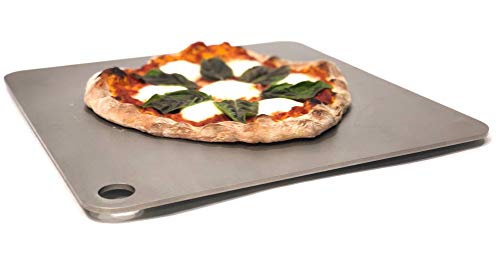
THERMICHEF states no maximum temperature, which for a solid piece of low carbon steel is reasonable rather than negligent: there is no coating and no ceramic to crack. What it does state is the comparison, claiming heat conduction up to 20 times more efficient than a ceramic pizza stone, and that its 3/8 inch thickness stores more heat and recovers faster between pizzas.
Elsewhere in this pool the other steels make the same argument. Boachee states 20 times faster heat transfer than stone from a single quarter inch slab. Loftern states that carbon steel withstands high temperatures without warping or cracking, unlike ceramic stones. Steel does not publish a ceiling because it does not really have one that matters here.
Weight Is What You Will Actually Notice
Under four pounds against twenty seven
Old Stone publishes 3.75 pounds, the lightest of the five, for a 14 inch round clay stone 0.43 inches thick. THERMICHEF publishes 27.0 pounds and states 27.5 lbs in its own title, for a 16 by 16 inch steel plate 0.38 inches thick. Similar thickness, seven times the mass, because steel is steel.
That difference is the whole practical distinction for a first kit. A 3.75 pound stone is lifted with one hand and slid onto a rack. A 27 pound steel plate is generally left in the oven permanently, which means it heats with the oven every time you use it and changes how the oven behaves for everything else you bake.
Handles, racks and getting it out
Emile Henry is the only pick that states handles, and at 5.5 pounds with a 14.5 inch footprint they are the difference between carrying it to the table and not. Gyreuni takes a different route and includes a 13 inch serving rack, stating it is there so you are not scalded by the hot stone.
Old Stone, KitchenStar and THERMICHEF state no handles at all. Elsewhere in the pool, Geetery states integrated side handles on a 14.5 inch glazed stone at 6.17 pounds, GoodCook states a metal rack with a carrying handle, and the Pampered Chef stone states contoured handles molded on. For a stone that comes to the table, the handle is the feature.
Soap, Seasoning and What Comes in the Box
Makers disagree about soap
This is the sharpest disagreement in the pool. Gyreuni states plainly: never use soap or detergent on a stone. American Metalcraft states to avoid soap and not to submerge the stone in water. Old Stone states only to rinse and air dry, and that the stone seasons over time.
Emile Henry states the opposite outright: dishwasher safe, easily cleaned with soap or water, and scratch resistant enough that you can cut directly on the glaze. Geetery makes the same claim for its glazed stone. The dividing line is the glaze: an unglazed stone is porous and absorbs what you wash it with, and a glazed one is not.
Two kits bring their own tools
Gyreuni is the most complete first kit here: a 13 inch cordierite stone, an oak peel at 12 by 17 inches, a 13 inch serving rack, a steel cutter and 10 sheets of parchment. Its larger sibling in this pool drops the rack and keeps the rest.
KitchenStar includes an acacia wood peel, a rocker cutter with a safety cover and, unusually, an oven brush with a stainless scraper and a long beech handle for cleaning the stone. That last item is the one nobody else supplies and the one a new baker discovers they need. Emile Henry, Old Stone and THERMICHEF each ship the slab alone.
Which One Fits Your Kitchen
Everything in one box. Gyreuni ships a 13 inch cordierite stone rated to 1472 F with an oak peel at 12 by 17 inches, a 13 inch serving rack, a steel cutter and 10 parchment sheets. It publishes 6.46 pounds and states never to use soap on it.
A kit that includes the brush. KitchenStar ships a 16 inch stone stated to 1800 F with an acacia peel, a rocker cutter with a safety cover and a metal brush with a stainless scraper. It publishes 13.7 pounds and no thickness figure.
Cut on it and wash it. Emile Henry publishes 5.5 pounds and 1.5 inches of thickness, states 900 degrees F, broiler and wood grill use, handles, a glaze you can cut on, dishwasher safe cleaning and a ten year guarantee.
Light enough to lift. Old Stone publishes 3.75 pounds, the lightest of the five, and 0.43 inches of thickness in a blend of lead free clays with an engineered heat core. It recommends up to 500 degrees and rinsing with no soap mentioned.
Back to back pizzas. THERMICHEF publishes 27.0 pounds and states 27.5 lbs, in 3/8 inch low carbon steel cut in the USA, claiming 20 times the heat conduction of ceramic and faster recovery between bakes. It ships unseasoned.
What We Could Not Verify
These are the figures a first kit would want, and that these listings do not give.
- A thickness for the KitchenStar stone, published by the other four.
- Why stated temperature limits for similar ceramic stones differ by more than threefold.
- Whether the KitchenStar stone may be washed with soap, which its listing never addresses.
- A preheat time for any of the five, stated only as 30 minutes at 400 degrees plus on one other listing in the pool.
- Any thermal shock or cycle rating for the four ceramic and clay picks.
- Whether the Old Stone 500 degree figure is a limit or a recommendation, since the listing says recommended.