How the Five Compare on the Numbers
A glass teapot never lives in a drawer, but what arrives with it usually does. So the deciding count on this page is pieces: how many objects come out of the box, and which of them need a home when the pot itself stays on the counter. These five range from a pot with a lid to a ten piece set with cups and samples.
Capacity is the second figure and the makers publish it in different units. Kitchen Kite publishes 35 ounces and 1000 ml, Teabloom 40 fluid ounces, Mixpresso 33 ounces, HARIO 700 ml and Rishi Tea 400 ml alongside 13.5 fluid ounces. Three of the five also translate that into cups, which is the figure a household actually plans around.
What the table cannot tell you is how much drawer space four double wall cups take, because not one of these listings publishes a cup dimension, a cup height or a packed size for the set. The only figures that describe an object rather than a volume are the dimension fields, and on one of these five those fields are plainly not a measurement of anything.
What Arrives in the Box
The two sets with cups
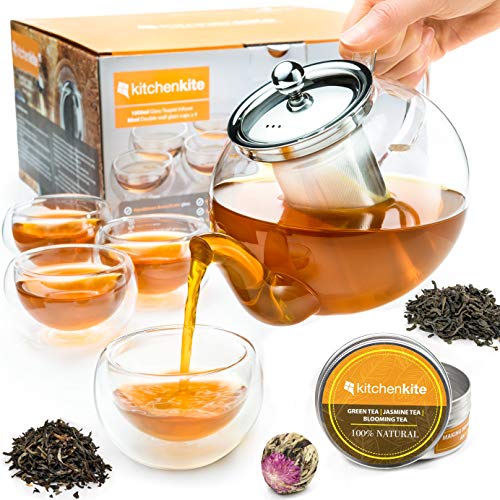
Kitchen Kite publishes the longest contents list here: a 35 ounce pot, four insulated double wall cups, a removable stainless mesh infuser with its own holder, and three tea samples, described as ten pieces in total. For a kitchen that wants everything for tea in one place, that is the whole shelf bought at once, and the infuser holder is the only dedicated storage part in this group.
Mixpresso publishes a 33 ounce pot with four double wall cups of 2.7 ounces each, and claims the pot serves eight to ten cups. Those two figures are worth reading together: the cups included are small, so the pot fills them several times over. It publishes 1.63 pounds for the purchase and no size for the cups at all.
The three pots that arrive nearly alone
Teabloom publishes a 40 fluid ounce pot with a removable glass infuser and two blooming teas in the box, which it says brews up to five cups. Nothing there needs storing except the infuser, and the two teas are consumed rather than kept, so this is a single object purchase with a small extra.
Rishi Tea publishes a 400 ml pot, also given as 13.5 fluid ounces, at 0.57 pounds, which is the lightest published weight among these five. HARIO publishes a 700 ml pot with a stainless strainer at 0.67 pounds. Both are a pot, a lid and a filter, which is as few parts as a loose leaf teapot can have.
Which Parts Need a Home
The infuser and where it goes
Four of these five publish a removable filter, and only Kitchen Kite publishes somewhere to put it. Its listing names a dedicated holder for the mesh infuser, which is the difference between a wet basket sitting on the counter and a wet basket sitting in something. HARIO publishes a large stainless strainer and no holder, and notes that the strainer is made in China while the glass and lid are made in Japan.
Mixpresso publishes a detachable lid and a food grade stainless infuser mesh without a holder. Teabloom’s infuser is glass rather than steel, which means the whole assembly is one material and can be washed with the pot. None of the four publishes an infuser dimension, so how deep the basket is has to be judged from the photographs.
The lid that holds the filter
Rishi Tea takes a different approach and publishes a strainer built into the lid, which unscrews from it for washing. That reduces the purchase to a pot and a lid in two parts, and it is the only listing here that describes a threaded fitting. For a drawer, it means there is no loose basket to lose, which is the usual fate of a small stainless infuser.
The trade is control. A built-in strainer keeps the leaves in the pot between steepings rather than letting you lift them out, and Rishi Tea’s own text says the leaves stay in the pot for future steepings. Whether that suits you depends on whether you drink the pot in one sitting or return to it, and the listing publishes no advice either way.
Figures, Fields and What They Describe
One maker publishes millimeters
HARIO is the only listing here that publishes its own measurements, given as W173 by D132 by H108 mm, and the only one that labels which figure is which. Its published dimension fields say 5.6 by 6.4 by 4.6 inches, unlabeled, so a reader has two sets of numbers and only one of them states what it is measuring. This page quotes the maker’s set.
Rishi Tea and Mixpresso publish no size in their text at all, leaving fields of 4.5 by 6.1 by 4.5 inches and 4.5 by 4.5 by 6.4 inches to speak for them. Kitchen Kite’s fields, 11.81 by 9.06 by 5.12 inches, are the largest here and almost certainly the carton for a ten piece set rather than the pot.
One set of fields cannot be believed
Teabloom publishes 1.97 by 1.97 by 1.97 inches in its three dimension fields. Three identical figures for a pot the maker says holds 40 fluid ounces and brews up to five cups is a placeholder, not a measurement, and this page discards it. The listing’s own words are the only usable description of the object’s size, and they describe volume rather than shape.
That gap matters more than it looks. Of these five, only one publishes a labeled measurement of the pot, one publishes an unusable set of fields, and three publish fields with nothing in the text to confirm them. For a page about what fits where, that is the honest state of the data, and no amount of arithmetic fixes it.
Which One Fits Your Kitchen
The household buying tea service in one box. Kitchen Kite publishes ten pieces: a 35 ounce pot, four double wall cups, a mesh infuser with a dedicated holder and three tea samples, at 1.8 pounds. It is the only purchase here with a published place to put the wet infuser.
The household that serves small cups. Mixpresso publishes a 33 ounce pot with four double wall cups of 2.7 ounces each and a claim of eight to ten servings. At 1.63 pounds it is a set rather than a single pot, and it publishes no cup dimensions.
The tea drinker who wants the pot and nothing else. Teabloom publishes a 40 fluid ounce pot with a glass infuser and two blooming teas, stovetop and microwave safe. Its dimension fields are unusable, so buy it on the capacity and the contents rather than on a measurement.
The tea drinker who loses small parts. Rishi Tea publishes a 400 ml pot at 0.57 pounds whose filter unscrews from the lid, so there is no separate basket to store. It is the lightest published weight here and the fewest pieces to keep track of.
The tea drinker who wants a measured object. HARIO publishes W173 by D132 by H108 mm for a 700 ml pot at 0.67 pounds, with a large stainless strainer and dishwasher permission. It is the only listing in this group that states its own dimensions and labels them.
What We Could Not Verify
Everything above is from these makers’ published text. Here is what is missing from it.
- No cup dimension or cup height from either of the two sets that include cups.
- No infuser depth or diameter from any of the five listings.
- No packed or boxed size for the ten piece set, only its dimension fields.
- No usable dimension figures at all for the pot with three identical fields.
- No stovetop statement from Rishi Tea or HARIO, only hot water and washing.
- No storage guidance from any of the five for the parts that come off the pot.