How the Five Compare on the Numbers
Bought as part of a first set of bakeware, a loaf pan is not one object. These five purchases contain four pans, three, two, two and sixty. That count is the deciding figure, and the second is whether lids arrive with them, because a pan with a lid stops being bakeware and starts being a container you can put in the freezer.
Sizes then split the group in two. TeamFar publishes 9.25 by 5 by 2.5 inches and P&P CHEF 9.2 by 4.9 by 2.5, both standard loaves. HONGBAKE publishes 6 by 3.3 by 2 inches and Benestanti 6 by 3.5 by 2, both minis. Razab publishes no pan dimensions at all and sells its glass pans by volume instead.
What the table cannot tell you is how a set behaves after the first year, and it cannot compare capacity across the group, because only three of the five publish one and all three use a different unit: cups of batter, cups of volume, and a pound of dough. A page cannot convert between those honestly, so it reports them as they stand.
How Many Pans a First Kitchen Needs
Four, three and two
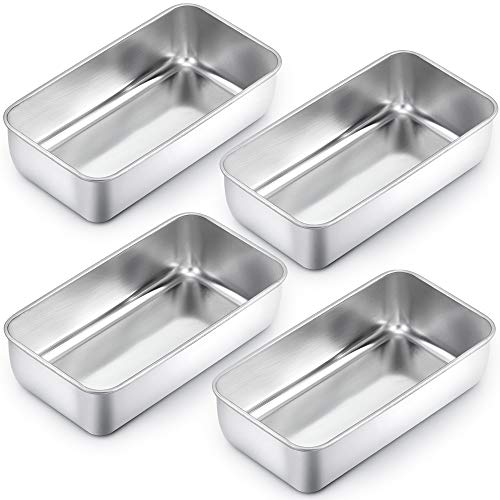
TeamFar publishes four stainless pans at 9.25 by 5 by 2.5 inches with an interior of 9 by 4.7 inches, stackable and made in one piece, at 1.55 pounds for the set. Four pans of one standard size is a batch baker’s purchase: two loaves for now and two for the freezer, with no coating to wear off any of them.
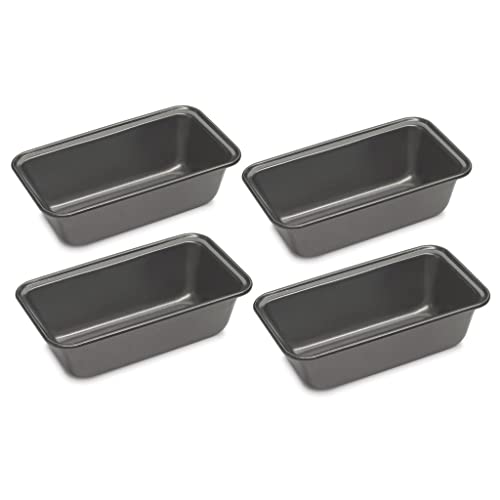
P&P CHEF publishes two pans at 9.2 by 4.9 by 2.5 inches at 1.0 pound, also stainless with no coating, and makes the same case in a smaller quantity. HONGBAKE publishes three mini pans at 6 by 3.3 by 2 inches, which is a different proposition: three small loaves rather than one large one.
Sixty, once
Benestanti publishes sixty disposable aluminum pans at 6 by 3.5 by 2 inches with clear plastic lids, labeled as one pound pans. Nothing here is bakeware in the lasting sense, and that is the point: for a bake sale, a freezer batch or a run of gifts, sixty pans with lids solves a problem that a set of four metal pans cannot.
It is worth being clear about the trade. The listing says the pans withstand various temperatures and are safe for conventional ovens, toaster ovens and freezer storage, without publishing a figure. Compared against HONGBAKE’s stated 450 F or Razab’s 500 F, that is the least specific heat claim in this group.
The Two Sets That Include Lids
Glass with a snap-on lid
Razab publishes two borosilicate glass pans with snap-on plastic lids, holding 7.6 cups, also given as 1800 ml and 1.9 quarts, and heat resistant to 500 F. It is the only purchase here that publishes its capacity as a volume, which is the honest way to measure a pan you will also use for casseroles, pasta and freezing.
The listing is careful about the lid, and rightly so: the plastic lid is not safe in a microwave or an oven, even though the glass is. It also recommends lowering the oven temperature by 25 degrees when baking in glass, which is the single most useful sentence in this whole group and the kind of thing metal pans never have to say.
Foil with a clear lid
Benestanti’s sixty pans each come with a clear plastic lid, which is what makes the purchase a food container as much as a baking pan. You can see what is inside, and the pan travels. Nothing needs washing afterwards, which for a first kitchen with no dishwasher is a genuine argument.
TeamFar, P&P CHEF and HONGBAKE publish no lid at all, so anything baked in them and then stored needs foil, wrap or a second container. On a stainless pan that is not much of a hardship, but it is worth counting when comparing a two pan purchase against a two pan purchase with lids.
Steel, Glass and Foil in One Category
What each material commits to
TeamFar and P&P CHEF both publish uncoated stainless steel and both make the same argument: no coating to flake, nothing leaching at high heat, a replacement for aluminum and nonstick pans. Neither publishes an oven limit, which is the gap in that argument, since a temperature is exactly what a baker wants to see.
HONGBAKE publishes a nonstick carbon steel pan built in five layers, oven safe to 450 F, free of PFOA, PTFE, BPA and lead, and asks for hand washing to extend its life. Razab publishes borosilicate glass to 500 F with dishwasher, microwave and freezer permission. Benestanti publishes aluminum foil and no figure.
Depth, interiors and what actually fits
Two of the five publish an interior measurement. TeamFar publishes 9 by 4.7 inches inside a 9.25 by 5 inch pan, and says a 2.5 inch deep side is what shapes a loaf. HONGBAKE publishes 5.5 by 2.75 by 2 inches inside its 6 by 3.3 by 2 inch minis, and adds that each holds about 1.5 cups of batter.
HONGBAKE also does the arithmetic a reader would otherwise have to do, stating that one standard 9 by 5 recipe divides into its three mini loaves. That is the most useful sentence a mini pan listing can carry, and the reason a three pack of small pans can stand in for a large pan rather than only supplement it.
Which One Fits Your Kitchen
The baker who wants four of one pan. TeamFar publishes four uncoated stainless pans at 9.25 by 5 by 2.5 inches with a 9 by 4.7 inch interior, stackable and dishwasher safe, at 1.55 pounds. Four standard loaves at once, with nothing to chip.
The two person kitchen. HONGBAKE publishes three mini pans at 6 by 3.3 by 2 inches, each holding about 1.5 cups of batter, oven safe to 450 F at 0.7 pounds for the set. One standard recipe divides into all three, and hand washing is recommended.
The cook who wants steel and nothing else. P&P CHEF publishes two uncoated stainless pans at 9.2 by 4.9 by 2.5 inches at 1.0 pound, dishwasher safe and freezer safe. No coating, no lid and no published oven limit.
The household that bakes and then stores. Razab publishes two borosilicate glass pans of 7.6 cups with snap-on lids, heat resistant to 500 F, at 3.74 pounds. Keep the lid out of the oven and drop the oven temperature by 25 degrees.
The bake sale or the gift run. Benestanti publishes sixty disposable aluminum pans at 6 by 3.5 by 2 inches with clear lids, labeled one pound. Nothing to wash and nothing to get back, at the cost of any published temperature.
What We Could Not Verify
All the figures above come from these makers’ own listings. Here is what they do not state.
- No oven limit from three of the five purchases.
- No interior measurement from three of the five, so recipe fit has to be guessed.
- No capacity from two of the five, in cups, milliliters or pounds of dough.
- No pan dimensions at all from the glass set, only its volume.
- No gauge or wall thickness from four of the five.
- No statement about how many times a disposable foil pan can be reused.