How the Five Compare on the Numbers
A spiralizer is bought for the noodle it makes, and the only figure that describes that noodle is the width of the cut. Four of these five publish one. What they do not do is agree on the unit: two publish millimeters, two publish inch fractions, and one publishes a single millimeter figure for a single blade.
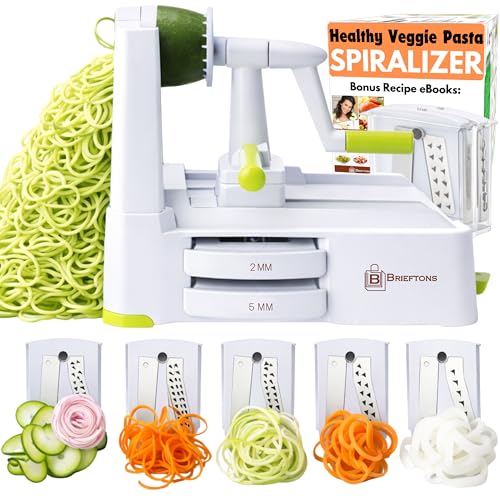
Blade counts run from one to six. Bron Coucke publishes one blade at 1.5 mm, OXO three, Brieftons and SUSTEAS five each, and WellToBe six. Counting blades is easy and comparing them is not, because a blade is only as useful as the label on it, and one listing names six cuts while publishing a figure for one.
The table cannot tell you how a blade behaves on a raw beet, and only one listing here even addresses it: Brieftons states that its two coarsest blades handle the hardest vegetables and its finest ones suit soft produce. Nobody publishes a blade thickness, a tooth pitch or a replacement blade, so a dulled blade is a dulled machine.
The Same Noodles, Written Two Ways
Millimeters against inch fractions
Brieftons publishes four labeled cuts in millimeters: 2 mm angel hair, 3 mm spaghetti, 5 mm fettuccine and 5.5 mm pappardelle, plus a flat ribbon slicer. SUSTEAS publishes four labeled cuts in inch fractions: 5/64 for angel hair, 1/8 for spaghetti, 3/16 for fettuccine and 7/32 for pappardelle, plus a flat ribbon slicer.
Those are the same four noodles. An eighth of an inch is a shade over 3 mm, and 5/64 of an inch is a shade under 2 mm, so the two machines cut within a hair of each other on every setting. Read side by side they look like different products, and the only real difference between the blade sets is which unit the copywriter reached for.
Three cuts, clearly stated
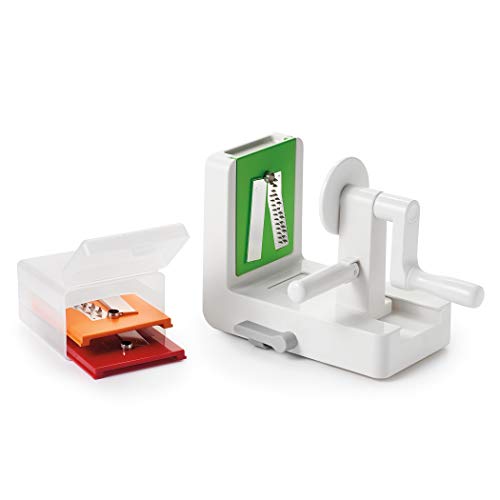
OXO publishes the smallest blade count here and the plainest labeling: three stainless blades cutting a 1/8 inch spaghetti, a 1/4 inch fettuccine and a ribbon. A quarter inch is a coarser noodle than anything Brieftons or SUSTEAS publishes, so OXO is not simply a reduced version of the five blade machines. It covers less ground and includes one cut they do not.
For a basic kitchen that is a real argument. Three labeled blades that you will actually use beat five where two live in a caddy, and OXO publishes 1.5 pounds, the lightest published weight of these five, with a side handle that folds up for storage and a removable blade box that stores onboard.
Where the Blade Count Stops Helping
Six blades, one figure
WellToBe publishes six blades and names them as a group: one flat blade fixed on the body and four more in a plastic storage box, with two of the six described as additions to an older five blade design. Only one gets a measurement, an ultra thin 1.2 mm angel hair blade, which by that figure is the finest cut published by any of these five.
What WellToBe does publish that nobody else does is the produce it will take: a maximum of 6.8 inches long and 5 inches wide. That is a more practical number than a blade count, because a spiralizer that cannot take a fat butternut squash cannot cut it at any width, and only Brieftons publishes the other half of that limit at 1.5 inches minimum.
One blade, and a different job
Bron Coucke publishes a single 1.5 mm blade on a Japanese turning slicer, with a 1/16 inch figure in its size field, and describes the output as lasagna-like sheets for spring rolls and pate lining rather than as noodles. At 3.84 pounds it is the heaviest object here and the only one aimed at sheets instead of strands.
It is on this page because the cut is documented and unusual, not because it competes with a five blade machine. If what you want is a continuous sheet off a turnip or an apple, the blade count is one and the width figure is the whole specification. If what you want is spaghetti, this is the wrong tool and the listing does not pretend otherwise.
Bodies, Blades and What Can Be Washed
Plastic, steel and the dishwasher
Brieftons publishes a BPA free ABS plastic body with Japanese 420 grade blades, all of it dishwasher safe on the top rack only, with a warning against high heat cycles. SUSTEAS is stricter and more specific: blades, handle bar and blade holder go on the top rack, the main body is hand wash only, and the limit is 158 F.
WellToBe publishes a 304 stainless steel body, which on paper is the most washable construction of these five, and then publishes no washing instruction at all. OXO and Bron Coucke also publish nothing. On a tool that fills with wet vegetable shreds, three silent listings out of five is the real gap in this group.
Where the blades sleep
Four of the five publish an answer, and they are nearly identical in shape. Brieftons keeps one blade in the rack, two in a built-in compartment and two in a separate caddy. SUSTEAS keeps one pre-installed, two inside the body and two in a case that stacks on top of the unit. WellToBe fixes one to the body and boxes four.
OXO publishes a removable blade box that stores onboard, which for three blades is enough. Bron Coucke publishes nothing, which for a single fixed blade is fair. The reason any of this matters is that a loose spiralizer blade in a drawer is the most dangerous object in a kitchen, and these listings know it.
Which One Fits Your Kitchen
The cook who wants the cuts in millimeters. Brieftons publishes 2 mm, 3 mm, 5 mm and 5.5 mm blades plus a ribbon slicer, in Japanese 420 grade steel, with a 1.5 inch minimum produce width and top rack washing. Every blade is labeled, and two are stated to handle raw beets.
The cook who thinks in inches. SUSTEAS publishes 5/64, 1/8, 3/16 and 7/32 inch blades plus a ribbon slicer, and the clearest washing rule here: top rack for the blades and holder, hand wash for the body, 158 F maximum. It publishes 2.54 pounds.
The kitchen that wants three blades and no caddy. OXO publishes a 1/8 inch spaghetti cut, a 1/4 inch fettuccine cut and a ribbon, at 1.5 pounds, with a folding side handle and a blade box that stores onboard. The 1/4 inch cut is the coarsest in this group.
The cook with big vegetables. WellToBe publishes six blades including a 1.2 mm angel hair, a 304 stainless body, and the only produce limits in this group: up to 6.8 inches long and 5 inches wide. Five of its six blade widths are not published.
The cook making sheets, not strands. Bron Coucke publishes a single 1.5 mm blade on a turning slicer for lasagna style vegetable sheets, spring rolls and pate lining, at 3.84 pounds. One documented cut, one job, no blade caddy to lose.
What We Could Not Verify
All the figures above are from these makers’ own listings. Here is what none of them publishes.
- No width figure for five of the six blades on the six blade machine.
- No blade thickness or tooth pitch from any of the five.
- No replacement blade availability from any of the five.
- No washing instruction from three of the five.
- No produce size limit from three of the five.
- No statement of which blades suit hard vegetables, except on one listing.