How the Five Compare on the Numbers
A pizza steel is a slab of carbon steel, and carbon steel has rules. It cannot go in a dishwasher, soap strips what protects it, and it either arrives with a seasoning layer or you have to build one. So the deciding specification on this page is what each maker publishes about that layer: whether the plate comes seasoned, and what it says about washing it afterwards.
Four of these five publish that the plate arrives pre-seasoned. THERMICHEF publishes the opposite and then tells you exactly what to do about it: wash it, apply a thin coat of oil, and bake it at 375 F for one hour. That is the only complete seasoning procedure in this group, and it comes from the one plate that ships bare.
One figure has been left out of that table on purpose. Chef Pomodoro’s listing publishes 32.5 pounds for a 16 by 16 inch plate at 1/4 inch thick, while THERMICHEF publishes 17.6 pounds for the same size at the same thickness. Those cannot both be right, and its dimension fields of 0.9 by 1.3 by 0.9 inches are a placeholder, so this page quotes neither.
Seasoned in the Factory or Seasoned by You
The plate that arrives bare
THERMICHEF ships shot-blasted rather than pre-seasoned, and says so plainly. The instruction is one paragraph long and complete: wash the plate, apply a thin coat of oil, bake it at 375 F for an hour, and after that it builds a natural non-stick patina with every use, in the same way cast iron does. No Teflon, no PFAS, nothing to chip off.
That is an hour of oven time before the first pizza, and for some kitchens it is a deal breaker. For others it is the point: you know what is on the surface because you put it there, and you know how to repair it because the instruction is written down. None of the four pre-seasoned plates here tells you how to re-season when the layer eventually thins.
The four that arrive ready
ROCKSHEAT publishes the most specific factory process: pre-coated with vegetable oil and baked at 400 F for 30 minutes to form a protective layer. VEVOR publishes oxidation and sandblasting treatments and states the surface is rust free with no chemical residues. Loftern publishes pre-seasoned and ready to use, and Chef Pomodoro publishes a seasoned surface that develops further with use.
The difference between those four is how much they will commit to. ROCKSHEAT names an oil, a temperature and a time. VEVOR names two industrial processes. Loftern and Chef Pomodoro say pre-seasoned and leave it there. For a first pizza it makes no difference; for knowing what you are maintaining, it makes all of it.
What Washing a Steel Actually Means
Three listings say it, two do not
Chef Pomodoro publishes the clearest rule: no soap, no scrubbing, just scrape and rinse. That is the correct instruction for a seasoned carbon steel surface, and it is the sentence most buyers need to read before they take a scouring pad to a new plate. Loftern publishes the same idea in different words, a quick wipe with no soaking.
VEVOR publishes cleaning with a soft cloth and water. THERMICHEF publishes a wash only as the first step of seasoning, which is the one moment soap belongs anywhere near the plate. ROCKSHEAT publishes no cleaning instruction at all, only that the seasoned layer resists stains, scratches and wear.
What nobody warns you about
Not one of these five mentions rust, which is the actual failure mode of a carbon steel plate left damp in an oven that gets used for other things. Another listing in this same category publishes the sentence these five omit, noting that discoloration, blueing and gray spots are normal for carbon steel and do not affect performance.
That is the sort of thing an easy-clean page has to fill in. A pizza steel is not stainless. It will change color, it will pick up marks from cheese that escaped the crust, and none of that needs fixing. What it does need is drying, and none of these five says so in as many words.
Thickness, Weight and Getting It Out of the Oven
Thin plates and thick plates
Four of these five publish a quarter inch of steel, written variously as 1/4 in, 0.24 and 0.25. VEVOR publishes 3/8 inch and 24.47 pounds, and THERMICHEF’s own listing explains the trade in plain terms: the thicker plate stores more heat and recovers faster between pizzas, while a 1/4 inch gives most of the performance at roughly ten pounds less.
Weights follow the size as well as the thickness. ROCKSHEAT publishes 10.57 pounds for an 11.8 inch square, Loftern 13.6 pounds for a 14 by 16, THERMICHEF 17.6 pounds for a 16 by 16, and VEVOR 24.47 pounds for a 16 by 14.5 at 3/8 inch. Cleaning a plate you cannot lift is a different job entirely.
Handles change the chore
This is where the cleaning question becomes physical. ROCKSHEAT publishes two sturdy handles and says they are there so beginners and smaller hands can move the plate. VEVOR publishes a thumb hole that also lets the plate hang on a wall, which solves storage and drying at once. Chef Pomodoro publishes integrated lifting holes.
THERMICHEF and Loftern publish nothing to hold. On a 17.6 pound plate that has to come out of a 500 F oven to be scraped, that is a real omission, and it is the reason a lighter plate with handles can be easier to keep clean than a heavier one with a better surface.
Which One Fits Your Kitchen
The cook who wants to know what is on the surface. THERMICHEF publishes a 16 by 16 inch plate at 1/4 inch and 17.6 pounds, shipped bare with a full seasoning routine: wash, thin oil, 375 F for an hour. It also publishes the only preheat guidance here, 500 F for 45 to 60 minutes.
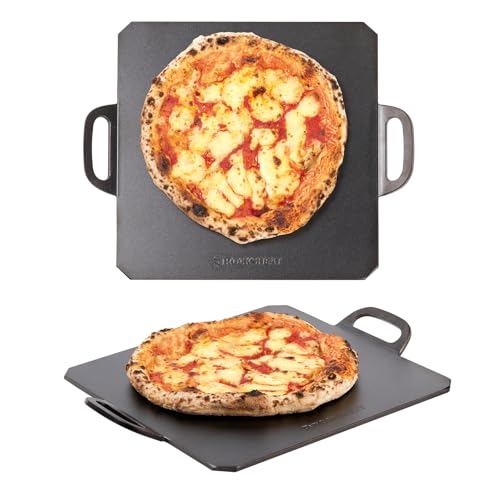
The cook who wants to lift it easily. ROCKSHEAT publishes an 11.8 inch square at 0.24 inch and 10.57 pounds with two handles, pre-coated with vegetable oil and baked at 400 F for 30 minutes. It is the lightest published weight here and the easiest to carry to a sink.
The cook baking back to back. VEVOR publishes 16 by 14.5 inches at 3/8 inch and 24.47 pounds, pre-seasoned by oxidation and sandblasting, cleaned with a soft cloth and water, with a thumb hole for hanging it up to dry.
The cook who wants the rule spelled out. Chef Pomodoro publishes a 16 by 16 inch plate at 1/4 inch with lifting holes and the plainest care line in this group: no soap, no scrubbing, scrape and rinse. Ignore its published weight, which cannot be right.
The cook who wants one wipe and done. Loftern publishes 14 by 16 inches at 0.25 inch and 13.6 pounds, pre-seasoned, with a quick wipe as the stated routine and no soaking. Nothing to hold it by, so plan how it comes out of the oven.
What We Could Not Verify
All the figures above are from these makers’ own listings. Here is what they leave out.
- No re-seasoning instruction from any of the four pre-seasoned plates.
- No mention of rust or drying from any of the five.
- No cleaning instruction at all from one of the five.
- No believable weight from another of the five.
- No preheat time from four of the five.
- No statement of what the seasoning oil is on three of the four seasoned plates.