How the Five Compare on the Numbers
Two things go wrong with a nesting bowl set in a kitchen where hands are the limiting factor. The bowl slides across the counter while you stir it, and the lid will not come off without a fingernail. Three of these five publish something about the base and four publish something about the lid, and only one publishes both.
Umite Chef publishes non-slip silicone bottoms and says why: metal bowls slide the harder you work in them. Oggi publishes a ribbed base for grip. DUTZUN publishes a brushed, textured base. E-far publishes raised handles on both sides of every lid, and Joseph Joseph publishes lids that lock and snap together.
Three of these five publish no weight at all and four publish no bowl dimensions, so the only figures describing the objects are capacities and a single nested stack measurement. The weight that is published on the largest set is not believable, and the section below explains why this page ignores it.
Keeping the Bowl Still
Silicone, ribs and texture
Umite Chef publishes the most deliberate answer: non-slip silicone bottoms, with the listing explaining that most metal mixing bowls slide on the counter the harder you work in them, and adding that the silicone will not scratch or mark a stone countertop. For anyone who cannot brace a bowl with one hand while mixing with the other, that is the single most useful feature on this page.
Oggi publishes a ribbed base described as giving an effortless grip, on plastic bowls. DUTZUN publishes a full brushed surface inside and out for a secure non-slip grip and a textured base it says protects marble and quartz. Those are grip claims about the outside of the bowl rather than a separate material, which is a weaker version of the same idea.
The two that publish nothing
E-far and Joseph Joseph publish no base treatment at all. E-far is bare stainless steel, which is the material Umite Chef’s listing is warning about, and Joseph Joseph is plastic, which slides less than steel but is not gripped either. Both spend their design effort on the lids instead.
That is a real trade rather than an oversight. A bowl that grips the counter is a bowl for mixing; a bowl with a lid you can work one handed is a bowl for storing. This category sells both jobs in one purchase and no listing here manages both well.
Getting the Lid Off
Handles, locks and inner hatches
E-far publishes raised handles on both sides of every plastic cover, specifically for easy opening and closing. On a sealed bowl straight from a refrigerator that is the difference between a tool and a puzzle, and it is the only listing here that puts handles on the lid itself.
Joseph Joseph publishes lockable, airtight, leak-proof lids that snap together, so the lids store as one block rather than as five loose discs. Umite Chef publishes a removable inner lid on its 4 quart bowl so contents can be added without taking the whole lid off, which solves a different part of the same problem.
Lids that cannot be machine washed
Two listings warn about their own lids. Umite Chef says the bowls are dishwasher safe but recommends hand washing the lids because dishwasher heat can warp them. DUTZUN is blunter still: the bowls and colander are dishwasher safe but the lid is not, and it says so in capital letters.
Oggi publishes plain dishwasher permission for a plastic set, and is the only one of these five that publishes both microwave and freezer use alongside it. Joseph Joseph publishes freezer and microwave use for its containers. E-far publishes neither a dishwasher statement nor a microwave one in its visible text.
Sizes, Labels and One Figure to Ignore
Five ways of stating capacity
Umite Chef publishes 5, 4, 3.5, 2 and 1.5 quarts and puts a QT label on each bowl, which is the only labeling of that kind here and genuinely useful when five nested bowls come apart on a counter. Oggi publishes 0.7, 1.4, 2.6 and 4 quarts in four color combinations. DUTZUN publishes 1.5, 2, 2.5 and 4.5 Q plus a colander.
Joseph Joseph publishes 8, 18, 37, 63 and 101 fluid ounces, converts each into cups, and is the only listing in this whole category that publishes the size of the nested stack: 7.75 by 9.5 by 6.5 inches. That is the figure a cupboard shelf actually needs. E-far publishes six pieces and no capacity at all.
Why 0.82 pounds is not the weight
Umite Chef publishes 0.82 pounds for a set of five stainless steel bowls with five lids and three grater attachments, and dimension fields of 2 by 2 by 2 inches. Neither figure can describe that purchase: Oggi’s four plastic bowls publish 1.81 pounds and a single Pyrex glass set in this category publishes 8.89.
So this page ranks Umite Chef on its silicone bases, its labeled quarts and its graters, and not on a weight. Three of the other four publish no weight at all, which makes this category almost impossible to compare on what your wrist will carry, and that is worth saying plainly rather than working around.
Which One Fits Your Kitchen
The bowl that will not slide while you stir. Umite Chef publishes non-slip silicone bottoms on five stainless bowls of 5, 4, 3.5, 2 and 1.5 quarts, each labeled with its capacity, with three grater attachments and a removable inner hatch on the 4 quart lid.
The lid with handles on it. E-far publishes raised handles on both sides of every lid for easy opening and closing, on six food grade stainless steel bowls that nest for storage. It publishes no capacities and no washing instruction.
The set that tells you how much shelf it needs. Joseph Joseph publishes 8, 18, 37, 63 and 101 fluid ounces with lockable snap-together lids, color coding by size, microwave and freezer use, and a nested stack of 7.75 by 9.5 by 6.5 inches.
The plastic set for reheating. Oggi publishes 0.7, 1.4, 2.6 and 4 quart bowls at 1.81 pounds with a ribbed base for grip, see-through airtight lids, and dishwasher, microwave and freezer permission across the set.
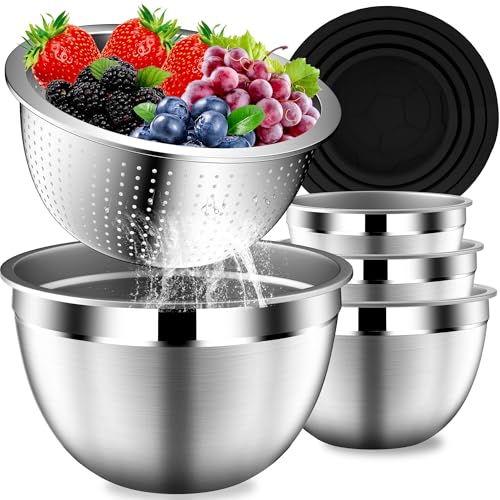
The set with a colander in it. DUTZUN publishes 1.5, 2, 2.5 and 4.5 Q stainless bowls with a colander that nests in the largest, a brushed non-slip surface inside and out, and a lid that must never go in a dishwasher.
What We Could Not Verify
All the figures above come from these makers’ own listings. Here is what they leave out.
- No weight from three of the five, and an unbelievable one from a fourth.
- No bowl dimensions from four of the five, only capacities.
- No nested stack size from four of the five.
- No capacity at all from one of the five.
- No base grip treatment published on two of the five.
- No washing instruction from one of the five.