How the Five Compare on the Numbers
The hidden cost of a pizza stone is the wait. A cold slab has to be brought up to temperature before anything goes on it, and that is an hour of oven time you have to plan around, or stand near. Two of these five publish a preheat figure, one says no preheating is needed at all, and two publish nothing on the subject.
Pampered Chef publishes the shortest answer possible: no pre-heating, put the food directly on the stone and then into the oven. Gyreuni publishes 30 minutes at 400 degrees F and above before first use. THERMICHEF publishes 45 to 60 minutes at 500 F with a bake under 8 minutes. Old Stone and American Metalcraft publish neither.
Three of these five publish no preheat guidance, which on a slab of ceramic is the single most important instruction: a stone put into a hot oven cold can crack, and a stone used before it is hot bakes a pale base. The absence is not neutral, it is the gap a new owner falls into.
The Stone That Skips the Wait
No preheating, by design
Pampered Chef publishes an instruction no other listing here comes close to: no pre-heating, put the food directly on the stone and then into the oven, with the one caveat that dense frozen food like meat should be thawed first. For anyone who cannot stand at a counter for an hour, or simply wants dinner, that changes the whole proposition.
It backs it with two more claims that fit an accessible kitchen. It publishes contoured handles molded onto the sides so the stone travels from oven to table, and it states the stoneware is non-porous and will not retain oils or odors, with darkening described as an improvement rather than a stain. It publishes 4.4 pounds.
What that costs in browning
There is a trade and the listing is honest about where it lies: this is a stone for crisp frozen pizza and golden cookies, not for a 90 second Neapolitan base. A slab that goes in cold reaches temperature with the food on it, so the crust sets more slowly than it would on a stone that has been soaking up heat for an hour.
Its field figure of 0.3 inches is the lowest thickness in this group, which is consistent with that: less mass to heat means less heat stored, and also less wait. For a kitchen where the oven is used for frozen pizza, sheet vegetables and cookies rather than artisan dough, that is the right end of the trade.
The Two That Publish a Wait
Thirty minutes, and an hour
Gyreuni publishes the most reasonable preheat in this pool: clean and dry the stone before first use, then preheat it in the oven for 30 minutes at 400 degrees F or above, which it says ensures a crisp result and no smell. That is half the time THERMICHEF asks for and at a lower temperature.
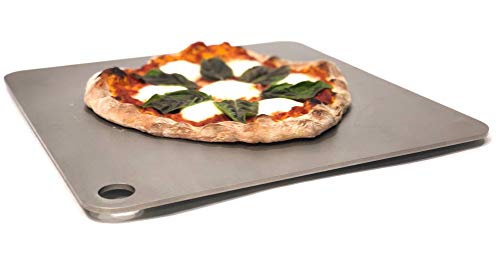
THERMICHEF publishes 45 to 60 minutes at 500 F with the steel inside, then a bake in under 8 minutes, on a 16 inch square plate weighing 27.0 pounds by its dimension field and 27.5 by its own text. It is the only listing here that publishes what happens between pizzas: more stored heat, faster recovery.
Weight is the other half of the wait
Those two figures are related. A 7.1 pound cordierite stone needs 30 minutes; a 27 pound steel plate needs up to an hour, because there is four times as much material to bring up to temperature. The lighter slabs here, at 2.7, 3.75 and 4.4 pounds, would heat faster still, and two of the three publish no figure for it.
For an accessible kitchen the arithmetic runs the same way in both directions: the slab that takes longest to heat is also the one you cannot lift out of the oven, and the one that heats fastest is the one you can carry to the table. Nothing on this page publishes both a short preheat and a large thermal mass, because no such object exists.
What the Quiet Listings Leave Out
Two stones with no preheat instruction
Old Stone publishes a recommended ceiling of up to 500 degrees in a standard home oven, a heat core stated to eliminate soggy centers, and the simplest cleaning line here: rinse and air dry, seasons over time. What it never says is whether the stone should be in the oven as it heats, or for how long.
American Metalcraft publishes even less on the subject. Its instructions cover cleaning carefully, telling you to let the stone cool completely and then wipe it with a damp cloth while avoiding soap and submersion, and its other bullets cover heat distribution in general terms. At 2.7 pounds it is the lightest slab here and the least instructed.
Why that matters more than it sounds
A ceramic stone put into an already hot oven can crack from thermal shock, and the standard advice is to heat it with the oven from cold. Neither of these two listings says so, and neither says how long to leave it. A buyer following the packaging alone has no way to know, which is a documentation failure rather than a product one.
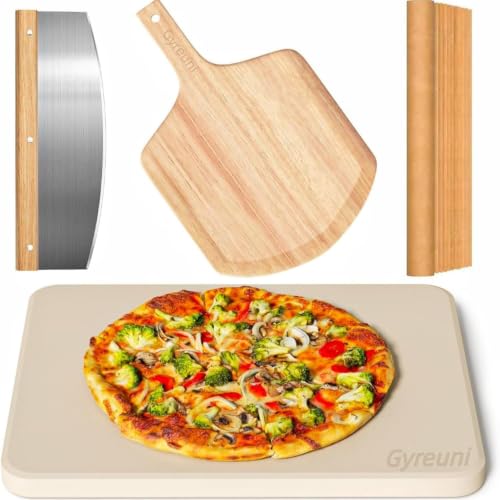
Gyreuni, by contrast, covers the whole sequence: a first use routine, a cleaning method, a warning against soap and a reassurance about stains. It also includes an oak peel of 12 by 17 inches, a cutter and ten sheets of parchment, so the first bake needs nothing else bought.
Which One Fits Your Kitchen
The kitchen that will not wait an hour. Pampered Chef publishes no preheating at all, food placed straight on the stone, with contoured handles molded onto the sides, a non-porous stoneware surface and 4.4 pounds. Microwave, freezer and convection oven use are all published.
The shortest published preheat. Gyreuni publishes 30 minutes at 400 degrees F and above for its 15 by 12 inch cordierite stone, rated to 1472 F at 7.1 pounds, with an oak peel, a cutter, a serving rack and ten sheets of parchment in the set.
The lightest slab to handle. American Metalcraft publishes a 13 inch ceramic stone at 2.7 pounds with a clear cleaning routine: cool completely, wipe with a damp cloth, no soap, never submerged. It publishes no preheat and no temperature ceiling.
The simplest care of all. Old Stone publishes a 14 inch round stone at 3.75 pounds, recommended up to 500 degrees, with rinse and air dry as the whole instruction and a stone that seasons over time.
The cook who plans ahead. THERMICHEF publishes 45 to 60 minutes at 500 F then a bake in under 8 minutes on a 16 inch square steel plate, with faster recovery between pizzas. At 27.0 pounds it is a plate that lives in the oven.
What We Could Not Verify
All the figures above come from these makers’ own listings. Here is what they leave out.
- No preheat instruction from three of the five.
- No bake time from four of the five.
- No temperature ceiling from two of the five.
- No warning about thermal shock from any of the ceramic stones here.
- No recovery time between pizzas from four of the five.
- No size in the text from one of the five, only dimension fields.