How the Five Compare on the Numbers
A bundt pan gets lifted full, turned over and held there, so the empty weight is the part of the job a buyer feels every time. All five of these listings publish one, which is unusual on this pool, and they run from 0.71 lb to 1.06 lb: 0.71, 0.79, 0.79, 0.99 and 1.06 lb, across aluminum, carbon steel and two silicone pans braced with metal.
Weight here tracks material almost exactly. The lightest is formed aluminum, the two at 0.79 lb are a carbon steel pan and a silicone pan braced with a metal rim, and the two around a pound are silicone in a steel frame and carbon steel. None of these five publishes a wall thickness, so the metal gauge behind those figures is not documented anywhere.
What the table cannot settle is how thin the metal is on any of these five. A pan can be light because it is small or because it is thin, and thin is the version that scorches a cake edge. None of these five publishes a gauge, a wall thickness or a weight per inch of diameter, so there is no way to separate the two from published text alone.
Where the Weight Comes From
Aluminum at 0.71 lb and Carbon Steel at 0.79
Wilton publishes 0.71 lb, the lightest of these five, and it is the only aluminum pan in the group. The listing says heavy duty aluminum and resists warping in the same bullet, which is a claim about stiffness rather than mass, and it publishes both figures a baker needs in words: 9.49 inches in diameter and 3.37 inches deep. It also names extended handles, which nothing else light here does.
Tuvonirzo publishes 0.79 lb of carbon steel at the same stated 9.5 inch size. Its coating bullets go further than the rest: BPA, PTFE and PFOA free, oven safe to 450 F, dishwasher safe, and then two care instructions no other pick prints. Use wood or plastic utensils and never heat the pan empty. Those are limits, and a listing that publishes limits is telling you where the coating ends.
Two Silicone Pans, Both Braced With Metal
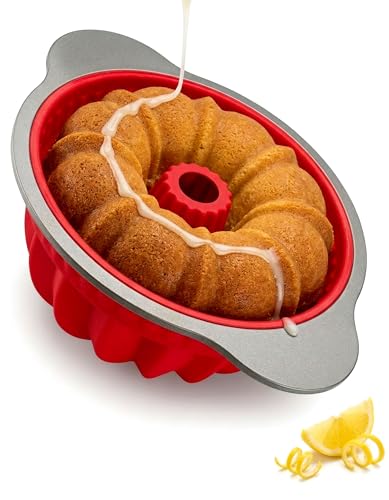
Vinino publishes 0.79 lb as well, and it is silicone rather than steel. The listing explains the weight as a metal reinforced rim and says the pan holds its shape from countertop to oven with no baking sheet underneath. It publishes the widest usable range on this page, from minus 40 F to 446 F, and it is the only pick that publishes a capacity: 9.6 cups, or 77.16 fl oz.
Boxiki Kitchen publishes 0.99 lb for silicone inside a heavy grade steel frame with handles, and its case is the same one Vinino makes: the frame stops the silicone bending and sagging. It states oven, freezer and dishwasher safety in one line, and it publishes a 90 day warranty, which is the only warranty figure in this group. No oven limit is published anywhere in it.
The Figures That Do Not Agree
Wilton Publishes 3.37 Inches Deep and a 1.16 Inch Field
Wilton’s first bullet gives the pan as 9.49 inches in diameter and 3.37 inches deep. Its dimension fields read 10.14, 1.16 and 10.14 inches. Two of those three are plausible for a pan with a rim wider than its baking diameter. The 1.16 is not: a fluted tube pan 1.16 inches deep would not hold a cake, and the maker’s own sentence says 3.37.
So the bullet wins and the field is discarded, which is the house rule and in this case also the obvious reading. It matters on a weight page because depth is what makes a light pan feel flimsy or not: 0.71 lb spread over 3.37 inches of wall is a different pan from the same mass in a shallow tray, and only the bullet tells you which one this is.
Boxiki Publishes Its Internal Size as Its Only Size
Boxiki’s size bullet gives 9 inches long by 9 inches wide by 4.6 inches deep and then adds, in brackets, that this is the internal size. Its dimension fields publish the same three numbers. One of the two is therefore wrong, because a pan with a steel frame and handles cannot have the same outside and inside measurements, and nothing in the listing says which figure was measured.
The safe reading is that 9 by 9 by 4.6 inches is the inside, as the maker says, and the outside is larger by an unpublished amount. The stated basin here is 4.6 inches against 3, 3.06 and 3.37 inches elsewhere on the page, which is consistent with it also being the heavier of the two silicone picks.
What the Weight Does Not Settle
Two Pans at 0.79 lb, One Steel and One Silicone
Tuvonirzo and Vinino publish the same weight, 0.79 lb, and nothing else about them matches. Tuvonirzo is carbon steel with a gray non-stick coating, oven safe to 450 F, and its size is given once as 9.5 inches. Vinino is food grade silicone with a metal reinforced rim, rated from minus 40 F to 446 F, and it publishes an outer diameter of 9.6 inches, a 3 inch height and a 2 inch center tube.
That is the useful comparison on a weight page, because it shows weight is not the whole specification. The silicone pan is the better documented of the two, with the only capacity figure here at 9.6 cups or 77.16 fl oz and a dishwasher line of its own. The steel pan answers a different question, publishing the only two care limits on the page: wooden or plastic utensils only, and never heat it empty.
Which Coatings Are Actually Named
Weight tells you what you lift and the coating tells you what the cake comes out of, and these five name it with very different precision. Tuvonirzo publishes a coating free of BPA, PTFE and PFOA. Wilton says made without PFAS and never says what the coating is instead. Novery calls its coating premium non-stick and scratch resistant with no chemistry attached at all.
The two silicone picks sit at opposite ends of that. Vinino publishes BPA free food grade silicone and a temperature range to go with it. Boxiki Kitchen publishes high quality non-stick silicone in a heavy grade steel frame, states it is safe in the oven, the freezer and the dishwasher, and then publishes no temperature at all, which on silicone is the figure that decides whether a bake survives.
Which One Fits Your Kitchen
The lightest pan that still states its depth. Wilton publishes 0.71 lb of aluminum, 9.49 inches in diameter and 3.37 inches deep, oven safe to 450 F, dishwasher safe, with extended handles. Ignore the 1.16 inch dimension field, which its own bullet contradicts.
A baker who wants the coating limits in writing. Tuvonirzo publishes 0.79 lb of carbon steel, 450 F, dishwasher safe, and coating free of BPA, PTFE and PFOA. It is also the only pick that says to avoid metal utensils and never to heat the pan empty.
Someone who wants a capacity figure. Vinino publishes 9.6 cups and 77.16 fl oz at 0.79 lb, in silicone with a metal reinforced rim, rated from minus 40 F to 446 F. It publishes no dishwasher line, only a rinse.
A deeper basin that will not sag. Boxiki Kitchen publishes 0.99 lb, silicone in a steel frame with handles, and an internal 9 by 9 by 4.6 inches. It publishes no oven limit, which on silicone is the figure you most want.
A carbon steel pan with both diameters stated. Novery publishes 1.06 lb, a 9.5 inch outer and 9 inch inner diameter and a 3 inch height, in carbon steel with a scratch resistant coating. It publishes no oven limit and no washing instruction at all.
What We Could Not Verify
Everything above comes from each maker’s own published text. These are the things that text does not contain.
- A wall thickness or metal gauge for any of the five. That is the figure that separates a light pan from a thin one and nothing in this pool publishes it.
- A capacity for four of the five. Only Vinino publishes one, at 9.6 cups and 77.16 fl oz.
- An oven limit for two of the five, including the silicone pan in a steel frame.
- The outside dimensions of the Boxiki pan. Its bullet calls 9 by 9 by 4.6 inches the internal size and its fields publish the same three numbers.
- Any washing instruction from Novery, across five bullets that cover size, material, coating, uses and shape.
- Which figure is right on the 1.0 lb listing left off this page. Its title says non-stick and 9.5 inches, its bullets say seasoned cast iron, and its fields say 10 by 10 by 3 inches.