How the Five Compare on the Numbers
Sixteen listings sit on the fact sheet and eleven are off this page. Most of the pool is a 1 cup or 2 cup soup tray with a steel reinforced rim, which is a meal prep product rather than a trailer product. Three are lever-handle metal ice trays published at 11 to 11.6 in long, which is longer than many trailer freezer shelves. Several publish nothing but a carton and a weight.
A trailer changes which specifications matter. Space is measured in inches somebody already knows, the freezer shares a cabinet with everything else, and the whole kitchen moves down a road. That makes three published facts decisive: what one tray measures, what the lid is stated to do, and how the cubes come out. Only one listing among these five answers the first.
What the table cannot give you is how any of this behaves on a road. Not one of these sixteen listings says a word about a tray in a moving vehicle, and three of them name RVs as a use case anyway. The nearest thing to evidence is structural: a rim that stops a full tray flexing, and a lid that is described as sealing rather than merely covering. Both of those are published, and both are the right proxy for the question.
One Tray, and Nobody Will Tell You How Big It Is
The Only Published Tray Footprint
Tvmania publishes 7.3 by 5.1 by 1.2 in for the tray and 1.5 by 1.2 by 0.7 in for a cube, and it is the only pick on this page that gives either figure for the product rather than the box. For a trailer that single bullet is worth more than any other sentence in the pool, because a freezer compartment is a known quantity and a tray is either inside it or it is not.
The catch is what the figure leaves out. The listing does not say whether 1.2 in includes the lid, and the lid is described as sealing tightly, which usually means a rim that sits above the tray. Stacked two deep, the difference between 1.2 in and 1.2 in plus a lid is the difference between a drawer that closes and one that does not.
Cartons Instead of Products
The other four publish a box. Weftnom gives 4.3 by 10 by 4.3 in for four trays, NFK 4.52 by 7.9 by 3.38 in for four plus a bin, Aopigavi 4.53 by 10.43 by 1.57 in for two, Vortihive 5 by 7.3 by 1.3 in for two. Those figures are real and they describe shipping, so they are recorded above as cartons and used for nothing else.
They are not useless. Aopigavi’s 1.57 in and Vortihive’s 1.3 in are cartons holding two trays each, which puts an upper bound on how thick one tray can be, and both listings separately describe a flat low profile. That is inference rather than data, which is exactly why the single published tray dimension on this page is the specification the page is built around.
Lids That Have to Hold While the Trailer Moves
Three Listings That Say Spill
Aopigavi is the most direct: a tight-fitting airtight lid that prevents spills when moving the tray to the freezer, on a body with a stainless steel reinforced rim. Weftnom makes the same argument from the other end, that a rigid PP frame holds its shape while you fill and carry it, unlike a floppy all-silicone mold that bends and spills on the way. Both are describing the trip from counter to freezer, which in a trailer is the same trip over worse ground.
NFK and Tvmania describe seals against odors instead, which is a different job with an overlapping solution. NFK adds the one detail nobody else publishes: side notches that make the lid easy to open, which matters when your hands are cold and the tray is frozen to itself. Vortihive includes a lid and makes no claim about it at all.
Stacking in a Freezer the Size of a Shoebox
Four of the five claim stacking and each does it slightly differently. NFK says the trays stack securely with the lid on and names compact refrigerators. Aopigavi says a flat low-profile shape lets trays stack vertically. Weftnom says the lids let the trays stack to save space in mini fridges and RV kitchens. Tvmania publishes a tray only 1.2 in through and does not claim stacking anywhere.
That last combination is the trap. A 1.2 in tray is the one most likely to stack well and the one whose listing never confirms it, while the trays that promise stacking never publish a height. Anyone buying for a small freezer is choosing between a measurement without a claim and a claim without a measurement, and there is no listing in this pool that offers both.
Getting the Cubes Out Without a Tap Running
Press, Twist or Warm Water
Four of these five release by hand. NFK publishes two options, press the soft silicone base or twist the tray. Aopigavi says each compartment pops out individually by pressing the bottom, with no twisting, pounding or rinsing. Weftnom says twist and press in seconds. Tvmania says twist and push up from the bottom. None of the four needs anything from the kitchen to work.
Vortihive is the exception and the listing is honest about it: run the bottom of the tray under tap water for about 30 seconds, then wiggle it side to side. In a house that is a detail. In a trailer it is water out of a tank and into a waste tank, twice a day, for the life of the tray. That is the clearest example on this page of a specification that changes meaning with the kitchen.
Steel, Silicone and What Rattles
Vortihive is 304 stainless, stated as corrosion resistant and not easily deformed, and the maker says steel helps cubes form faster. Those are genuine advantages: steel does not take on odors and does not distort in a freezer that cycles. It is also 1.04 lb for two trays, the heaviest of these five, and it is the one material here that will make noise against a metal shelf on a rough road.
The silicone picks answer the same durability question differently. Aopigavi and Weftnom both put a rigid element into a flexible tray, a steel rim and a PP frame respectively, so the tray flexes where release needs it and holds firm where carrying needs it. Weftnom at 0.49 lb is the lightest of these five and covers four trays, which is the better arithmetic for a kitchen that has to be packed.
Which One Fits Your Kitchen
A freezer you have already measured. Tvmania, the only pick publishing the tray at 7.3 by 5.1 by 1.2 in with cubes of 1.5 by 1.2 by 0.7 in, 15 per tray, rated -40 F to 428 F, 0.6 lb for the pair. The listing does not say whether the lid adds height.
Carrying a full tray across a moving kitchen. Weftnom, a rigid PP frame around a silicone base stated to hold its shape while filled and carried, with a snap-on sealing lid, 56 cubes across four trays, -40 F to 428 F, at 0.49 lb, the lightest of these five.
Cold hands and a stiff lid. NFK, four trays of 12 cubes plus a storage bin, with side notches for opening the lid, press or twist release, cubes at 1.7 by 1.1 by 0.8 in, and RVs and compact refrigerators named directly. No temperature range published.
Stock, herbs and small portions. Aopigavi, two trays of 10 compartments marked 1 Tbsp and 15 ml up to 2 Tbsp, 30 ml and 1 oz, with a steel reinforced rim and an airtight lid stated to prevent spills in transit. A flat shape for stacking.
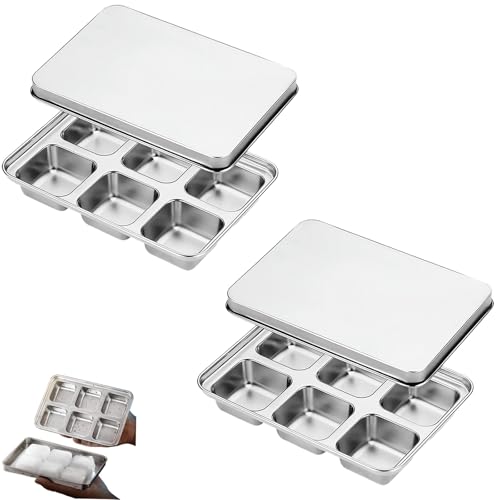
Nothing that warps or absorbs. Vortihive, 304 stainless with a lid, cubes at 1 by 1.5 in, dishwasher safe, 1.04 lb for two. Release means running the base under a tap for about 30 seconds, which is water a trailer has to carry twice.
What We Could Not Verify
Every figure above is from the maker’s own listing. These are the things we went looking for and could not source in any of the sixteen.
- Four of these five publish no tray dimension at all, only a carton, so the figure a small freezer needs is missing from most of the pool.
- No listing says whether a published height includes the lid, which is the figure that decides whether trays stack in a shallow compartment.
- NFK, Aopigavi and Vortihive publish no temperature range, so three of five picks cannot be compared on cold or heat.
- Vortihive publishes no cube count, so the yield of the only metal pick here is unstated.
- Weftnom tells you to fill below the top edge and never says by how much, so its usable volume is not published.
- Not one listing in this pool says anything about a tray in a moving vehicle, even the three that name RVs as a use.