How the Five Compare on the Numbers
Every listing on this shortlist states what its silicone is, which is unusual, and the sentences are not the same sentence. One states platinum silicone. One states 100 percent food-grade silicone. Two state BPA-free food-grade silicone. One states silicone and PP together and explains which part does what. That spread is the whole reason this page ranks by material rather than by cube count.
The second question is what has been added. Three of the five put something stiff inside the silicone, a metal frame, a stainless steel reinforcement or a PP structure, and those three are the trays meant to carry liquid. The two that add nothing are cube trays. Only two listings publish a temperature figure to stand behind any of it.
What the table cannot tell you is what any of this silicone is cured with, which is the fact behind the word platinum. No listing here states it, so platinum grade sits on the page as a label rather than a specification. Nor does any listing state a shelf life, a maximum number of freeze cycles, or what happens to an unreinforced tray after a year of being twisted.
What the Word Silicone Is Doing in Each Listing
Platinum Grade and Food Grade
ZIP STANDING states BPA-free platinum silicone with the lid included, and it is not alone in this pool: Xomoo and CyhHave both use the same phrase on their own trays. What none of them does is define it. Platinum refers to how the silicone is cured, and a listing that claims it without naming the process is asking to be taken on trust.
Aopigavi takes a different route to the same reassurance. It states 100 percent food-grade silicone reinforced with high quality stainless steel, and then names a standard, stating the set meets strict NBTS safety standards. That is the only named standard anywhere on this shortlist, and a named standard is a stronger claim than an adjective even when the adjective sounds more premium.
The One With Nothing Added
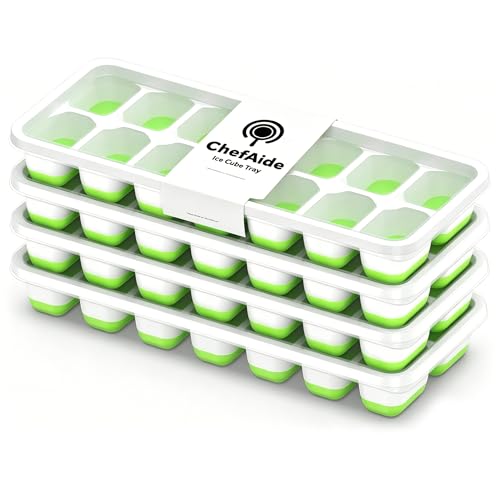
LYQOQYL is the plainest listing here and the most limited. It states BPA-free food-grade silicone that is safe in direct contact with food and drink, three trays with removable lids, fifteen cubes per tray and a stackable design. There is no steel, no PP, no temperature figure and no dimension for a tray, so the material sentence is doing all the work.
That is not automatically a problem. A cube tray holding fifteen small cubes does not need a steel rim the way a 1 cup soup mold does, and the listing’s own claim, that the silicone keeps its flexibility at freezer temperatures so cubes come out without cracking, is the right claim for the product. It just leaves nothing to check.
What Holds the Tray Up When It Is Full
Steel Rings and Embedded Frames
ZIP STANDING states a metal frame embedded in silicone that is very sturdy and allows the trays to hold their shape when being transferred, which is the moment a full soup tray fails. Its compartments are marked at 125 ml and 4 oz and again at 250 ml and 8 oz for 1 cup portions, and the snap closure is stated to seal the wall between each compartment so portions do not run together.
Aopigavi uses the same idea at a smaller scale, stating silicone reinforced with stainless steel on a flat low-profile tray with an airtight lid. Its portions are tiny by comparison, ten cubes per tray at 2 Tbsp, with markings from 1 Tbsp and 15 ml up to 2 Tbsp, 30 ml and 1 oz, which is a herb, broth or baby food tray rather than a meal tray.
PP Frames and Silicone Layers
Tohsssik is the listing that says out loud what the others imply. It states the trays are made from food-grade silicone and PP materials, and that the soft silicone layer prevents warping and retains shape. So the plastic is structural and the silicone is the release surface, which is exactly the division of labor a stack of five trays with fourteen cubes each needs.
It is also the only listing here that publishes a filling method: pour the water in, let the overflow drain out through the tray, snap the lid on, then push the cubes out with no bending or twisting. Elsewhere in this pool Weftnom describes the same arrangement in sharper terms, contrasting a rigid PP frame with all-silicone molds that bend and spill on the way to the freezer.
Heat, Cold and the Figures Behind Them
Two Ranges and Three Silences
Tvmania publishes the only complete range on this page, stating the trays are safe from minus 40 F to 428 F and can withstand microwaving as well as freezing. ZIP STANDING publishes the top half, stating the trays are safe in ovens up to 428 F, and gives no low figure at all despite being a freezer product first.
Aopigavi, Tohsssik and LYQOQYL publish nothing. LYQOQYL comes closest with a phrase rather than a number, stating it withstands extreme freezer temperatures while staying flexible enough to release cubes, which is exactly the kind of sentence a figure would settle. For reference, two listings in this pool publish minus 40 F to 428 F, so the figure is available in the category.
Care That Follows From the Material
Material decides washing, and here the listings are thinner than they should be. Tvmania states a rinse with water and nothing about a dishwasher. LYQOQYL, Aopigavi and Tohsssik publish no washing instruction at all on this sheet. That leaves the reinforced trays as the only ones where the question even gets interesting, because steel inside silicone is not something a dishwasher will reach.
The other half of care is what the silicone touches. All five state BPA-free material safe for direct food contact, and Tohsssik alone names its second material so you know a plastic is in there. If a plastic free kitchen is the reason you are buying silicone, that sentence is the one that matters, and only one listing here is candid enough to give it to you.
Which One Fits Your Kitchen
Freezing soup by the cup. ZIP STANDING states platinum silicone with a metal frame embedded in it, 1 cup compartments marked at 125 ml and 250 ml, and ovens to 428 F. It publishes 1.9 pounds and never says how many trays or compartments you get.
A buyer who wants a standard, not an adjective. Aopigavi states 100 percent food-grade silicone with stainless steel reinforcement and names NBTS. Its ten cubes per tray at 2 Tbsp suit herbs, broth and baby food, and it publishes no temperature figure at all.
Ice in quantity. Tohsssik states silicone over PP, five trays, fourteen cubes each and seventy in total, with a published filling and release method. The PP is structural, so this is not a pure silicone tray and the listing says so.
Anyone who wants the figures. Tvmania publishes minus 40 F to 428 F, microwaving, a tray at 7.3 by 5.1 by 1.2 inches and a cube at 1.5 by 1.2 by 0.7 inches. It states no reinforcement, so expect flexibility rather than rigidity when full.
Cubes for drinks and nothing more. LYQOQYL states BPA-free food-grade silicone, three trays, fifteen cubes each and removable lids that stack. There is no steel, no PP and no temperature figure, so judge it on the material sentence alone.
What We Could Not Verify
These are the questions the five listings leave open, and nothing above has answered them by inference.
- No listing states what its silicone is cured with, so platinum grade is a label here rather than a specification.
- Aopigavi, Tohsssik and LYQOQYL publish no temperature figure in either direction.
- ZIP STANDING publishes no tray count and no compartment count, only 1 cup per compartment.
- Four of the five publish only a package figure, so the footprint of one tray is unstated on all but Tvmania.
- Three of the five publish no washing instruction at all, and none says whether steel inside silicone affects it.
- No listing publishes how many freeze cycles the silicone is expected to survive.