How the Five Compare on the Numbers
A vacuum bag has almost no specifications, which makes the two it does have carry the whole decision. One is how thick the film is, given in mils. The other is how hot the water can be if you intend to cook in the bag rather than only freeze in it. Those two figures are published unevenly across this pool, and one brand contradicts itself on the second.
Three of these five publish a thickness. Two publish a water temperature. Four name boiling in a bullet and one does not, despite putting sous vide in its own title. That is the shape of this category: a lot of language about freshness, very little about what the plastic will take, and the gaps are not where a buyer would guess.
What the table cannot tell you is how long any of these will stand a given temperature. Two listings give a ceiling and neither gives a duration, which for a long sous vide cook is the other half of the question. Nor does any listing here state a seal width, so how much of the bag the machine consumes on each seal is unpublished throughout.
One Brand, Two Different Ceilings
230 Degrees on the Rolls
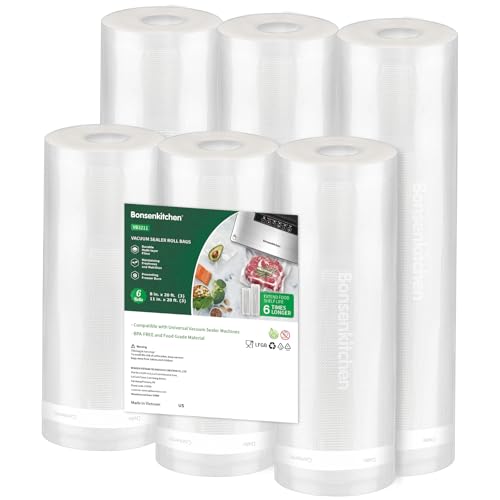
Bonsenkitchen’s roll listing carries the most generous heat claim in this pool. Its first bullet states the bags can be microwaved, frozen, re-used, washed, boiled and put in a dishwasher, and then that you can cook sous vide by placing them in water at any temperature up to 230 degrees Fahrenheit or 110 Celsius. That is above the boiling point of water at sea level.
The rest of the listing matches the ambition. The film is described as 4 mil heavy duty with embossed air removal channels, one side recessed and the other glossy and transparent, in a food grade material named as PA and PE. Six rolls arrive, three at 11 inches wide and three at 8 inches, each stated at 20 feet, cut to length as you need them.
195 Degrees on the Precut Bags
The same brand’s 150 count box states something different. Its safety bullet reads that you can cook sous vide in Bonsenkitchen bags in water at any temperature up to 195 degrees Fahrenheit or 90 Celsius. The wording around it is close to identical to the roll listing, the brand is the same, and the figure is 35 degrees Fahrenheit lower.
Both conversions are internally sound, so this is not a units error of the kind that turns up elsewhere in this pool. The plain reading is that these are two different films sold by one brand, and the page reports both figures rather than picking the flattering one. For a long cook, the lower number is the one to plan around unless you are holding the roll listing in your hand.
Thickness Is the Other Half of the Answer
The Only Listing That Measures Both Panels
A vacuum bag is not one film. One side is smooth and the other carries embossed channels so the machine can draw air out, and those two sides are not the same gauge. O2frepak is the only listing in this pool that says so: a 3.5 mil front panel and a 4 mil textured or embossed back panel, stated in the same bullet as its bone guards.
That detail changes how you read the other listings. Bonsenkitchen’s rolls state 4 mil and Syntus states 4 mil, and neither says which panel the figure describes, so a 4 mil claim could be the back panel of a bag whose front is thinner. O2frepak publishes no water temperature at all, so the best documented film here has the least documented heat rating.
Where 4 Mil Is All You Get
Syntus states a 4 mil thickness with single side embossed dotted texture and ties the figure directly to bones: the thickness is what it says prevents piercing. It is also the only listing on this page that tells you what its bags will not do, stating that the precut bags have no zipper and no air valve and cannot be used with a handheld vacuum sealer.
Two of the five publish no thickness at all. Bonsenkitchen’s 150 count box describes deeper air passages than other brands and puncture guard sheets, and never states a gauge. FoodSaver describes BPA free material and a custom fit and never states a gauge either. Both are otherwise detailed listings, which makes the omission a choice rather than an oversight.
What the Pool Is Actually Full Of
Clothing Bags, Machines and a Stand
Nine of the sixteen listings collected under this heading are not bags for a food sealer. Four are compression bags for clothes and bedding: Amazon Basics ships 15 bags with sizes up to 48 by 32 inches and a hand pump, Cozy Essential ships 20 with a jumbo stated at 39.35 by 27.5 inches, and HIBAG and Wfiia sell the same idea for closets and luggage.
Two are the machines themselves, one stating 95 kPa of suction with a 12 mm seal bar and one stating 90 kPa. One is a 304 stainless steel stand measuring 7.9 by 7.9 by 11.8 inches with a 7 inch circular opening, whose job is to hold a bag upright while you fill it. Useful things, all of them, and none of them a bag you put in a sealer.
A Package Measured at Eleven Feet
xinbaolong sells six rolls in the same configuration as Bonsenkitchen, three at 8 inches and three at 11, and its package fields read 8 by 132 by 11 inches. One hundred and thirty two inches is eleven feet, which is a roll unwound rather than a carton, and the listing’s own weight of 2.9 pounds sits in a figure the pipeline flagged as far too light for an object of those dimensions.
It is worth naming because the same listing is otherwise sound: BPA free, cleared for freezers, refrigerators, microwaves and boiling, with puncture prevention claimed and 20 foot rolls. What it does not publish is a thickness or a temperature, which is why it is not one of the five. The package figure is a measurement of something, just not of the box.
Which One Fits Your Kitchen
The cook who works sous vide. Bonsenkitchen’s roll listing states water at any temperature up to 230 degrees Fahrenheit or 110 Celsius, publishes a 4 mil film with embossed channels, and is the only pick cleared to be washed and re-used. Six rolls arrive in two widths, cut to whatever length the food needs.
The kitchen that portions three ways. Bonsenkitchen’s 150 count box is the only pack here with three sizes, 11 by 16, 8 by 12 and 6 by 10 inches, with puncture guard sheets for ribs and seafood. Its stated ceiling is 195 degrees Fahrenheit, the lowest figure published on this page.
The cook sealing bone in cuts. O2frepak publishes 3.5 mil on the front panel and 4 mil on the textured back, with bone guards stated separately, on 100 gallon bags at 11 by 16 inches. It clears cooking, freezing, a dishwasher, a microwave and boiling, and gives no temperature for any of it.
The buyer with a desktop machine. Syntus publishes a 4 mil thickness on 100 gallon bags at 11 by 16 inches and states plainly that they carry no zipper or valve and will not work with a handheld sealer. It publishes complete dimension fields of 11 by 16 by 11 inches and a weight of 4.78 pounds.
The household that hates waste. FoodSaver ships five rolls in two widths, stated at 8 by 20 and 11 by 16 inches, cut to length so the bag matches the food, and states it is made in the United States. It is cleared for the freezer, the refrigerator, the microwave and the dishwasher, and says nothing about boiling.
What We Could Not Verify
Everything above comes from the makers’ own listings. These are the things a cook sealing food needs and the published data does not supply.
- Three of the five name boiling or sous vide and publish no temperature figure, so the clearance is a verb rather than a limit.
- Bonsenkitchen publishes 230 degrees Fahrenheit on its rolls and 195 on its precut bags, and neither listing explains why one brand’s film differs.
- No listing states how long a bag may stay in hot water, which for a long cook matters as much as the temperature it will take.
- Bonsenkitchen’s rolls and Syntus both state 4 mil without saying which panel the figure describes, and O2frepak’s listing shows the two panels differ.
- FoodSaver names sous vide in its title and boiling water in no bullet, so its own listing does not agree with itself.
- No listing publishes a seal width, so how much of each bag the machine consumes on a seal is unstated throughout the pool.