How the Five Compare on the Numbers
A vacuum bag is film, and film has weight. So for packs of precut bags the published weight ought to be the one figure that tells you what you are buying: for the same bag size and the same count, more pounds means more plastic and a bag less likely to tear. That is the theory, and this pool breaks it twice in the same page.
Two listings ship 100 precut gallon bags of 11 by 16 inches and publish 2.27 and 4.78 pounds. One brand ships 200 bags in one listing and 200 slightly smaller bags in another, and publishes 4.21 pounds and 1.15. All four figures are in the listings. At least two of them describe something other than the bags.
What the table cannot tell you is how much of each bag the sealer consumes. No listing in this pool publishes a seal width, and a machine that takes half an inch off every bag is taking a real share of a 6 by 10 inch pint bag. Nor does any listing state a bag weight, only a pack weight, so the arithmetic has to be done in the other direction.
Two Packs of a Hundred, Two Different Weights
2.27 Pounds Against 4.78
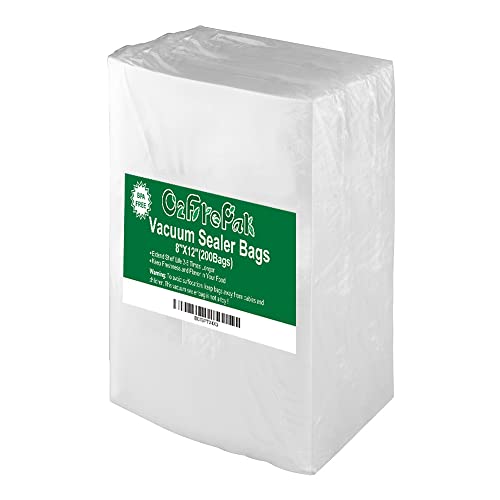
O2frepak publishes 2.27 pounds for 100 precut gallon bags of 11 by 16 inches. Syntus publishes 4.78 pounds for 100 precut gallon bags of 11 by 16 inches. The counts match, the stated sizes match, and the published weights differ by more than a factor of two. Both listings are otherwise careful and neither addresses the gap.
The film figures make it stranger rather than clearer. O2frepak states a 3.5 mil front panel and a 4 mil textured back. Syntus states 4 mil. If anything Syntus should be marginally heavier, not double, and a 4 mil bag of that size does not weigh what 4.78 pounds across a hundred implies. One of the two fields is describing shipping rather than contents.
Only One of Them Explains Its Film
What separates the two listings is disclosure rather than weight. O2frepak is the only listing in this pool that measures the two sides of a bag separately, because a vacuum bag is a smooth panel bonded to an embossed one and those are not the same gauge. It also states bone guards as a feature distinct from the film thickness.
Syntus takes a different and equally useful line, tying its 4 mil thickness directly to bones piercing the bag and then stating what the bags cannot do: no zipper, no air valve, and no use with a handheld sealer. That is the only incompatibility named anywhere in this pool, and it is the sentence most likely to save a wasted purchase.
One Brand, Two Hundred Bags, Four Times the Weight
8 by 12 at 4.21 Pounds
Wevac’s quart pack publishes 4.21 pounds for 200 precut bags of 8 by 12 inches, supplied in a keeper box the listing states is for cutting as well as storage. Embossed channels are stated to increase suction, five sealer brands are named for compatibility, and the published dimension fields read 12 by 12 by 8 inches, which is a box you can measure a shelf against.
It is a well specified pack in every respect except the gauge, which it does not give. For a shelf of jars and small stores it is also the most practical dispenser on this page: the listing describes taking some bags from the box each time and closing the lid when you finish, which is how a pack of 200 stays clean over a year.
6 by 10 at 1.15 Pounds
The same brand’s pint pack publishes 1.15 pounds for 200 precut bags of 6 by 10 inches. The bullets are almost word for word the same, with a box for storage rather than a keeper box for cutting, the same embossed channels and the same five named sealer brands, and published fields of 10 by 10 by 6 inches.
A 6 by 10 inch bag has roughly two thirds the area of an 8 by 12, so 200 of them should weigh roughly two thirds as much. Four to one is not that. The 1.15 pound figure is the lowest pack weight on this page and the pack contains more bags than three of the other four, which is the clearest sign in this pool that a weight field can be a guess.
What a Pack Weight Is Actually Good For
Three Sizes in One Box
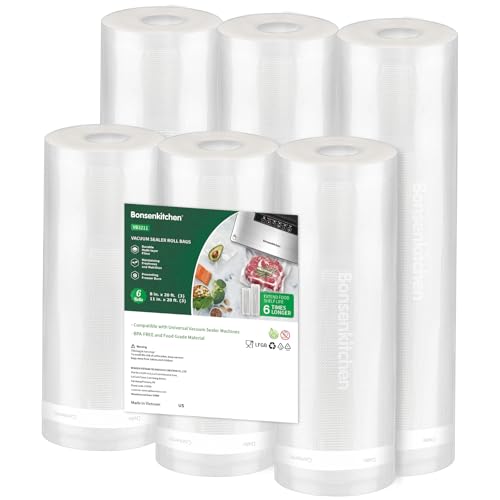
Bonsenkitchen publishes the most useful breakdown here and the least useful weight. The box holds 150 bags split as 20 gallon bags of 11 by 16 inches, 90 quart bags of 8 by 12 and 40 pint bags of 6 by 10, which is the only pack on this page that covers three sizes and the only one that tells you how many of each.
It publishes 2 pounds for all 150, which sits below Syntus’s 4.78 for a hundred and above Wevac’s 1.15 for two hundred, so it does not resolve anything. What it does publish is a sous vide clearance of 195 degrees Fahrenheit or 90 Celsius, puncture guard sheets for ribs and seafood, and a package figure of 9.06 by 12.4 by 3.15 inches.
Rolls Do Not Compare
Two listings in this pool sell rolls rather than bags and their weights cannot be set against any of the five here. FoodSaver publishes 3.09 pounds for five heat seal rolls, two stated at 8 by 20 inches and three at 11 by 16. xinbaolong publishes 2.9 pounds for six rolls of 20 feet each, with a package field reading 132 inches, which is eleven feet and therefore a roll unwound.
The same scaling problem turns up in the compression bag listings too. One publishes 1.3 pounds for 20 bags including four jumbo ones at 39.35 by 27.5 inches, and another publishes 2.69 pounds for 10 jumbo bags. Whatever those two figures are measuring, it is not the same thing in both cases.
Which One Fits Your Kitchen
The cook sealing bone in cuts. O2frepak publishes 3.5 mil on the front and 4 mil on the textured back with bone guards stated separately, on 100 gallon bags of 11 by 16 inches at 2.27 pounds. Stated dishwasher, microwave and boilable safe, with a package figure of 9.06 by 11.02 by 2.36 inches.
The owner of a desktop machine. Syntus publishes a 4 mil film on 100 gallon bags of 11 by 16 inches and states plainly that the bags carry no zipper or valve and will not work with a handheld sealer. Published at 4.78 pounds with fields of 11 by 16 by 11 inches.
The shelf that dispenses. Wevac’s 200 quart bags of 8 by 12 inches come in a keeper box stated for cutting and storage, with embossed channels and five sealer brands named. Published at 4.21 pounds with fields of 12 by 12 by 8 inches, and no film thickness.
The cook portioning small. Wevac’s 200 pint bags of 6 by 10 inches come in a box for storage with the same channels and the same named brands, published at 1.15 pounds with fields of 10 by 10 by 6 inches. Treat that weight as unexplained beside the brand’s own quart pack.
The kitchen that seals everything. Bonsenkitchen’s 150 count box splits 20 gallon, 90 quart and 40 pint bags, with puncture guard sheets and a sous vide clearance of 195 degrees Fahrenheit. Published at 2 pounds with a package figure of 9.06 by 12.4 by 3.15 inches, and no gauge.
What We Could Not Verify
Everything above comes from the makers’ own listings. These are the things a cook stocking a shelf needs and the published data does not supply.
- Two packs of 100 bags at 11 by 16 inches publish 2.27 and 4.78 pounds, and neither listing explains the difference.
- One brand publishes 4.21 pounds for 200 bags of 8 by 12 inches and 1.15 for 200 bags of 6 by 10, which does not scale with the area.
- Three of the five publish no film thickness, so their pack weights cannot be checked against a gauge.
- No listing states the weight of a single bag, so the pack figure has to be divided and it is the figure in doubt.
- O2frepak and Syntus both name boiling or sous vide cooking and attach no temperature to either.
- No listing publishes a seal width, so how much of a 6 by 10 inch bag the machine consumes on each seal is unstated.