How the Five Compare on the Numbers
Five live pages on this pool rank by weighing range, by footprint, by what the timer does and by what the top surface is made of. None of them asks the one question a drawer asks, which is how much of a fixed gap the scale uses up. On this pool that question is unusually interesting, because the published dimension fields and the makers’ own sentences do not agree.
Read by stated height the five come out close together and their data quality does not. Three state 0.7 inches outright. One states 0.7 in a bullet and 0.75 in its size field. One states H29 mm and publishes an inch field of 9.4 that cannot be a reading of the same object. Two of the five also publish a lid for the weighing surface.
What the table cannot tell you is how tall any of these is with its cover fitted. A lid sits on top of the weighing surface, so it adds to the figure a drawer has to take, and not one of the two listings that publish a cover publishes a height with the cover on. The stated figures are almost certainly the bare scale.
The Height That Decides It
Four Makers in Inches, One in Millimeters
WEIGHTMAN is the plainest case on the page. Its size label reads Small and then gives 2 by 3.8 by 0.7 inches inside the label itself, and a portable design bullet repeats the same three figures. Greater Goods states 5.7 by 3 by 0.7 inches in its opening sentence and adds that the scale fits under most home espresso machines, which is the same clearance question a drawer asks from the other side.
DENENTT states 3.54 by 3.4 by 0.7 inches and MHW-3BOMBER states 4.1 by 4.1 by 0.7 inches, both inside a compactness bullet. HARIO alone gives a product details line rather than a sentence: W120 by D190 by H29 mm, along with a 2000 g capacity and two AAA batteries. It is the only figure on this page you can read without translating marketing prose first.
Where a Field and a Maker Disagree
Two of the five have fields that back their own words. WEIGHTMAN’s are identical to its sentence. MHW-3BOMBER’s read 4.1 by 4.1 by 0.75, against a bullet that says 0.7, which is a listing disagreeing with itself by five hundredths of an inch. Greater Goods reads 0.67 against 0.7, which is a rounding difference in the other direction and the least troubling entry here.
HARIO is the case this page had to decide. Its published fields are 2.2 by 5.9 by 9.4 inches. Its own millimeters work out nothing like that in any order, and the bullet above them calls the scale slim, sleek and easy to store. Nothing 9.4 inches in one direction earns that description, so the maker’s line wins and the fields are reported rather than used. DENENTT publishes no fields at all, which is at least not misleading.
What Covers the Surface Once the Drawer Shuts
Two Lids, Two Pads and One Bare Platform
A drawer is not a shelf. Things get dropped in on top of whatever is already there, and a weighing platform sits on a load cell that does not want a jar of beans landing on it. Two of these five publish something for that. WEIGHTMAN states a flip plastic cover that protects the scale from damage when not in use, which is the only cover on this page described as protection for a scale that is not in use.
Greater Goods states a lid that covers the stainless steel weighing surface between uses. DENENTT and MHW-3BOMBER both state a removable silicone pad, waterproof and heat resistant, which is a spill and scratch answer during use rather than a lid for a closed drawer. HARIO states anti-slip rubber feet and improved water resistance and publishes nothing that goes over the top at all.
A Cover That Earns Its Space Twice
Both cover designs here do a second job, which matters when the point is to store less. WEIGHTMAN states that the removable plastic cover can be used as a scale weighing tray for coffee beans, so the thing protecting the scale in the drawer becomes the thing you weigh into on the counter.
Greater Goods goes further and states that the lid flips into a tray which catches loose grounds and expands the usable weighing area while dosing espresso. On a 5.7 by 3 inch body that extra area is the difference between a portafilter sitting on the scale and a portafilter overhanging it. Neither listing publishes what either scale measures with its cover fitted.
What Else Living in a Drawer Changes
Batteries, Ports and the Cable Problem
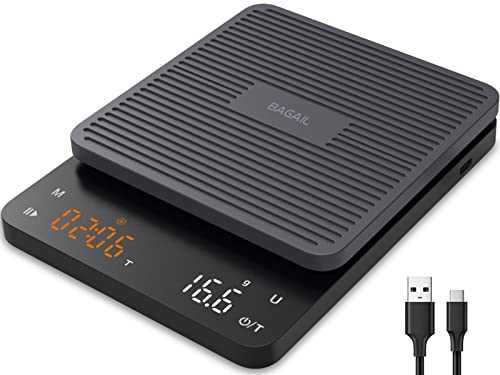
A drawer item that charges brings its cable with it. DENENTT and MHW-3BOMBER both charge over USB-C, and MHW-3BOMBER is the only listing here to publish a silicone-protected charging port, which is a sensible thing to have on something stored next to loose coffee. DENENTT states up to 90 days of daily use or 13 hours continuous from one charge.
HARIO takes two AAA batteries and needs no cable, at the cost of batteries to keep. WEIGHTMAN and Greater Goods publish no power source at all, in either the title or any bullet, which is a strange omission on a digital scale and the one gap on this page that a drawer buyer cannot work around by measuring.
Range, Surface and What Sits On Top
The two smallest bodies here also have the lowest ceilings, and the listings say why. Greater Goods stops at 750 g and describes itself as espresso-sized, fitting under most home espresso machines. WEIGHTMAN stops at 1000 g and states that it fits on Breville espresso machines and Flair espresso makers, which very few scales do. Both are dosing scales rather than brewing scales.
DENENTT, MHW-3BOMBER and HARIO all reach 2000 g, with DENENTT stating a 0.2 g floor and MHW-3BOMBER a 0.3 g floor. That is enough for a full pour-over server, which is what HARIO is built around: its slim design bullet says it is meant to fit a server comfortably. Only Greater Goods states a stainless steel weighing surface; MHW-3BOMBER states ABS plastic and the other three state nothing.
Which One Fits Your Kitchen
Storing it lid-down in a drawer. WEIGHTMAN, because it is the only listing whose bullets discuss being put away. A flip plastic cover protects it when not in use and comes off to act as a weighing tray, on a body stated at 2 by 3.8 by 0.7 inches.
Dosing espresso on a steel top. Greater Goods, for the stainless steel weighing surface and the lid that flips into a tray to catch grounds. Stated at 5.7 by 3 by 0.7 inches, with a 750 g ceiling and no timer published.
Working without pressing buttons. DENENTT, whose gravity sensing tares to zero as soon as a dripper or portafilter lands on it. Accept that its weight field and its own sentence disagree, at 0.44 pounds against 0.32, and that it publishes no dimension fields.
Keeping a charged scale ready. MHW-3BOMBER, for the 700 mAh battery behind a silicone-protected port and pressure sensing that wakes it when over 100 g lands on it. Its own figures disagree by five hundredths of an inch on height.
Brewing pour-over by weight. HARIO, stated at W120 by D190 by H29 mm with a 2000 g ceiling on two AAA batteries, and described as sized to sit under a server. Read the millimeters and ignore the inch fields entirely.
What We Could Not Verify
Every item below was looked for across all five listings and is not published:
- The height of either covered scale with its lid fitted, which is the figure a drawer actually has to take.
- Any explanation for HARIO’s published inch fields of 2.2 by 5.9 by 9.4, which match neither its own millimeters nor each other.
- Any dimension field at all for DENENTT, whose stated 3.54 by 3.4 by 0.7 inches rests on a single sentence.
- Which of DENENTT’s two weights is right, the 0.44 pounds in the field or the 0.32 pounds in its own bullet.
- A power source for WEIGHTMAN or Greater Goods, so whether a cable or a battery shares the drawer is unknown.
- The weighing surface material on WEIGHTMAN, DENENTT and HARIO, none of which names one.