How the Five Compare on the Numbers
Ten live pages already rank this pool by cavity count, by coating, by footprint twice, by post-wash care, by published weight, by madeleine size, by temperature range, by pans per purchase, by the cleaning sentence and by batch size. What none of them asks is whether the pan has a separate structural part in it, which is the thing that either stops it warping or eventually comes apart.
Three of these five publish a reinforcement and two publish none. Vinino puts a metal-reinforced frame inside a silicone pan. CHEFMADE publishes a reinforced rim on 0.8mm carbon steel and ZEENEEK a strengthened edge on the same gauge. Fchil is plain flexible silicone with nothing added, and Chicago Metallic publishes no reinforcement and two different metals.
The gauge row is the most useful thing in this table and it only has two entries. CHEFMADE and ZEENEEK both publish thickened 0.8mm carbon steel, which is a figure you can compare. The other three publish a material name and no thickness, so how much metal or silicone is actually in the pan is unstated on three of five listings.
A Metal Frame Inside Silicone
What Vinino Adds and Why
Vinino publishes a silicone madeleine pan with a metal-reinforced frame, stated to provide exceptional stability. That is a real answer to the real problem with silicone bakeware: a floppy sheet of it cannot be carried to the oven full of batter without a tray underneath. A frame turns the mold into a pan.
It also publishes the only range here with both ends given, -40°F to 446°F, described as allowing the pan to go directly from the refrigerator to the oven without warping or damage. Twelve cavities with deep, well-defined shell texture, release by pushing from the bottom, and a published size of 14.8 by 10 by 0.5 inches at a 0.73 lb weight field.
The Figure Its Sibling Gets Wrong
Elsewhere in this pool the same maker’s two-pack publishes the same Celsius pair, -40°C to 230°C, alongside a Fahrenheit range of -104°F to 446°F. The single-pan listing publishes -40°F to 446°F against the identical Celsius figures. Both cannot be right, because -40 is the one temperature where the two scales meet.
I have used the single pan’s figure here, because -40°F and -40°C are the same temperature and the pairing is internally consistent. The two-pack’s -104°F appears to be an error rather than a different product. The two listings also publish different heights for what they describe as the same pan, 0.5 inches and 0.9 inches.
Two Steel Pans That Reinforce the Rim
The Same Gauge, the Same Idea
CHEFMADE publishes thickened 0.8mm carbon steel with a reinforced rim stated to add stability and prevent warping, and a food-grade silicone coating free of PTFE and PFOA. ZEENEEK publishes thickened 0.8mm carbon steel with a strengthened edge stated to avoid warping, and a food-grade non-stick coating described as non-Teflon and free of PTFE and PFOA.
Those are the only two listings in these five to publish a metal thickness, and the only two to state what their coating is free of. Both describe themselves as commercial grade and both use a spherical shell cavity rather than the flatter classic shell, which changes the shape of the finished madeleine.
Where They Diverge
On what they tell you about size. ZEENEEK publishes 26.5 by 18.5 by 2.2 centimeters and never converts it to inches, which for a pan bought to fit an oven shelf is an odd choice. CHEFMADE publishes no size in words at all, leaving only its dimension fields.
Neither publishes a temperature limit, a dishwasher statement or an appliance list. On carbon steel with a coating those three are the specifications that decide how the pan is treated, and both listings put their detail into the metal instead.
The Two With Nothing Added
Plain Silicone, Twenty Cavities
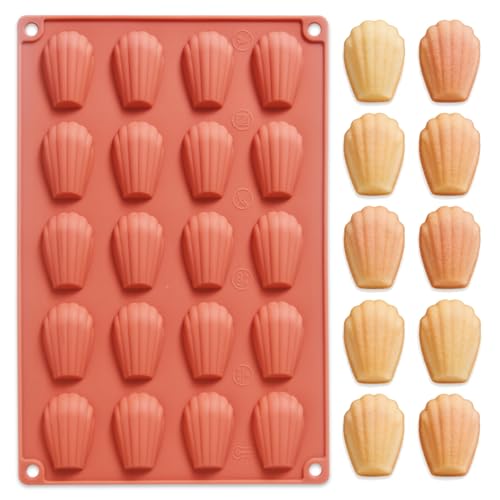
Fchil publishes a flexible silicone mold with 20 cavities, the most on this page, at 11.8 by 7.6 by 0.5 inches and a 0.35 lb weight field, which is the lowest here. It publishes heat resistance up to 440°F and the fullest appliance list in these five: oven, air fryer, microwave and dishwasher.
What it does not publish is any reinforcement. At 0.35 lb across a footprint that size it is a sheet, so a baking tray underneath is implied rather than stated. For a kitchen where the oven is the only appliance in use, the air fryer and microwave clearances are worth more than they look, and Fchil is the only pick here that gives them.
Aluminized Steel, or Carbon Steel
Chicago Metallic publishes a 12-cup pan at 15.75 inches by 7.75 inches and describes its metal twice. One bullet states it is made from heavy-weight aluminized steel for superior heat conduction. Another states it is crafted from durable carbon steel and designed for superior heat conduction. Those are different materials and the listing does not choose.
It is also the only pick here to publish a washing instruction, stating that the pan is dishwasher safe but that hand-washing is recommended to extend product life. Its coating is described as silicone based with a non-stick finish. No reinforcement, no gauge, no temperature figure and no weight field appear anywhere.
Which One Fits Your Kitchen
The silicone pan that has to travel full. Vinino. A metal-reinforced frame inside 100% food-grade silicone, published at 14.8 by 10 by 0.5 inches and rated -40°F to 446°F from fridge to oven.
The pan that gets used every week. CHEFMADE. Thickened 0.8mm carbon steel with a reinforced rim stated to prevent warping, a silicone coating free of PTFE and PFOA, and a spherical shell cavity.
The buyer who reads centimeters. ZEENEEK. The same 0.8mm carbon steel with a strengthened edge against warping, a non-Teflon coating, and a published size of 26.5 by 18.5 by 2.2 cm.
The oven that also has to be an air fryer. Fchil. Twenty cavities in flexible silicone at 11.8 by 7.6 by 0.5 inches, heat resistant to 440°F and cleared for oven, air fryer, microwave and dishwasher.
The baker who wants a washing instruction. Chicago Metallic. A 15.75 by 7.75 inch 12-cup pan with a silicone based non-stick coating, dishwasher safe with hand washing recommended, if you can accept two metals named for one pan.
What We Could Not Verify
Everything above is the makers’ own text. These six things I looked for and none of these five publishes.
- Whether Chicago Metallic is aluminized steel or carbon steel, which its own bullets answer both ways.
- Any gauge or thickness for Vinino, Fchil or Chicago Metallic.
- Any temperature figure for CHEFMADE, ZEENEEK or Chicago Metallic.
- Any size in words for CHEFMADE.
- Whether Fchil needs a baking tray underneath, on a 0.35 lb sheet of silicone.
- Any washing instruction except Chicago Metallic’s, on four pans with coatings or silicone surfaces.