How the Five Compare on the Numbers
Every daily job on a sourdough culture happens through the mouth of the jar: discard, feed, stir, scrape down the sides, wash. Four of the sixteen listings on this fact sheet publish a figure for that opening. Howasai publishes 5 inches, Brod & Taylor 4 inches, Adodeen 4 inches, and ComSaf 3.3 inches, which it calls extra-wide.
The fifth pick publishes no opening figure at all and earns its place another way. Rakovar puts holders on its date band that hold a silicone spatula and a spoon, so the tool lives on the jar rather than in a drawer. That is the only listing in the pool that answers where the spatula goes between feeds.
What the table cannot tell you is how much of the opening figure is glass and how much is thread or rim. No listing publishes an internal diameter separately, and none says whether the figure was taken across the lid or across the hole. It also says nothing about the one thing a daily feed really costs, which is the wash, because only two of the five publish a washing instruction of any kind.
The Mouth Is Where the Daily Work Happens
Four Listings Publish a Figure and One Does Not
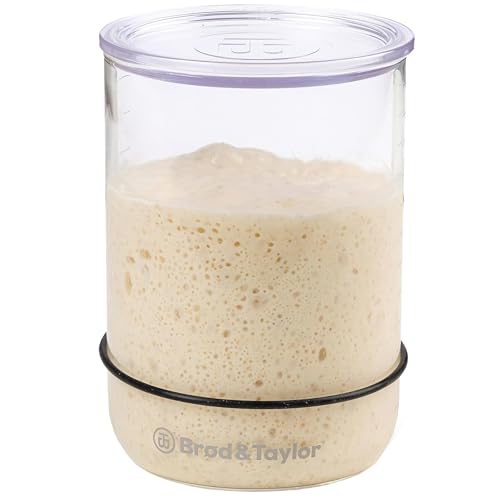
Howasai puts 5 inches in its own bullet heading and ties it directly to the routine, saying the mouth makes feeding, stirring, scraping and cleaning easier than a traditional narrow-mouth jar. Brod & Taylor publishes 4 inches and frames it differently: the opening fits your hand, which is a claim about scrubbing rather than stirring.
Adodeen publishes a 4 inch opening and ties it to feeding, stirring and thorough handwashing. ComSaf publishes 3.3 inches and calls that extra-wide, which is a fair description of a 34 oz jar and a smaller figure than either of the others. Rakovar describes a spacious opening and attaches no number to it anywhere.
What Each Maker Says the Opening Is For
The phrasing matters because it tells you which step the maker had in mind. Two listings name scraping, which is the job that actually needs room: getting the last of a discard off the wall of the jar with a spatula. ComSaf names spatula stirring specifically, which is the only listing to assume a tool rather than a hand.
Brod & Taylor is the outlier and the most concrete. Its opening is sized for a hand, and the same bullet pairs that with no grooves or ridges and a curved bottom so there are no hard-to-reach areas. For a jar washed by hand every few days, a shape argument beats a diameter on its own.
The Steps Nobody Else Removes
One Listing Sells Two Jars as a Rotation
ComSaf publishes something no other listing in this pool does: a two-jar feeding system. Its bullet describes rotating between two 34 oz jars as you discard, feed, swap and wash, so one jar can stay clean and ready while the other is in use. That removes the wait between washing a jar and needing it again.
Three of the five picks ship two jars, but only ComSaf publishes a reason for the second one. Adodeen and Rakovar both supply a pair and describe them as capacity or as a gift. The rotation argument is the difference between two jars and one jar bought twice, and it is stated in one listing out of sixteen.
One Listing Gives the Spatula a Home
Rakovar puts holders on the date tracking band that hold a silicone spatula and a spoon, and says the point is to save space and keep the workspace tidy. Four listings in this pool supply a spatula and none of the others says where it goes, which for a tool used once or twice a day is the whole problem with it.
It is a small feature and it is the only one of its kind here. The cost is that Rakovar publishes no opening figure, no body shape claim and no base, so it answers one daily question precisely and leaves the others to the other four. Its own dimension fields read 3.0 by 5.0 by 5.0 inches for a listing that sells two jars.
What Keeps the Jar Still and the Walls Clear
Two Bases and Two Straight-Wall Claims
Stirring a stiff starter moves the jar, and two listings address it. Howasai publishes a non-slip silicone base stated to keep the jar secure on a counter. Adodeen publishes a silicone cover that doubles as an anti-slip base during fermentation, which is one piece doing two jobs and the more interesting design of the two.
Howasai and ComSaf both publish a straight-sided body and both give a cleaning reason: less buildup around the rim in one case, less dough trapped in awkward places in the other. Brod & Taylor makes the opposite kind of claim, no grooves and a curved bottom, which is about scooping rather than about the wall.
Where the Markings Are and What They Measure
Three of the five publish markings and each measures something different. Brod & Taylor publishes measurement markings in both inches and centimeters plus a black silicone ring to mark the current height. Howasai publishes clear measurement marks and an adjustable feeding band. Rakovar publishes markings it says track the weight of the starter.
Adodeen and ComSaf publish none, which is a real gap on a jar sold for daily feeding: without a mark on the glass, a doubling has to be judged by eye. ComSaf compensates with a thermometer sticker and a feeding band in the box, and Adodeen with date-marked bands and a thermometer.
Which One Fits Your Kitchen
The baker who scrapes the walls down every feed. Howasai publishes a 5 inch mouth, straight sides with less buildup at the rim, and a non-slip silicone base, on a 50 oz jar with a bamboo storage lid and two cotton covers for active fermentation.
The baker who washes the jar by hand. Brod & Taylor publishes a 4 inch opening sized to fit a hand, no grooves or ridges, a curved bottom, and markings in inches and centimeters, on a 32 oz jar with a loose-fitting lid at 0.7 lb.
The baker who wants a jar always ready. ComSaf publishes a 3.3 inch mouth, a straight body, 304 stainless steel lids and a rotation system across two 34 oz jars so one stays washed while the other works.
The baker who keeps losing the spatula. Rakovar is the only listing in this pool with holders on the band for a silicone spatula and a spoon, on two 50 oz jars with wooden lids and markings for tracking weight.
The baker whose jar slides while stirring. Adodeen publishes a 4 inch opening and a silicone cover that doubles as an anti-slip base, across two 34 oz borosilicate jars with date-marked bands and a thermometer. Its published weight cannot be right.
What We Could Not Verify
Everything above is the makers’ own published text, and on the daily routine it leaves the measurements half finished.
- No listing publishes an internal mouth diameter separately, or says whether the figure spans the lid or the hole.
- Rakovar publishes no opening figure at all, only the word spacious.
- Adodeen and ComSaf publish no measurement markings on the glass, so a doubling has to be judged by eye.
- Only one listing in the pool publishes a reason for shipping two jars rather than one.
- Adodeen publishes a weight that cannot describe two glass jars and a kit of accessories.
- No listing publishes how long a wash takes, how much discard sticks, or any figure behind the shape claims.