How the Five Compare on the Numbers
Ice trays live in a stack, and in a cabinet or a freezer drawer with little to spare the figure that matters is the thickness of one tray. Every listing in this pool is a multipack, which means almost every published dimension set describes a carton rather than a tray. Thirteen listings sit here and only two of them state a per tray figure at all.
Azxb states 7.3 by 5.1 by 1.2 in for each of its two trays and DOQAUS states 7.2 by 4.1 by 1.3 in for each of its four. The other three publish package figures of 1.18 in for four trays, 1.45 in for three and 3.2 in for five, and the first of those is smaller than a single Azxb tray, which tells you those cartons are not simple stacks.
What the table cannot tell you is what a lid adds. All five ship lids and not one publishes a figure for one. A stack of five trays with five lids between them is taller than five tray thicknesses, and the only listing that hints at the geometry is DOQAUS, which says its covers have lift tabs and are deliberately not airtight so air can move.
Only Two Listings Measure a Tray
1.2 In and 1.3 In, Stated in Words
Azxb puts 7.3 by 5.1 by 1.2 inch in its size field and repeats it in a bullet, alongside a cube stated at 1.5 by 1.2 by 0.7 in. DOQAUS puts 7.2 by 4.1 by 1.3 inch in its size field. Those are the only two per tray figures in these five listings, and they agree closely enough to suggest an industry norm of a little over an inch.
That is the figure to plan a cabinet around. Two Azxb trays at 1.2 in each is under two and a half inches before lids; five Weftnom trays would be over six on the same arithmetic, and the Weftnom listing publishes 3.2 in for the whole carton, which means the trays cannot be stacking the way that sum assumes.
Three Cartons and One That Cannot Be a Stack
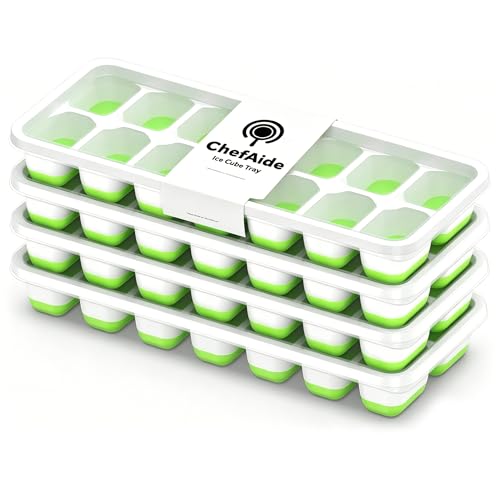
ChefAide publishes 3.94 x 9.84 x 1.18 in for four trays. One Azxb tray is 1.2 in thick, so 1.18 in cannot be four trays on top of each other. Either the ChefAide trays nest into one another, or the figure describes one tray, and the listing says neither.
Vethwal publishes 4.6 x 7.4 x 1.45 in for three trays and has the same problem in milder form. Weftnom publishes 4.2 x 9.9 x 3.2 in for five, which at least could be a stack of five slim trays if each is under two thirds of an inch. All three figures are reported here as package figures, which is what the listings file them as.
Where a Figure Cannot Be Believed
Twelve Pounds of Silicone Trays
DOQAUS publishes 12.3 lb for four silicone ice trays with lids. ChefAide publishes 0.75 lb for four, Vethwal 0.8 lb for three and Weftnom 0.64 lb for five. Four trays cannot weigh fifteen times what five of the same kind weigh, so the DOQAUS weight is not a measurement of this product.
This page quotes it once, in the table, labeled as what it is, and builds nothing on it. The DOQAUS listing is otherwise one of the better documented here: it states a per tray size, an LFGB certification, a dishwasher instruction naming the top rack, and an unusually honest note that its lids are spill resistant rather than airtight.
One Temperature Range in Five Listings
Azxb states that its trays withstand temperatures from 40 degrees below zero to 428 degrees Fahrenheit and are therefore safe for freezing and microwaving. No other listing in these five publishes a temperature figure of any kind. Vethwal states dishwasher and microwave use without a number, and the other three say nothing.
For a tray that goes from a freezer to a dishwasher and sometimes a microwave, that is the specification most worth having and the one four of five makers withhold. It is also the only figure on this page that would tell you whether a tray can take hot stock as well as water, which is what half of these listings suggest using them for.
What a Minimal Cabinet Is Actually Buying
How Many Trays, and How Many Cubes
Azxb ships two trays making 30 cubes. Vethwal ships three trays at 15 cubes each. ChefAide ships four at 14 cubes, stating 56 in total. Weftnom ships five at 14 cubes, stating 70. DOQAUS ships four and never says how many cubes each holds.
In a cabinet counted by objects the Azxb two pack is the smallest commitment and the Weftnom five pack the largest, and the cube arithmetic runs the other way. A household that fills one tray a day is better served by five slim trays than by two thick ones, which is the trade this page cannot resolve for you.
Construction, and the Part That Is Not Silicone
Three of the five state that they are not wholly silicone. ChefAide states a rigid plastic upper half to hold shape with a flexible silicone bottom, and explains that this is unlike fully silicone molds. Weftnom states a soft silicone bottom with a sturdy PP frame. DOQAUS states silicone and PP.
Azxb and Vethwal both describe flexible food grade silicone with no rigid frame mentioned, which releases cubes by twisting or pushing from underneath. A rigid frame is the difference between a tray you can carry full and one that folds when you lift it, and only three of these five makers say which one you are getting.
Which One Fits Your Kitchen
A carton figure that beats a single tray. ChefAide publishes 3.94 x 9.84 x 1.18 in for four trays and 0.75 lb, with 14 cubes per tray and 56 in total, removable lids and a rigid plastic top over a silicone base. It publishes no per tray figure and no washing instruction.
The only stated temperature range. Azxb states 7.3 x 5.1 x 1.2 in per tray, a cube at 1.5 x 1.2 x 0.7 in and a range from 40 degrees below zero to 428 degrees Fahrenheit, with two trays making 30 cubes. It publishes no weight at all.
Honest about its own lids. DOQAUS states 7.2 x 4.1 x 1.3 in per tray, an LFGB certification and a dishwasher top rack instruction, and says outright that its covers are spill resistant rather than airtight. Ignore its 12.3 lb weight field.
Lids you can hang up. Vethwal publishes 4.6 x 7.4 x 1.45 in for three trays and 0.8 lb, states cubes at 1.2 x 1.2 x 1.2 inches, and is the only pick whose lids have small holes for hanging. It publishes no per tray figure.
Most ice per batch. Weftnom publishes 4.2 x 9.9 x 3.2 in for five trays and 0.64 lb, the lightest published weight here, with 14 cubes per tray and 70 in total, snap on lids and a silicone bottom in a PP frame.
What We Could Not Verify
These are the things I went looking for in the five listings and did not find.
- Three of the five publish no per tray thickness at all, only a package figure.
- ChefAide publishes a 1.18 in package figure for four trays, which is less than one tray measured by another maker here.
- DOQAUS publishes 12.3 lb for four silicone trays where another listing publishes 0.64 lb for five.
- Not one of the five publishes a figure for a lid, so what a stack of lids adds is unknown.
- Only Azxb publishes a temperature range, and only Azxb and Vethwal state a cube size.
- No listing says whether its trays nest into one another rather than stacking on one another.