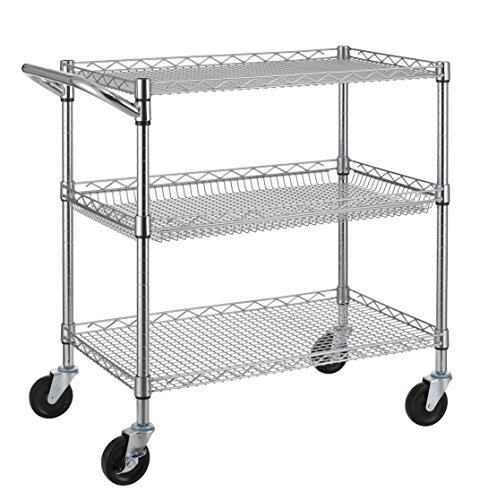
How the Five Compare on the Numbers
A cart that holds the week’s lunches carries jars, boxes, bottles and a chopping board, and the figure that decides whether it copes is the published load. Every listing in this pool states one. The trouble is that no two of them state the same kind of number, and the biggest figure on the page is a test result rather than a rating.
Finnhomy publishes a 1320 pound static load bearing test held for 24 hours with wheels, then begins a sentence about its recommended maximum which the listing cuts off mid-word. VEVOR publishes up to 661 pounds. uyoyous publishes 500 pounds. Nisorpa publishes up to 420 pounds. Goovilla publishes 124 pounds and is the only one of the five that breaks the total into layers.
What the table cannot show is whether any of these numbers is comparable to the others. A static test held for 24 hours is not a working load. Up to 661 pounds is a ceiling with no method behind it. 124 pounds broken into 24 and two 50s is the only figure here a reader can check by addition, and it adds up.
Four Kinds of Load Figure
A Test Result Is Not a Rating
Finnhomy’s number is the outlier and the listing is unusually open about why. Each shelf is made of 69 pieces of thickened wire on 1 inch diameter poles, and the cart has passed a 1320 pound static load bearing test for 24 hours with wheels. A static test is a cart standing still. The sentence that would give the working figure is cut off in the listing itself.
VEVOR, uyoyous and Nisorpa all publish a single ceiling and no method. VEVOR states it can carry up to 661 pounds, or 300 kg, of heavy objects. uyoyous states it maintains a 500 pound load capacity. Nisorpa states the dining cart can load up to 420 pounds on stainless steel of 0.8 mm thickness. None of the three says whether that is the cart total or one tier.
The Only Load You Can Plan With
Goovilla publishes the smallest figure of the five and the most useful one. The cart holds up to 124 pounds for daily use, the top layer holds 24 pounds and the other layers hold 50 pounds each, and the listing adds that loading close to the limit is not recommended. That is a number a reader can put a crate of tins against.
Two listings outside the five publish per-basket figures and no total. LOFTEY publishes 15 pounds per basket across four mesh baskets 2.4 inches deep. C·Kalosa publishes a tested capacity of up to 20 pounds per wire basket and up to 50 pounds for the top shelf. Best Choice publishes both, 25 pounds per basket and 75 pounds total, and the two agree.
The Cart Under the Load
Wheels Are Where the Load Ends Up
A load rating means nothing without the four points it stands on, and every listing here publishes those. Finnhomy publishes four 4 inch industrial wheels with two braked. VEVOR publishes four 4 inch silent casters with an upgraded rear brake. uyoyous publishes four silent casters, two swivel and two braked. Nisorpa publishes four rubber mute wheels on the same split.
Goovilla is the exception in both directions. Its four wheels swivel 360 degrees and two lock, and it publishes what they are made of: thick metal with durable plastic and smooth edges. It also publishes no wheel diameter, which Finnhomy and VEVOR both give as 4 inches. On a 124 pound cart that matters less, which is probably why it is missing.
Same Three Numbers, Different Order
On three of these five the dimension fields contain the same figures as the maker’s own sentence and put them in a different order. Finnhomy writes 30 by 18 by 32.4 inches and its fields read 32.4 by 18 by 30. uyoyous writes 37 by 20 by 37 and its fields read 20 by 37 by 37. Nisorpa writes 37.4 by 19.68 by 37.4 and its fields read 37.4 by 37.4 by 19.69.
VEVOR is the one where the numbers actually differ. Its size field reads 18 inches deep by 30 wide by 32.4 high, and its dimension fields read 34 by 18 by 35 inches. Goovilla publishes no sentence at all and fields of 14.9 by 30.59 by 10.6 inches, where a 30.59 inch middle figure on a three tier cart is almost certainly the height in the wrong slot.
What the Load Is Actually For
Steel for Crates, Plastic for Snacks
The five split cleanly by material and by what the listing imagines on the shelves. Finnhomy publishes chrome anti-rust shelves and names fresh vegetables, fish and meat. VEVOR publishes industrial-strength steel and names large kitchen appliances and heavy machinery. uyoyous publishes thick stainless steel and names restaurants, laboratories and hotels.
Goovilla publishes durable plastic throughout and names snacks, diapers, makeup and a bedside table. It is the only one of the five that publishes accessories for small items, two cups and four hooks and a removable drawer on the top level. For a lunch routine that is jars and boxes rather than stockpots, that list is the honest match.
The Cart’s Own Weight Is Part of the Answer
Four of the five publish what the cart itself weighs. uyoyous publishes 33.5 pounds, the heaviest of these five. Its rating is 500 pounds. Nisorpa publishes 28.0 pounds against a 420 pound rating. Finnhomy publishes 26.5 pounds while claiming a 1320 pound static test. VEVOR publishes 21.0 pounds against 661. Goovilla publishes no weight at all.
That last pairing is the one to read carefully. A cart weighing 26.5 pounds of steel wire and claiming a 1320 pound static test is describing a laboratory result, not a working shelf in a kitchen. The figures on this page are quoted as the makers published them and are not treated as equivalent, because they plainly are not.
Which One Fits Your Kitchen
You load crates, not lunchboxes. Finnhomy publishes 69 wires per shelf on 1 inch poles, a 1320 pound static load test for 24 hours with wheels, four 4 inch wheels with two braked, and no tools needed to assemble it.
You move appliances around the kitchen. VEVOR publishes up to 661 pounds, or 300 kg, shelves adjustable at 1 inch intervals, four 4 inch silent casters with an upgraded rear brake, six hooks and a curved handle.
You want a cart you can wipe down hard. uyoyous publishes thick stainless steel with a 500 pound capacity, 11 inches of clearance between tiers, a groove on each shelf against sliding, and assembly in about 10 minutes.
You want the same steel in a narrower frame. Nisorpa publishes 0.8 mm stainless steel, a load of up to 420 pounds, four rubber mute wheels with two brakes, and a circumferential edge to stop cargo sliding off.
Your lunch prep is jars and snack boxes. Goovilla publishes 124 pounds total, 24 on the top layer and 50 on each of the others, a removable drawer, two cups, four hooks, and layers that can be recombined.
What We Could Not Verify
Every figure above is a manufacturer’s own published number or sentence. These are the things we went looking for across all sixteen listings and did not find.
- A working load for Finnhomy, whose recommended maximum sentence is cut off in the listing itself.
- A per layer figure for Finnhomy, VEVOR, uyoyous or Nisorpa. All four publish one number for the whole cart.
- A weight for the Goovilla cart, the only one of the five that publishes none.
- Any statement of how a 1320 pound static test relates to a rolling load, from Finnhomy or anyone else here.
- A wheel diameter from uyoyous, Nisorpa or Goovilla, though all three count and describe their casters.
- Which of the three dimension fields is the height on any of these carts, since three of the five reorder the maker’s own figures.