How the Five Compare on the Numbers
Every listing in this category says the dough will not stick. Only some of them say why, and the five answers here are genuinely different things: an applied coating with a name, an argument about the material, a polished surface and nothing else, an oil put on at the factory, and an oil the maker expects you to keep reapplying. The last of those is the only one that is also a chore.
The figures are less consistent than the claims. Three of the five state a length in words, at 12 in, 17 in and 17 in, and only two of those three agree with their own dimension fields. The published weights run 0.22 lb for an 8 in pin up to 1.5 lb for a steel one, and only one listing on the page publishes a thickness figure for the dough.
What the table cannot tell you is how long any of these surfaces stays the way it arrives. A coating wears, polish dulls, an oil finish is consumed, and not one of these five publishes a figure or a period for any of that. The only listing that treats the surface as something with an ongoing cost is TUSIWIT, and even it says occasionally rather than naming an interval.
What Each Maker Says Makes It Non-stick
One coating with a name, one argument about steel
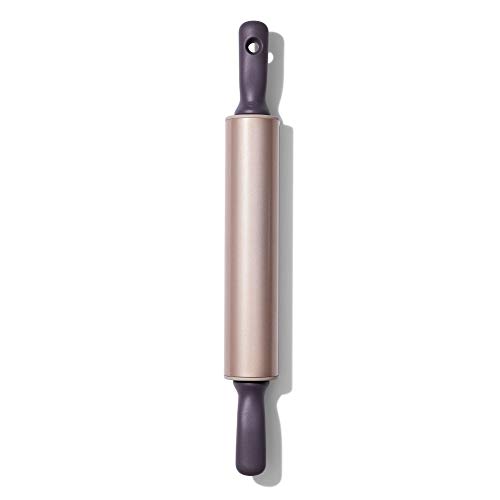
OXO is the only listing here that names what is on the surface. Its first bullet reads steel rolling pin with non-stick ILAG coating for effortless food release, which is a specific product rather than a property, and it is the only non-stick claim on this page a reader could look up independently. The same listing adds that the metal pin can be chilled to keep dough from softening.
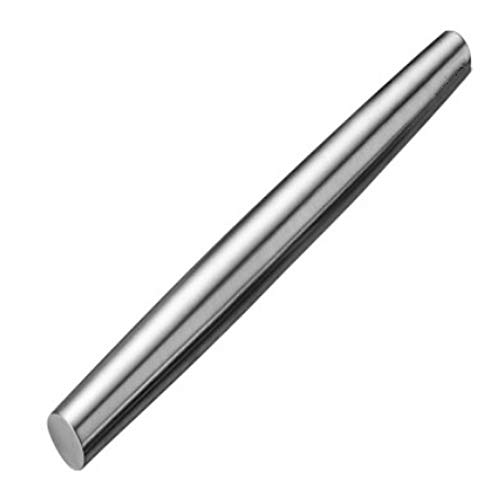
Fulimax takes the opposite approach and argues from material. It states food-grade 304 stainless steel, calls the pin nonstick and dishwasher safe in the same breath, and then makes the case against the alternative: wooden rolling pins for baking can splinter, stick to dough, and absorb odors. Nothing is applied to that surface, and nothing needs to be.
Polish alone, a factory oil, and an oil you reapply
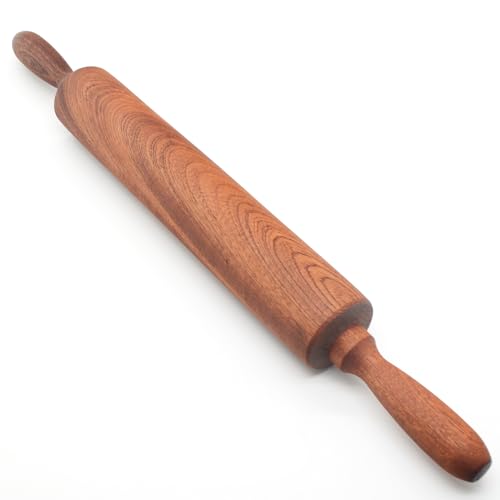
Amazon Basics heads a bullet non-stick surface and then supplies only the mechanism: a smooth, polished surface prevents dough from sticking. That is the thinnest of the five answers, and it sits beside the strictest care line of the three wooden picks, which asks for a hand wash and an immediate towel dry and rules out soaking or a dishwasher.
LorisArm is the only pick that puts a finish on wood at the factory: its bullet says the pin is finely burnished and with oil coating, so it has very smooth surface, and that the smooth surface makes it non stick. TUSIWIT instead credits the wood, saying the naturally smooth Sapele surface uses minimal flour dusting, and then asks you to treat it occasionally with food-grade mineral oil.
What the Non-stick Answer Costs in Upkeep
Two wooden pins that rule out a dishwasher in writing
Amazon Basics and LorisArm both say no, and both say it plainly. Amazon Basics asks for a hand wash with an immediate towel dry and says not to soak the pin or put it in a dishwasher, in order to maintain the wood’s natural beauty. LorisArm says cleaning is a wipe with a damp or wet rag, or a quick thorough rinse, and then rules out both a dishwasher and soaking.
TUSIWIT publishes no dishwasher statement either way. What it publishes is a routine: wipe clean with a damp cloth after each use, and treat occasionally with food-grade mineral oil to preserve the grain, resist drying and keep the rolling surface smooth. That is the only maintenance task any of these five asks for, and it is the price of the non-stick answer it gives.
The two steel pins ask for nothing and publish different amounts
Fulimax states dishwasher safe outright and ties it to the steel. It is also the only pick publishing a thickness figure for the dough, with four removable rings at 1/16, 1/8, 1/4 and 3/8 inch, which the listing also gives in millimeters. That is a figure about the result rather than the surface, and no other listing on this page states one.
OXO publishes no washing instruction at all, in either direction. Its five remaining bullets are about the handles, the chilling, the length and the weight of the pin, and the ILAG coating is mentioned once and never qualified. For a coated surface that is a gap worth noticing, because a coating is the one finish here that a dishwasher could plausibly shorten.
Where the Published Figures Disagree
A length in a bullet against a length in a field
OXO publishes two lengths that cannot both be right. Its fifth bullet states the length as 12 in, with a metric figure beside it the listing misspells, and its dimension fields read 2.5 by 20.5 by 0.1 in. A reader measuring a shelf gets 12 in from the maker’s sentence and 20.5 in from the data, and nothing in either place reconciles them or flags the gap.
This page uses the maker’s own sentence of 12 in, which is the rule here when a field and a sentence disagree, and reports the 20.5 in figure as what the data holds. The practical consequence is that the length of the OXO pin is not settled by its listing, which matters more on a shelf than on a counter.
A width that includes the handles and a field with no sentence
TUSIWIT states 17 in long by 1.77 in wide in its title and its size attribute, and carries dimension fields of 2.3 by 17.3 in. Those are not contradictory so much as measuring different things: 1.77 in reads as the barrel and 2.3 in reads as the handles rather than the barrel. The listing never says which, so the barrel figure is the maker’s word and the field is not.
LorisArm states no size at all. Its fields read 4.02 by 8 by 0.1 in on a pin it calls small with a T-shape handle, so the 4.02 in is almost certainly the handle across rather than the barrel. At 0.22 lb it is the lightest of these five by a wide margin, which is the figure that actually tells you it is a small tool.
Which One Fits Your Kitchen
The baker who wants the coating named. OXO is the only pick that says what is on the surface, a non-stick ILAG coating on steel, with raised offset handles and a pin that can be chilled. It publishes 12 in in a bullet, 2.5 by 20.5 by 0.1 in in its fields and 1.5 lb.
The baker who wants a set thickness. Fulimax is food-grade 304 stainless steel at 17 in and 1.1 lb, dishwasher safe, with four removable rings at 1/16, 1/8, 1/4 and 3/8 inch. Its non-stick claim rests on the steel, so there is nothing on the surface to wear off.
The baker who wants a tapered wooden pin. Amazon Basics is FSC certified acacia at 17 in and 0.66 lb, with a polished surface as its whole non-stick answer. It asks for a hand wash and an immediate towel dry and rules out soaking and the dishwasher.
The baker rolling small batches by hand. LorisArm is beech with a T-shape handle, burnished and oil coated at the factory, published at 4.02 by 8 by 0.1 in and 0.22 lb. Cleaning is a damp rag or a quick rinse, with no dishwasher and no soaking.
The baker who does not mind maintaining a surface. TUSIWIT is Sapele with two handles, stated at 17 in long by 1.77 in wide and 0.64 lb, and the only pick admitting you will still dust with flour. It asks for occasional food-grade mineral oil to keep the surface smooth.
What We Could Not Verify
Everything above comes from the makers’ own listings. These are the things those listings do not answer.
- How long any of these surfaces lasts. No coating life, no polish life and no reoiling interval is published by any of the five.
- Which OXO length is right: its own bullet states 12 in and its dimension fields read 20.5 in.
- Whether a dishwasher would shorten the OXO coating. That listing publishes no washing instruction in either direction.
- Whether the TUSIWIT 1.77 in is the barrel and the 2.3 in field the handles. The listing states neither.
- Any length for the LorisArm pin in the maker’s own words. Its 4.02 by 8 by 0.1 in comes from the data alone.
- How much flour four of these five still need. Only TUSIWIT mentions dusting at all, and it does so without a quantity.