How the Five Compare on the Numbers
A starter lives under two different covers. During a feed it wants air, and in the fridge it wants a lid that keeps the surface from drying and the smell from reaching the milk. This page ranks by the second one: what the storage lid is actually made of and whether the maker says it seals. On that question these five give five different answers, and one of them says plainly that its lid does not seal at all.
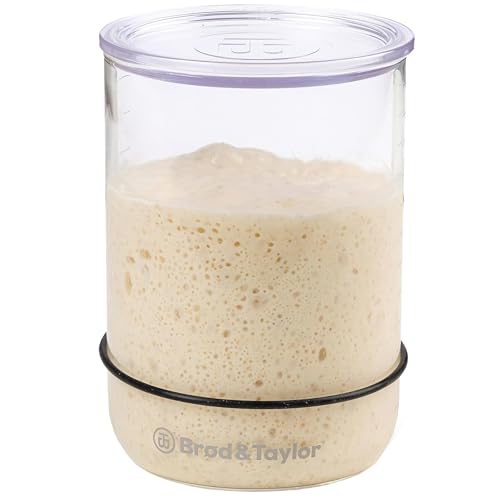
Ritayedet publishes a lid with a removable silicone seal you detach for breathable fermentation and attach for airtight storage, which is the only convertible lid here. Freshmage publishes a glass lid with a gasket and clamps. ComSaf publishes 304 stainless steel. Howasai publishes bamboo. Brod and Taylor publishes a plastic lid stated to be loose fitting on purpose, to prevent pressure building up.
What the table cannot tell you is which of these two philosophies is right for your fridge. Ritayedet and Freshmage both sell a seal and Brod and Taylor argues against one, and all three are describing the same jar in the same appliance. No listing here publishes a figure for pressure, for moisture loss or for how long a starter keeps under either arrangement, so the choice is between stated intentions.
The Lid That Does Both Jobs
One Seal, Removed or Attached
Ritayedet is the only pick on this page whose single lid covers both halves of a starter’s week. Its baker’s bullet states a removable silicone seal: detach it for breathable fermentation, attach it for airtight storage. The same listing calls the closed configuration a powerful barrier against moisture, odors and water, which is the specific thing a fridge asks of a starter lid.
It is also the biggest jar here by a long way, publishing 1 gallon a jar, stated as 3.8 L, and 9.57 lb for the two. The listing publishes straight walls, dual measurement scales in ounces and milliliters, an ergonomic lid with a smooth grip round handle, and every part dishwasher safe. It states the jar fits an entire 5 lb bag of flour or sugar, which is what that figure describes.
What Else This Listing Is Selling
It is worth saying what Ritayedet actually is, because the title reads cookie jars before it reads sourdough starter jar. Four of its five bullets are about pantry storage: bulk rice, beans, pasta, cereal, snacks, coffee, tea, nuts, spices, a laundry room canister, a pet treat container and a terrarium gift. Only the third bullet is written for a baker.
That does not make the seal claim less true, and the removable silicone seal is the most useful lid design on this page. It does mean the rest of the listing is not describing starter care, so figures such as the wide opening and the round handle are published for scooping flour rather than for feeding a culture. Nothing here publishes a mouth figure at all.
A Seal With Hardware, and a Lid in Steel
Glass, a Gasket, Clamps and Spares
Freshmage publishes the most mechanical seal here and the only spare parts on this page. Its first bullet names the classic canning system, a glass lid with a gasket and clamps, and calls it a leak proof closure for keeping contents fresh long term. Its last bullet goes further than any other listing in this pool: four metal clamps a jar, two for use and two spare.
It is also the only pick that ships two different lids a jar, a glass sealing lid for long term preservation and a plastic lid for daily use, which is a different answer to the same problem Ritayedet solves with one removable seal. At 12 oz a jar, stated as 350 ML, it is the smallest capacity here, and it publishes no weight at all.
A Metal Lid and the Rust Question
ComSaf is the only pick with a metal storage lid, publishing 304 stainless steel, and it is also the only one that explains why: the metal lids help avoid rusty lid worries in fridge storage. That is an argument against the mason jar bands a lot of bakers use, and the listing pairs it with an instruction, to wipe the lids dry after washing to keep the finish clean.
What it does not do is claim a seal. There is no airtight word anywhere in the listing, and the breathing half of the week is handled by a separate breathable cloth cover in the accessory set rather than by the lid. It publishes two 34 oz jars, stated as 1 L, a 3.3 in mouth opening, soda lime glass, and 2.55 lb for the pair.
Bamboo, and a Lid That Refuses to Seal
The Only Wooden Lid Here
Howasai is the one pick whose storage lid is wood. Its accessory bullet lists two breathable cotton covers for active fermentation, a bamboo lid for storage, a feeding band and a silicone base, so the division of labour is explicit: cloth while it works, bamboo while it rests. That is the clearest statement of the two cover routine among these five.
The lid itself is described in two words and nothing more. There is no seal claim, no gasket, no washing instruction for the bamboo and no statement about what wood does in a fridge, which is the question a reader would ask. The jar around it is well documented: 50 oz, a 5 in wide mouth, high borosilicate glass, a non slip silicone base and 1.46 lb.
A Lid Designed Not to Close
Brod and Taylor is the honest outlier and the reason this page is worth reading. Its title names a loose fitting lid that prevents pressure buildup, and its fourth bullet explains the intent: the plastic lid prevents pressure building during active fermentation while protecting the starter, and maintains the airflow for a strong bubbly culture. It is a lid that is deliberately not a seal.
Everything else it publishes is unusually specific. The jar is borosilicate glass at 4 by 5 inches and 32 oz, with a 4 in opening stated to fit your hand for scrubbing, a curved bottom with no grooves, straight vertical sides, a capacity of up to 300 g of fully active starter, measurement markings, a black silicone level marker, and jar and lid both 100 percent dishwasher safe at 0.7 lb.
Which One Fits Your Kitchen
You want one lid that feeds and stores. Ritayedet publishes a removable silicone seal, detached for breathable fermentation and attached for airtight storage, on 1 gallon jars at 9.57 lb for two. Read the listing knowing it is sold mainly as a pantry canister.
You want hardware and a spare. Freshmage publishes a glass lid with a gasket and clamps for a stated leak proof seal, a second plastic lid for daily use, and four metal clamps a jar with two of them spare. It is 12 oz a jar and publishes no weight.
Your lid lives in a damp fridge. ComSaf publishes 304 stainless steel lids stated to avoid rusty lid worries in fridge storage, with an instruction to wipe them dry, two 34 oz jars with a 3.3 in mouth at 2.55 lb. It makes no seal claim.
You keep cloth on for feeding and want something solid for the fridge. Howasai publishes two breathable cotton covers plus a bamboo lid for storage, on a 50 oz jar with a 5 in mouth and a non slip base at 1.46 lb. The bamboo lid is described in two words.
You would rather your starter never be sealed. Brod and Taylor publishes a plastic lid stated loose fitting to prevent pressure buildup and maintain airflow, on a 4 by 5 inch 32 oz borosilicate jar holding up to 300 g of starter, jar and lid both dishwasher safe at 0.7 lb.
What We Could Not Verify
Six things a reader buying for the lid would want, and no listing among these five supplies.
- How long a starter keeps under a sealed lid against a loose one, which no listing addresses.
- Whether the Howasai bamboo lid may be washed, since the listing gives no instruction for it.
- Whether the ComSaf 304 lids are airtight, since the listing claims rust resistance and not a seal.
- Whether a replacement gasket can be bought for the Freshmage glass lid, where the clamps have spares.
- Any mouth figure from Ritayedet or Freshmage, where the other three publish 3.3, 5 and 4 inches.
- Any weight figure from Freshmage, where the other four publish one.