How the Five Compare on the Numbers
A holiday batch is bounded by the vessel, so capacity is the question. The complication on this pool is that capacity is published five different ways. One listing states a weight of chocolate. Two state quarts. One states ounces. One states liters. Only the two quart figures can be read against each other without arithmetic that none of the listings supplies.
That is not a presentation quibble. Chocolate is bought by the pound and a quart figure does not say whether a two pound bag fits with room to stir, because it depends how the chocolate is broken. One pick skips the problem entirely and the other four leave it to the reader. The second complication is that the largest number here is the one its own listing argues with twice.
What the table cannot tell you is the working capacity as opposed to the brim capacity. Tempering needs headroom, because chocolate is stirred and seeded rather than sat still, and a bowl filled to its published figure will go over the side on the first pass with a spatula. None of these five publishes a working level, and only ChocoVision’s figure is likely to mean the charge it will actually handle, since a machine that overflows is a machine that fails.
The One Listing That Measures in Chocolate
Pounds Held and Pounds Per Day
ChocoVision publishes two figures no other pick here comes close to. It is stated to melt, temper, set and hold up to 1.5 lbs of chocolate, and separately to allow a daily output of 10 lbs. The first is the batch and the second is the session, and for a holiday weekend the second is the one that decides whether the plan is realistic.
It holds that chocolate to two tenths of a degree Fahrenheit in the maker’s own wording, using a fully automatic microprocessor and forced hot air, with an LED temperature display. The bowl and the baffle are both stated to be removable. Against the other four picks, which publish a volume and nothing about heat, this is the only listing on the page that treats temperature as a specification at all.
A Weight Flag Worth Overruling
The fact sheet flagged the 10.0 lb weight field on this listing as high against a pool whose median is a bowl. That flag is correct about the pool and wrong about the product. A tabletop machine published at 10.5 by 12.5 by 5.25 inches, with a motor, a heater and a microprocessor in it, should weigh roughly ten pounds, so the figure was kept and the flag was recorded rather than acted on.
That is the opposite of what the same flag means elsewhere. On a bowl, a weight that sits far off the pool median usually means grams have been typed into a pound field. On the one appliance in a pool of bowls it means the appliance is an appliance. Reading the flag rather than obeying it is the difference between a page that keeps its best pick and one that drops it.
Volume, and How Checkable It Is
A Capacity With a Diameter Attached
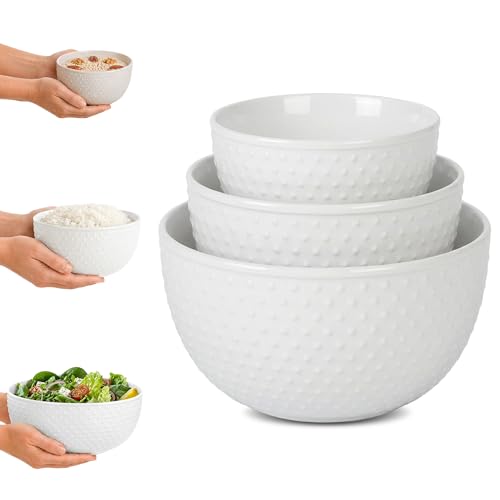
Gibson is the easiest listing here to verify, because it never gives a capacity without saying which bowl it belongs to: 46oz for the 6.75 inch bowl, 74oz for the 8 inch, 147oz for the 9.75 inch. Its dimension fields read 9.6 by 9.6 by 5.25 inches, which matches its 9.75 inch bowl to within a rounding, and its 7.84 lb weight field is what three stoneware bowls of those sizes should weigh.
It is also the only pick on this page named microwave safe, which for candy making means the chocolate can be melted in the bowl it will be dipped from. What it does not publish is a temperature figure of any kind, which is the one specification a microwave claim really wants, and it publishes no lid, so a finished batch has nothing stated to cover it.
The Ladder and the Single Bowl
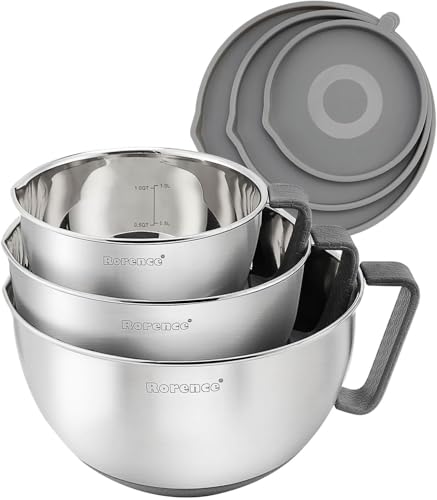
Rorence publishes a usable ladder, 1.5 QT, 3 QT and 5 QT, and pairs it with the features a dipping session needs rather than a mixing session: a pour spout, a silicone handle, measurement marks inside each bowl and an airtight lid for all three. Its carton, published at 11.0 by 11.0 by 5.5 inches, is consistent with a 5 QT bowl, which on this page is not something to take for granted.
KUNANG takes the other approach and sells one bowl, published as 3L, which is the only liter figure here. At 8.66 by 8.66 by 5.2 inches that figure is plausible, and the bowl is stated to be freezer and refrigerator safe as well as dishwasher safe, which is how ganache is set. The weakness is where the figure lives: 3L appears in the title and the size label and in none of the bullets, and no weight is published at all.
When a Listing Contradicts Its Own Capacity
Seven Quarts, One Pound, and an 8.4 Inch Box
Umite Chef publishes the largest quart figure on this page, 7 quarts against the 5 quarts Rorence states. Then its own listing undermines it twice. The weight field reads 1.0 lb, which cannot describe six heavy gauge stainless bowls when one of the six is a 7 quart bowl. The carton is published at 8.4 by 8.4 by 4.9 inches, and a 7 quart bowl is wider than that on its own.
There is a third disagreement in the same listing. The title names six sizes, 7, 3.5, 2.5, 2.0, 1.5 and 1QT. The capacity bullet names five, 1.5, 2.0, 2.5, 3.5 and 7 quarts, and drops the 1QT. A reader cannot tell from the page whether five bowls or six arrive. The set may be perfectly good; what cannot be done is rank it first on a figure its own listing refuses to support.
Why the Rest of This Pool Was Left Out
This pool carries more than chocolate vessels. It holds a folding dough proofer whose slow cook mode is stated at 85 to 195 F and which mentions melting chocolate in passing, a commercial hot drink dispenser published at 5L, a cover for a commercial double boiler, and several small silicone sets whose capacities belong on a small batch page rather than a holiday one.
The proofer and the dispenser were left out because neither is a vessel you temper in: one is a warm cabinet and the other pours finished drinks from a tap. The double boiler cover was left out because a lid has no capacity of its own, and the only capacity in its listing belongs to a pot it fits rather than to anything it holds.
Which One Fits Your Kitchen
A long session where the chocolate must stay workable. ChocoVision. It holds 1.5 lbs at temperature and states a 10 lbs daily output, and it is the only pick that removes retempering from the afternoon rather than just holding chocolate still.
Molding and filling in batches. Rorence, with 1.5 QT, 3 QT and 5 QT, a pour spout, a handle and an airtight lid on every bowl. The carton figure supports the capacity, which not every listing here manages.
Melting in the microwave and dipping from the same bowl. Gibson, at 46oz, 74oz and 147oz with each figure tied to a diameter. Accept that no temperature is published and no lid is included.
You own bowls and need one more. KUNANG, published at 3L with a handle, spouts and a non-slip base, and the only pick stated freezer and refrigerator safe. No weight is published anywhere.
You want six sizes and will measure them yourself. Umite Chef, which claims 7 quarts and six nesting bowls with lids. Read the 1.0 lb weight field and the 8.4 inch carton first, because they do not agree with that claim.
What We Could Not Verify
These are the specifications we went looking for in all five listings and did not find.
- How many pounds of chocolate the four bowls hold. Only the machine publishes capacity in the unit chocolate is sold in.
- Whether the Umite Chef set contains five bowls or six. Its title and its capacity bullet disagree.
- Any working or fill level, as opposed to a brim capacity, on any of the five.
- Any weight for KUNANG, and any restatement of its 3L figure outside the title and size label.
- A temperature figure from Gibson, the only pick claiming the microwave.
- Whether ChocoVision’s 1.5 lbs is a bowl volume or the charge it will temper properly.