How the Five Compare on the Numbers
These five span a stated size from 11.8 by 10.6 inches to 14 by 14 inches. The YGKATING mats state 11.8 inches by 10.6 inches, which the maker writes as a length and a width in that order. The GUCUJI sheets state 12 by 13 inches. The Bright Kitchen sheets state a 12.5 inch diameter with a 3 inch center hole. The Lova sheets state 14 by 14 inches. The Nesco trays are the odd item: they publish fields of 4 by 2.5 by 14 inches and state compatibility with 13 1/2 inch diameter trays.
Weight is published for all five, and every figure covers the whole pack. GUCUJI publishes 0.46 pounds for six sheets. Lova publishes 1.23 pounds for twelve. Bright Kitchen publishes 1.0 pound for four and the Nesco trays 1.0 pound for two. YGKATING publishes 1.3 pounds for four, the heaviest figure here. Not one of the five publishes the weight of a single sheet, so the figure a buyer could use is missing from all of them.
What the table cannot tell you is how any of these behaves in a dehydrator. Nobody at Lush has used them, and no measurement was taken here. It also cannot give you a material thickness, because not one of the five states one in words, and it cannot give a capacity, because no listing on this fact sheet publishes one. The stated size is the figure you can act on.
Counter Space and the Published Footprint
What the stated sizes mean
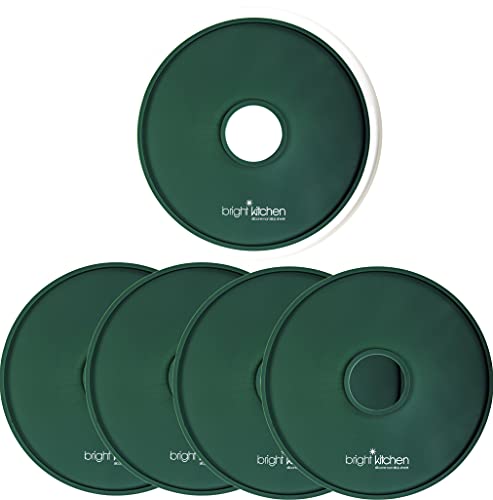
A small batch tray takes up the space its stated size says it does. The YGKATING mats state 11.8 by 10.6 inches, the only pair here under twelve inches on both sides. The GUCUJI sheets state 12 by 13 inches. The Bright Kitchen sheets state a 12.5 inch diameter. The Lova sheets state 14 by 14 inches, which the maker describes as a true fit for most standard round and square trays.
Set the two extremes side by side and the gap is clear. Lova states 14 inches on both sides where YGKATING states 11.8 and 10.6 inches, a difference of 2.2 inches on one side and 3.4 inches on the other. On a crowded counter that is the whole decision, and it is the one comparison on this page that every listing supplies the figures for.
Why the Nesco figures read differently
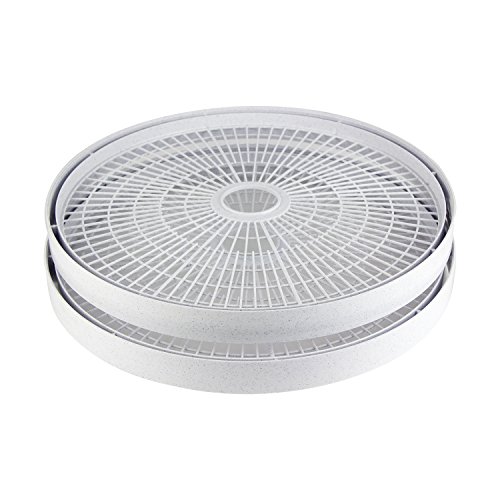
The Nesco trays publish fields of 4 by 2.5 by 14 inches, and nothing in the listing says which figure is which. The maker’s own words give the only usable size: the trays are compatible with 13 1/2 inch diameter trays and fit the Nesco 20 Series and 30 Series. A round tray of that diameter cannot pass a 4 inch figure, so the field set cannot describe the tray as a flat object.
They are also a different kind of thing. These are add-on trays rather than liners, sold as a set of two in food grade plastic and stated to expand a machine you already own. If you have one of the named Nesco series, the published fit is the figure that decides it. If you do not, nothing else in the listing applies to your machine.
Liquid Handling and Edge Design
The two picks with a published edge
Bright Kitchen publishes the only edge measurement here: a 1/4 inch edge or lip, stated to hold liquid batter on the sheet, on a 12.5 inch diameter circle with a 3 inch center hole. Its third dimension field reads 0.25 inches, which is the same quarter inch written as a decimal, so for once the field and the sentence agree.
YGKATING states a raised lip high enough to prevent liquid spill and names fruit leather, eggs, tomato, banana puree and pumpkin as what it is for. It does not put a height on that lip. It also states something the other four do not: the silicone is too soft to stand on its own, so the mat has to sit on a stainless steel tray before the liquid goes in.
The mesh sheets and what they publish
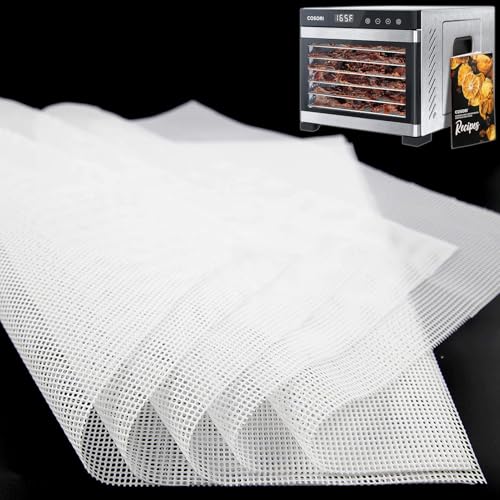
GUCUJI publishes the only mesh figure among these five, holes of about 1 by 1 mm, stated fine enough to keep blueberries and raspberries from falling through while liquids drain. The same listing states -40 to 428 degrees Fahrenheit, repeats it as -40 to 220 degrees Celsius, claims over 5,000 uses, and says the mesh can be cut into any size or shape.
Lova states a tight mesh weave and no hole size, and is unusually direct about the limit: mesh is designed for solid foods, and purees, yogurt or fruit leather need a solid surface liner instead. So on this page the split is clean. Two picks hold liquid and publish an edge or a lip, two are mesh for solid food, and the fifth is a rigid tray.
Machine Fit and Pack Count
Listed model numbers
GUCUJI names the Cosori CP267-FD. YGKATING names the Cosori CP267-FD and the Magic Mill MFD-7070. Bright Kitchen states its sheets fit all round and square Nesco models and warns in capitals that they may not fit other brands and that any other machine should be measured first. The Nesco trays name the 20 Series, the 30 Series and the FD-37.
Lova takes the other route and names no machine at all, stating instead that its sheets are pre cut to 14 by 14 inches, trim cleanly with household scissors, and should be measured against your tray before ordering. GUCUJI offers both: a named model and a sheet that can be cut. For a machine nobody lists, the trimmable sheets are the only two picks that answer the question.
How many racks one purchase lines
Lova ships twelve sheets and argues the case itself: twelve lets you line every rack in one batch instead of reusing a few liners across shelves and pausing to wash mid run. GUCUJI ships six. YGKATING and Bright Kitchen ship four each. The Nesco set is two trays, which adds racks rather than lining them.
For small batch preserving the biggest pack is not automatically the right one. Four sheets stating a 12.5 inch diameter may suit a small machine better than twelve stating 14 by 14 inches, and the published weights follow the same pattern: 0.46 pounds for six GUCUJI sheets against 1.3 pounds for four YGKATING mats, which says more about the material than about the count.
Which One Fits Your Kitchen
You dry fruit leather and wet purees. Bright Kitchen publishes a 12.5 inch diameter with a 3 inch center hole, a 1/4 inch edge to hold batter, fields of 12.5 by 12.5 by 0.25 inches and 1.0 pound for four sheets, and states dishwasher safe.
You have very little counter to give up. YGKATING states 11.8 by 10.6 inches with a raised lip, publishes 1.3 pounds for four mats, states -86 to 446 degrees Fahrenheit, and tells you the mat must sit on a rigid tray before the liquid goes in.
You own a Cosori CP267-FD. GUCUJI and YGKATING both name that model. GUCUJI states 12 by 13 inches for six sheets at 0.46 pounds with 1 by 1 mm mesh holes; YGKATING states 11.8 by 10.6 inches for four mats with a raised lip.
You want to line every rack in one run. Lova states 14 by 14 inches pre cut, twelve sheets at 1.23 pounds, a tight mesh weave for solid food only, and trimming with household scissors. It publishes no temperature figure, only that it suits standard dehydrator temperatures.
You already own a Nesco 20 or 30 Series. The Nesco add-on trays publish 4 by 2.5 by 14 inches and 1.0 pound for two, state food grade plastic made in the USA, and are stated to suit 13 1/2 inch diameter trays. They add a rack rather than line one.
What We Could Not Verify
These are the figures I went looking for and could not source from the makers’ own listings.
- Not one of the five states a thickness in words, though all five publish a third dimension figure.
- Not one of the five publishes a capacity, so how much food a sheet holds is nowhere stated.
- Bright Kitchen and the Nesco trays publish no temperature range at all, and Lova gives a phrase rather than a figure.
- The Nesco trays publish 4 by 2.5 by 14 inches and never say which figure describes what.
- Every published weight covers the whole pack, so no listing gives the weight of one sheet.
- Only GUCUJI publishes a mesh hole size, so the Lova weave cannot be compared with it.