How the Five Compare on the Numbers
A drink station is a stack of trays that get carried full, stacked wet and opened by whoever is thirsty. The part that decides whether that works is the lid, and these five makers do not agree about what a lid is for. Two claim a seal that keeps freezer smells out. Two state in writing that the lid is not airtight. One describes a removable lid and never makes a claim either way.
That split matters more than cube count on a family tray, because the failure is water on the freezer shelf and ice that tastes of last week’s leftovers. The counts are here as context: these five run from thirty cubes across two trays to seventy across five, and only three of them publish a cube size.
What the table cannot tell you is how any of these seals was judged. Nobody publishes a tilt test, a water volume or a pressure figure, so a tight seal and a lid that is not airtight are two sentences and not two measurements. The DOQAUS weight of 12.3 lb is flagged as inconsistent with the size that same listing publishes, so nothing here is ranked on it.
What Each Lid Claims, and What It Admits
The Two That Claim a Seal
PET Hous states that each tray includes a secure, tight-sealing lid that locks in freshness and keeps freezer odors at bay, and describes the lid as an independent piece of flexible silicone. It also tells you to seal the lid tightly before freezing and gives a time, six to eight hours, which is the only freezing window published on this page.
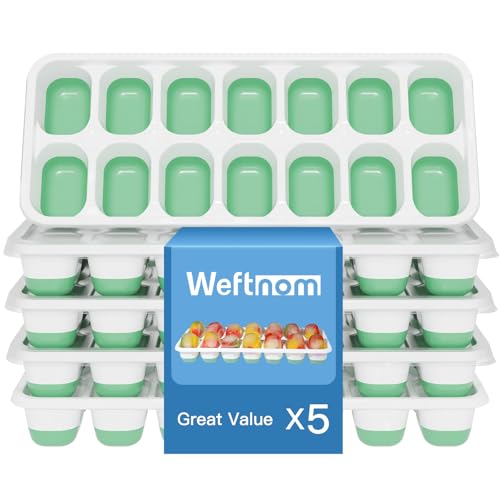
Weftnom claims the same outcome by a different route: snap-on lids that keep water from spilling when you stack or carry the trays and seal out freezer smells. Snap-on is a mechanical description rather than a material one, and it is the only lid here described as fastening rather than resting. Five trays makes seventy cubes.
The Two That Say the Lid Is Not Sealed
DOQAUS is unusually direct. Its lids have lift tabs for easy handling and minimize spills during filling and stacking, and the listing adds in brackets that they are not airtight because they allow airflow to prevent vacuum sealing. That is the maker telling you ice will pick up freezer smells over time, and it is more useful than a seal claim you cannot check.
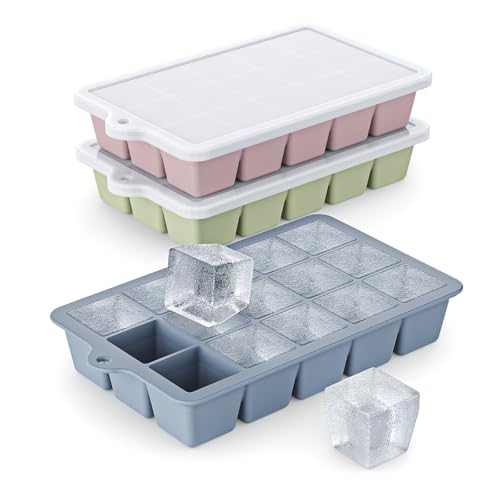
Azxb does the same with different wording: the lid prevents overflow to some extent but is not fully leak-proof. Both of those sentences are warnings rather than features, and on a drink station they are the two listings whose behavior you can predict. Vethwal sits between the groups, describing removable silicone lids whose purpose is to avoid diluting flavor and contamination, without claiming a seal.
Counts, Cube Sizes and What Reaches the Glass
Thirty Cubes to Seventy
Weftnom publishes five trays at fourteen cubes each for seventy per batch and makes the family argument directly: far less refilling than a single tray. PET Hous publishes four trays at fifteen each for sixty. Vethwal publishes three at fifteen for forty five, and Azxb two at fifteen for thirty.
DOQAUS publishes four trays and never states a cube count, which on a four-pack is an odd omission. What it publishes instead is a certification: the silicone and PP are independently certified to LFGB standards, with the claim that no odors or chemicals transfer. That is a different kind of assurance from a cube count.
The Three Cube Sizes
PET Hous and Vethwal both publish a 1.2 x 1.2 x 1.2 in cube, which is the standard small cube and the same figure twice. Azxb publishes 1.5 x 1.2 x 0.7 in, which is a flatter rectangular cube, and says that is deliberately sized for cocktails and everyday beverages rather than for a tumbler.
Weftnom and DOQAUS publish no cube dimensions at all. Weftnom describes the cubes only as coming out clean and whole, and DOQAUS describes clear cocktail ice or flavored cubes. On a drink station the cube size decides how many fit a glass, so two of these five leave the most practical figure unstated.
Living With a Stack of Trays
Stacking, Weight and Drying
All five describe a stackable design, and only two publish a tray figure to check it against: DOQAUS at 7.2 x 4.1 x 1.3 in and Azxb at 7.3 x 5.1 x 1.2 in. The other three publish a package figure instead, which is the carton the set arrives in and not the tray, and this page cites those as the carton.
Weftnom publishes 0.64 lb for five trays, the lightest set here, and Vethwal 0.8 lb for three. PET Hous publishes 1.34 lb for four. Azxb publishes no weight at all, and the DOQAUS figure of 12.3 lb cannot belong to four silicone trays that measure 7.2 by 4.1 by 1.3 inches each, so it is shown and not used.
Where the Trays Go Between Batches
Two of these five publish a hanging hole, and they put it in different places. PET Hous puts hanging holes on the mold itself and ties them to air-drying quickly, which is the practical reason. Vethwal puts small holes in the lid and ties them to storage and saving kitchen space.
The other three publish no hanging provision at all. DOQAUS and Azxb both describe stacking as the storage answer, and Weftnom describes slim trays that stack neatly instead of loose trays sliding around. None of the three says how a wet tray is meant to dry before it goes back in the stack.
Which One Fits Your Kitchen
Family that refills twice a day. Weftnom publishes five trays and seventy cubes at 0.64 lb, with snap-on lids it says keep water in while you carry and stack them. It publishes no cube size, so the ice is an unknown shape.
Wants the lid to actually seal. PET Hous claims a secure tight-sealing lid, publishes a 1.2 x 1.2 x 1.2 in cube, sixty cubes across four trays, and a six to eight hour freeze. It also puts hanging holes on the mold for drying.
Wants a maker that admits the limits. DOQAUS states plainly that its lids allow airflow and are not airtight, publishes a 7.2 x 4.1 x 1.3 in tray and claims LFGB certification. Its published 12.3 lb does not match that tray size.
Three trays and somewhere to hang them. Vethwal publishes three trays at fifteen cubes each, 0.8 lb, a 1.2 x 1.2 x 1.2 in cube and small hanging holes in the lid. It makes no claim about the lid sealing.
Small freezer, flatter cubes. Azxb publishes two trays at 7.3 x 5.1 x 1.2 in, a 1.5 x 1.2 x 0.7 in cube and a range of -40 to 428 degrees F. It states the lid is not fully leak-proof.
What We Could Not Verify
These are the figures we went looking for on the manufacturer listings and did not find.
- How any seal claim was judged. No listing publishes a tilt test, a water volume or a pressure figure.
- A cube count for the DOQAUS four-pack, which publishes trays but not cubes.
- A cube size for the Weftnom and DOQAUS trays.
- A tray figure for the PET Hous, Weftnom and Vethwal sets, all of which publish only a carton.
- Any weight for the Azxb trays, and whether the DOQAUS 12.3 lb belongs to this product at all.
- A temperature range for four of these five. Only Azxb publishes one.