How the Five Compare on the Numbers
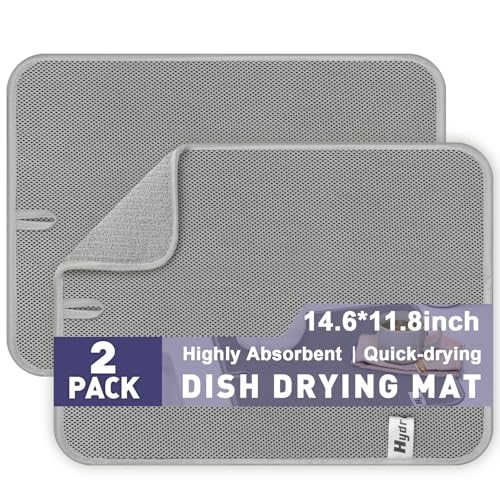
The five picks split into two groups. Two are microfiber mats, the Hydro2Go at 14.6 by 11.8 inches and the Jxiwfvl at 15.74 by 11.8 inches. Two are silicone mats, the COPLIB at 15.8 by 13 inches and the MeimeiDe at 15.7 by 12.6 inches. One is a stainless steel rack, the ANTOPY at 16.5 by 6.7 by 6 inches with 12 published slots. Published area is the first figure to compare, because it sets how many dishes rest on the counter at one time.
Drainage is the second figure. The MeimeiDe publishes an extended lip and diagonal ridges that move water toward the sink. The COPLIB publishes raised ribs that lift dishes above standing water but no lip. The Hydro2Go publishes absorbency up to four times its weight, and the Jxiwfvl publishes a non slip reversible backing. The ANTOPY publishes a silicone tray under a rack, so water collects below the upright plates rather than on the counter.
The table does not tell you how many plates fit on each mat, because no maker publishes a plate count or a load capacity. It also does not tell you how quickly a microfiber mat releases absorbed water, or how a silicone mat behaves when a hot pan is set on it. Those are performance questions, and the makers publish capability claims rather than measured results.
Drainage and Counter Protection
What the published drainage features mean
The MeimeiDe publishes the most specific drainage claim of the five. Its diagonal ridges are stated to guide water toward an extended lip, and the lip is stated to direct water into the sink. That matters in a family kitchen where the counter beside the sink is the busiest surface. The COPLIB publishes raised ribs that lift glasses and cups above standing water, but it publishes no lip, so water stays on the mat until it is rinsed or tipped.
The two microfiber mats take a different approach. The Hydro2Go publishes absorbency up to four times its weight in water, and the Jxiwfvl publishes that it soaks up excess water from dishes and utensils. Neither publishes a drain lip. In practice that means the mat holds the water until it is washed and dried, which is a different routine from a silicone mat that can be rinsed at the sink.
Protection for glassware and countertops
The Hydro2Go publishes a thick padded microfiber layer and a non slip backing, and it states that the padding absorbs shock to prevent scratches or cracks on delicate glassware. The Jxiwfvl publishes a non slip backing and a reversible design. Neither publishes a thickness figure, so the padding claim is a capability statement rather than a measurement.
The ANTOPY publishes soft tips on every peg of its plate holder, which it states keeps fine ceramics from scratching. Its silicone tray is published as providing additional drying space when the rack is moved away. The COPLIB publishes use as a countertop protector and a heat resistant trivet. The MeimeiDe publishes a raised surface that keeps dishes above collected water.
Storage and Daily Handling
Folding, rolling and hanging
The Hydro2Go publishes 0.2 pounds for its pair of mats, the lightest figure among the four picks that publish one, and a built in loop for hanging. The COPLIB publishes that it rolls up or folds flat and can be hung on a wall to drain. The MeimeiDe publishes that it folds for compact storage. The Jxiwfvl publishes that it folds neatly, and the ANTOPY publishes that the slim rack can be moved and stored separately while the silicone tray stays out.
For a busy family kitchen, the storage figure matters because the counter often needs to be clear between meals. A mat that folds into a drawer or hangs on a hook takes up no counter space once the dishes are put away. The ANTOPY is the only pick that publishes a height of 6 inches, so it needs clearance above the counter while it is in use.
Cleaning routines the makers publish
The COPLIB publishes that it is dishwasher safe and rinses clean under running water. The MeimeiDe publishes that it can be rinsed, wiped with a damp cloth or placed in the dishwasher. The Hydro2Go publishes machine wash and hand wash, and the Jxiwfvl publishes hand washing or machine washing in cold water with hanging to dry. The ANTOPY publishes that its rack assembles without tools, but it does not publish a dishwasher claim for the rack.
None of the five publishes a drying time after washing. The microfiber mats publish quick drying as a capability, and the silicone mats publish that they do not hold water. Those are maker statements, not measured results, and a reader should treat them as such.
Area, Material and What Each Pick Actually Is
The published surfaces, sheet by sheet
Four of the five publish a flat drying surface and the figures sit close together. COPLIB publishes 15.8 by 13 inches, MeimeiDe 15.7 by 12.6 inches, Jxiwfvl 15.74 by 11.8 inches and Hydro2Go 14.6 by 11.8 inches. The ANTOPY publishes 16.5 by 6.7 inches, a longer and narrower footprint, because plates stand up in it rather than lie down across it.
COPLIB’s sheet is the largest single surface of the four flat mats, and its margin over the MeimeiDe is a fraction of an inch on each side. Nobody should choose on that. The real separation is the drain lip, the absorbency and the material, which is why this page ranks drainage second rather than treating published area as the whole answer.
Two mats in one pack, and what that does to the figures
The Hydro2Go listing is a pack of two mats, and every figure on it has to be read that way. Its 14.6 by 11.8 inches describes one mat, and the maker states that two can be combined when more space is needed, which no other pick here offers. Its 0.2 pound weight, though, covers the pair, so a single Hydro2Go mat weighs less than the number printed.
That still makes it the lightest figure of the four picks that publish a weight, ahead of the COPLIB at 0.5 pounds, the MeimeiDe at 0.7 pounds and the ANTOPY at 2.25 pounds, and lighter again per mat. The other four picks are single items. Jxiwfvl publishes no weight at all, so it cannot be placed in that order in either direction.
Which One Fits Your Kitchen
Families who dry flat and want the largest published silicone surface. The COPLIB publishes 15.8 by 13 inches and raised ribs. It rolls or folds flat and is published as dishwasher safe, which suits a counter that must be cleared after each meal.
Families whose sink edge is the main drying spot. The MeimeiDe publishes a 15.7 by 12.6 inch surface with an extended lip and diagonal ridges. It is the only pick that publishes a drain lip, so water is directed toward the sink rather than held on the mat.
Families who need plates upright and off the counter. The ANTOPY publishes 12 slots, a detachable 3 slot cutlery holder and a 16.5 by 6.7 by 6 inch footprint. It holds plates vertically, which frees flat counter space for other tasks.
Families who want a light mat that hangs away. The Hydro2Go publishes 0.2 pounds for two mats, a 14.6 by 11.8 inch surface on each and a built in hanging loop. It folds for storage and is published as machine washable.
Families who want a reversible non slip microfiber mat. The Jxiwfvl publishes a 15.74 by 11.8 inch surface with a non slip backing and a reversible design. It folds neatly and is published as hand washable or machine washable in cold water.
What We Could Not Verify
Several figures that would help a family choose are not published by any maker on this sheet. These are the gaps I found.
- No plate count or load capacity is published for any of the five picks.
- No heat resistance temperature is published for the Hydro2Go, Jxiwfvl or MeimeiDe mats.
- No height is published for the Hydro2Go or Jxiwfvl microfiber mats.
- No weight is published for the Jxiwfvl mat, and the Hydro2Go figure covers both mats in its pack rather than one.
- No drying time after washing is published for any of the five picks.
- No thickness figure is published for the padded microfiber layer on the Hydro2Go.