How the Five Compare on the Numbers
Height is the first figure to check, because an over the range microwave has to clear both the range below and the cabinets above. The five published heights here run from 10.31 inches on the GE Profile to 17 inches on the Henyansen, a spread of 6.69 inches. That is a large difference in a fixed opening, and the maker of the Profile states it fits the same space as a regular undercabinet hood.
Capacity and venting split the group a second way. The BLACK+DECKER is the largest at 1.9 cubic feet and the Sharp the smallest at 1.1. Two models state 400 CFM, two state 300 CFM, and three makers publish no CFM figure at all. The Sharp is the only one whose maker states convection cooking, and it is also the heaviest at 71.5 pounds.
The table does not tell you how any of these units performs. It records what each maker publishes and nothing more. It also cannot resolve the BLACK+DECKER dimensions, where the listed width is smaller than the listed depth, and it cannot supply a CFM figure for the three makers who state none.
Fitting the Cabinet Opening and the Range Below
What the published heights mean for clearance
The GE Profile is listed at 10.31 inches tall, and the maker states it fits over the range in the same space as a regular undercabinet hood. That is the clearest fit claim on the sheet. The next lowest published height is the BLACK+DECKER at 13.9 inches, then the Sharp at 15.28, the Midea at 15.41 and the GE at 16.5.
The Henyansen is listed at 17 inches tall and the Frigidaire at 16.74, the two highest figures here. If your cabinets leave a fixed gap above the range, those two figures are the ones to check first. The listing publishes a length, a width and a height, and which of them is the depth or the height of the object is not stated for every model, so measure your own opening rather than relying on the order of the numbers.
Width, depth and what the listings do not settle
Four of the five publish a width of about 29.9 inches, which is the common over the range span. The BLACK+DECKER publishes 16.4 inches for width and 29.9 inches for depth, the reverse of the others, and no corrected figure appears in the listing. Treat that pair as unresolved until you confirm it with the maker.
Depth varies more than width. The GE is 15.25 inches deep, the Frigidaire 15.75, the Midea 15.41 and the Profile 18.62. A deeper unit projects further over the cooktop. The Sharp publishes 29.93 inches for depth and 16.34 for width, again the reverse of the usual format, so its true projection is not settled by the listing alone.
Venting, Controls and Cooking Method
CFM and the hood half of the appliance
The GE Profile and BLACK+DECKER both state a 400 CFM two speed venting system. The GE and Kenmore state 300 CFM, and the GE adds a replaceable charcoal filter. The Sharp, Frigidaire and Henyansen do not publish a CFM figure, so for those three the manufacturer does not state it.
CFM describes how much air the fan moves, not how well it clears a particular kitchen. Ducting, run length and vent direction all affect the result, and none of the five listings publishes a duct diameter or a maximum run. The Kenmore does state flexible three way venting, which is the only venting layout detail on the sheet.
Sensor, auto menu and convection differences
The GE Profile lists sensor cooking that automatically adjusts time and power. The BLACK+DECKER lists pre programd auto menus for popcorn, potato, vegetable, pizza, snack, bacon, frozen dinner, rice and frozen breakfast. The Frigidaire lists one touch buttons for baked potatoes, popcorn and adding 30 seconds. The GE lists one touch express settings and four convenience cook settings.
The Sharp is the only model whose maker states convection, with browning, baking, broiling, crisping and roasting, plus low and high racks. It is rated at 850 watts, lower than the 1000 watts published for the GE, Profile, BLACK+DECKER and Midea. The Frigidaire does not publish a wattage figure, so the manufacturer does not state it.
Which One Fits Your Kitchen
Buyer with low cabinets. The GE Profile is listed at 10.31 inches tall and the maker states it fits the same space as a regular undercabinet hood. Check that figure against your gap before anything else.
Buyer with a narrow cabinet run. The GE is the lightest here at 40 pounds and the smallest at 1.6 cubic feet, with a 300 CFM vent and a charcoal filter. It suits a tight install where capacity is secondary.
Buyer who cooks for a crowd. The BLACK+DECKER is the largest at 1.9 cubic feet with a 13.6 inch turntable and nine auto menus. Confirm its published width and depth with the maker first.
Buyer who wants browning and roasting. The Sharp is the only convection model here, with low and high racks and a 13 inch turntable. It is also the heaviest at 71.5 pounds and the smallest at 1.1 cubic feet.
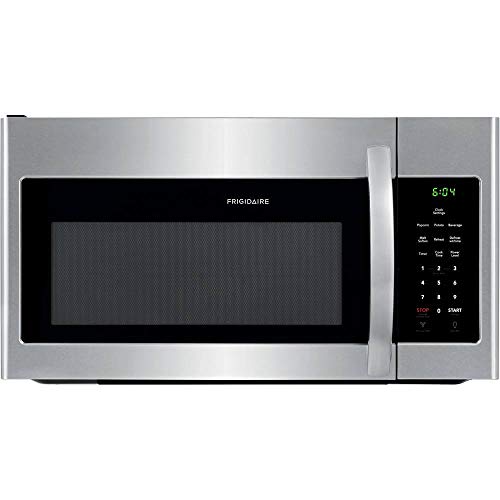
Buyer with a wall beside the door. The Frigidaire lists a zero clearance door that opens to 90 degrees without touching adjacent walls, and fits a 13 by 9 inch baking dish. The maker does not publish a CFM figure.
What We Could Not Verify
Several figures a buyer would want are absent from the listings, and we did not estimate any of them.
- The BLACK+DECKER publishes 16.4 inches for width and 29.9 inches for depth, the reverse of the other four, and no corrected pair is stated.
- The Sharp publishes 16.34 inches for width and 29.93 inches for depth, again the reverse of the usual format.
- No CFM figure is published for the Sharp, the Frigidaire or the Henyansen.
- No wattage figure is published for the Frigidaire.
- No turntable diameter is published for the GE, the GE Profile or the Frigidaire.
- No duct diameter, maximum duct run or vent direction is published for any of the five.