Lush Food & Drink

Buying Guide ·Baking

Best Sourdough Starter Jars for Tracking a Rise

The deciding specification is the shape of the wall the starter climbs, because a jar that tapers makes a doubling impossible to read.

By the Lush Editorial Team·Researched & Compared

  • Researched & ComparedSpecs pulled from the manufacturer listing
  • Like-for-LikeSame measures across every model
  • No Paid PlacementsNobody pays to appear here

I compared the published capacities, jar shapes, mouth widths, lids and included tools of five sourdough starter jars against each maker's own listing text.

Our shortlist

Five products, one set of published numbers.
  1. Brod & Taylor Sourdough Starter Jar (32oz) 100% Dish...
    Best for reading the rise accurately

    Brod & Taylor Sourdough Starter Jar (32oz) 100% Dish...

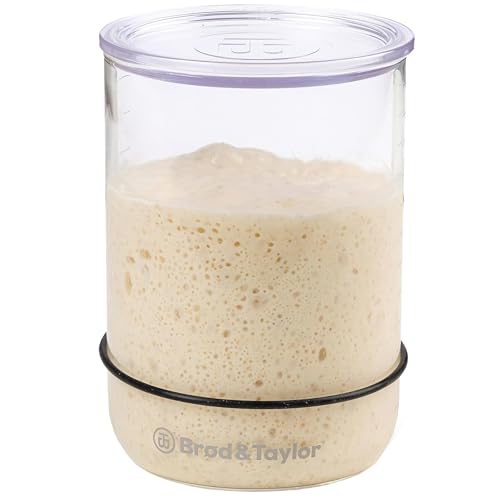
    Straight vertical sides, a 300 gram starter rating and a lid designed to stay loose during fermentation.

    • Brod & Taylor
    • 32 Ounce
    • 0.7 lb
  2. Howasai Sourdough Starter Jar 50oz
    Best for a large active starter

    Howasai Sourdough Starter Jar 50oz

    Fifty ounces behind a 5 inch mouth, with two cotton covers, a bamboo lid and a silicone base.

    • Howasai
    • 50 Oz
    • 1.46 lb
  3. KNEADACE Pro Sourdough Bread Starter Kit - 34 oz Lar...
    Best all in one starter kit

    KNEADACE Pro Sourdough Bread Starter Kit - 34 oz Lar...

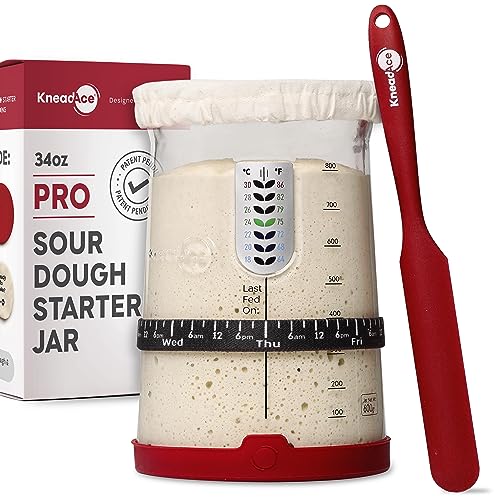
    Feed line marks on the glass plus a thermometer, spatula, cloth cover and a silicone cover that doubles as a base.

    • KNEADACE
    • 1 Pack
    • 1.98 lb
  4. 1 L (34 OZ) Sourdough Starter Jar
    Best for daily stirring and scraping

    1 L (34 OZ) Sourdough Starter Jar

    A spherical jar with a built in groove, two lid types, a thermometer strip and a weekday band.

    • Snuvid
    • 34oz
    • Weight not listed
  5. Weck Tulip Jars 1 Liter - Large Sour Dough Starter J...
    Best for a baker who needs no guidance

    Weck Tulip Jars 1 Liter - Large Sour Dough Starter J...

    Two 1 liter tulip canning jars with glass lids, in thick glass, with no markings or bands.

    • WECK
    • Glass Lids
    • 1 lb

Side by side

Blank means the maker does not publish it.
ModelBrandSize (capacity)WeightBest for
Brod & Taylor Sourdough Starter Jar (32oz) 100% Dish... Brod & Taylor 32 Ounce 0.7 lb Best for reading the rise accurately
Howasai Sourdough Starter Jar 50oz Howasai 50 Oz 1.46 lb Best for a large active starter
KNEADACE Pro Sourdough Bread Starter Kit - 34 oz Lar... KNEADACE 1 Pack 1.98 lb Best all in one starter kit
1 L (34 OZ) Sourdough Starter Jar Snuvid 34oz not published Best for daily stirring and scraping
Weck Tulip Jars 1 Liter - Large Sour Dough Starter J... WECK Glass Lids 1 lb Best for a baker who needs no guidance

Each pick in detail

What the listing says for it, and against it.
1 Best for reading the rise accurately

Brod & Taylor Sourdough Starter Jar (32oz) 100% Dish...

Straight vertical sides, a 300 gram starter rating and a lid designed to stay loose during fermentation.

  • For it
  • Only jar here rated in starter, up to 300 grams fully active
  • Straight vertical sides for a rise you can read as a multiple
  • Loose fitting lid specifically to prevent pressure building during fermentation
  • Jar and lid both stated 100 percent dishwasher safe, with a 4 inch mouth for cleaning
  • Against it
  • At 32 oz it is the smallest single jar capacity here
  • No thermometer or spatula is included
  • Its stated jar size and its dimension fields do not quite agree
2 Best for a large active starter

Howasai Sourdough Starter Jar 50oz

Fifty ounces behind a 5 inch mouth, with two cotton covers, a bamboo lid and a silicone base.

  • For it
  • Largest stated capacity of the five at 50 oz
  • A 5 inch wide mouth, against 4 inches on the only other jar that states one
  • Two breathable cotton covers plus a bamboo lid for the fridge
  • High borosilicate glass with a non slip silicone base
  • Against it
  • Publishes no starter weight, only a jar volume
  • No thermometer is included
  • No dishwasher guidance appears in the listing
3 Best all in one starter kit

KNEADACE Pro Sourdough Bread Starter Kit - 34 oz Lar...

Feed line marks on the glass plus a thermometer, spatula, cloth cover and a silicone cover that doubles as a base.

  • For it
  • Volume, net weight and feed line marks all printed on the glass
  • Thermometer, cloth cover, spatula and a day marked elastic band included
  • Silicone cover doubles as an anti slip base, so one part does two jobs
  • Video guide, recipe and support are stated
  • Against it
  • Funnel shaped opening narrows the jar where a rising starter needs room
  • Heaviest of the five at 1.98 pounds
  • The glass type is never named

Who should skip this: Skip this if weight matters: at 1.98 lb it is the heaviest of the five published weights.

4 Best for daily stirring and scraping

1 L (34 OZ) Sourdough Starter Jar

A spherical jar with a built in groove, two lid types, a thermometer strip and a weekday band.

  • For it
  • Cloth cover for fermenting and a bamboo lid for the fridge
  • Thermometer strip and silicone spatula included
  • Weekday labeled band records the last feed as well as the level
  • Built in groove and a spherical body described as easy to scrape
  • Against it
  • A spherical body makes a rise harder to read than a straight wall
  • Publishes no weight
  • Glass is described only as thick, lead free and food safe
5 Best for a baker who needs no guidance

Weck Tulip Jars 1 Liter - Large Sour Dough Starter J...

Two 1 liter tulip canning jars with glass lids, in thick glass, with no markings or bands.

  • For it
  • Two 1 liter jars in the box rather than one
  • Glass lids rather than plastic or bamboo
  • Thick sturdy glass in a tulip shape with a wide mouth
  • Usable for canning and storage as well as starter
  • Against it
  • No measurement markings, no feeding band and no thermometer
  • Glass canning lids are designed to seal, and an active starter needs to vent
  • The listing never mentions fermentation or starter care at all

Our verdict

Brod and Taylor is the only jar rated in starter rather than volume, at up to 300 grams, with straight vertical sides and a loose fitting lid that prevents pressure building. Howasai gives 50 oz with a 5 inch mouth and two cotton covers. KNEADACE packs a thermometer and feed line marks. Snuvid is a spherical 34 oz kit. WECK supplies two tulip canning jars with glass lids and no markings.

“A starter is measured by the wall it climbs.”

Lush Editorial Team

What separates these five

Capacity Howasai 50 oz, KNEADACE and Snuvid 34 oz, Brod and Taylor 32 oz, and WECK 1 liter in each of two jars.
Starter rating Only Brod and Taylor converts volume into starter, at up to 300 grams fully active.
Jar shape Straight vertical sides, straight sides, a funnel opening, a sphere and a tulip. Shape decides how a rise reads.
Lids A deliberately loose plastic lid, bamboo with cotton covers, a silicone cover that doubles as a base, and glass canning lids.
Tools included Thermometers with KNEADACE and Snuvid, bands with four of the five, nothing at all with WECK.

How we chose

Priorities, not a computed score. The inputs are published specifications, so we rank by what matters most and say how much.

  1. 30% Shape and headroomThe jar exists to show a rise, so wall geometry and published headroom carried the most weight.
  2. 25% Lid and airflowA starter needs to breathe while it ferments and to be covered in the fridge, and the lids differ more than the jars.
  3. 20% Tracking toolsFeed lines, day marked bands and thermometers address the mistakes that actually kill starters.
  4. 15% Mouth width and cleaningA hand has to get inside, and dried starter is the hardest thing in a kitchen to scrub.
  5. 10% Material dataA named glass type was credited over the word thick.

How the Five Compare on the Numbers

Capacity is the headline and it is the least useful number here. Howasai states 50 oz, KNEADACE 34 oz, Snuvid 34 oz or 1 liter, Brod and Taylor 32 oz, and the WECK tulip jars 1 liter each in a pair. What a starter actually needs is room to triple without climbing out, and only one maker converts its jar volume into starter: Brod and Taylor rates its 32 oz jar for up to 300 grams of fully active starter.

The published sizes tell you more about shape than volume. Brod and Taylor is 4 inches across and the lightest of the four that publish a weight at 0.7 pounds, Howasai 5 by 5 by 5.9 inches at 1.46 pounds, KNEADACE 4.13 by 4.13 by 6.7 inches and the heaviest of the five at 1.98 pounds, Snuvid 4.3 by 4.3 by 5.7 inches, and WECK 4.5 by 4.5 by 7 inches at 1 pound.

Specification Brod and Taylor 32oz Howasai 50oz KNEADACE Pro 34oz Snuvid 34oz Set WECK Tulip Pair
Stated capacity 32 oz 50 oz 34 oz 34 oz, 1 liter 1 liter each
Jars in the box One One One One 2 with glass lids
Starter weight rated Up to 300 g active not published not published not published not published
Jar shape Straight vertical sides Straight sides Funnel shaped opening Spherical with a groove Tulip
Mouth width 4 in 5 in not published not published not published
Published size 4 by 4 by 5.5 in 5 by 5 by 5.9 in 4.13 by 4.13 by 6.7 in 4.3 by 4.3 by 5.7 in 4.5 by 4.5 by 7 in
Weight 0.7 lb 1.46 lb 1.98 lb not published 1 lb
Glass described as Borosilicate High borosilicate not published Thick, lead free, food safe Thick and sturdy
Lid supplied Loose fitting plastic Bamboo lid and 2 cotton covers Silicone cover that doubles as a base, plus cloth Bamboo lid and cloth cover Glass lids
Markings Inches and centimeters Measurement marks Volume, net weight and feed line Measurement markings not published
Feeding band Black silicone level marker Adjustable feeding band Elastic band marked with days Weekday labeled band not published
Thermometer not published not published Included Strip included not published
Dishwasher stated Jar and lid, 100 percent not published not published not published not published

What the table cannot give you is the one measurement that decides whether a starter overflows, which is the height of the straight section of wall above the resting level. Brod and Taylor and Howasai both describe straight sides without publishing where the taper begins, and the funnel and spherical jars do not publish a taper at all. Nor does any maker state a glass thickness, including the two that lean on the word thick.

Why the Shape of the Jar Is the Specification

Straight Sides Against Funnels and Spheres

A sourdough starter is judged by how far it rises, which means the wall it rises against is doing the measuring. Brod and Taylor argues this explicitly, saying its straight vertical sides allow uniform rise and expansion, unlike mason jars that curve inward and make growth harder to track. Howasai makes the same claim in fewer words, straight sides with less buildup around the rim.

The other three take different shapes for different reasons. KNEADACE uses a funnel shaped opening, which its listing credits with effortless handling, and that is true for pouring out but it narrows the jar exactly where a doubling starter arrives. Snuvid is spherical and says the shape is easy to stir and scrape. WECK is a tulip, a canning shape that flares at the shoulder. All three make a rise harder to read as a straight multiple.

The Only Jar Rated in Grams of Starter

Brod and Taylor states that its 32 oz jar accommodates up to 300 grams of fully active starter without risk of overflow, and no other listing here converts its volume into starter at all. That single sentence is the most useful specification on this page, because a baker feeding 50 grams of starter with 50 flour and 50 water knows immediately whether the jar has headroom for the peak.

Howasai comes closest in spirit, saying its 50 oz gives active starter plenty of room to expand while reducing the risk of overflow, without a figure. KNEADACE publishes feed line marks on the glass, which is a practical substitute: the line tells you where to stop rather than how much the jar can take. Snuvid and WECK publish nothing about starter quantity.

Lids, Pressure and Airflow

A Lid Meant to Be Loose

Brod and Taylor is the only pick that treats the lid as a fermentation component. Its plastic lid is described as loose fitting specifically to prevent pressure building up during active fermentation while still protecting the starter, and the listing frames that as maintaining airflow for a bubbly culture. That is the correct engineering for a jar of living yeast, and it is the kind of detail most listings replace with the word airtight.

The contrast is sharp at the other end. WECK supplies glass lids designed for canning, which is to say for sealing, and the listing talks about seal proof storage and food preservation. A sealed jar of active starter builds gas, so the lid has to be left ajar, and nothing in the WECK listing acknowledges that this is what you would be doing with it.

Cloth, Bamboo and Silicone

Howasai and Snuvid both use the two lid approach that suits a starter’s two lives: a breathable cotton cover while it ferments on the counter and a bamboo lid when it goes into the fridge. Howasai supplies two cotton covers rather than one, which matters because a cover gets floury, and adds a non slip silicone base to keep the jar steady while you stir.

KNEADACE folds the base into the lid, with a silicone cover for fridge storage that doubles as an anti slip base during fermentation under the cloth cover. That is one fewer part to store and a neat piece of design. None of the three publishes anything about how breathable the cloth is, and none says whether the bamboo lid seals, which is the question a fridge answers badly.

What Comes With the Jar

Bands, Thermometers and Spatulas

Four of the five supply a way to mark the level. Brod and Taylor uses a black silicone level marker, Howasai an adjustable feeding band, and KNEADACE and Snuvid use elastic bands printed with the days of the week, which mark the last feed as well as the level. That day marking is the more useful version, because forgetting when you fed the starter is a more common failure than misjudging the rise.

Only KNEADACE and Snuvid include a thermometer, and temperature is the variable that decides how fast a starter peaks. Both also include a spatula, KNEADACE calling it a flexible spatula and Snuvid a silicone one. Brod and Taylor supplies no tools beyond the level marker, and WECK supplies nothing at all, which is consistent with a canning jar sold for canning.

Two Kits, One Product, Two Brand Names

Two other listings in this data are worth knowing about. One is a 40 oz kit and the other is a two pack of the same 40 oz kit, and their titles and feature copy match almost word for word, down to the marked feeding band, thermometer, scraper, cloth cover and silicone lid and base. Both describe soda lime rather than borosilicate glass, which is a genuine material difference worth checking.

Neither is picked, for a simple reason. One publishes dimensions of 2 inches in all three directions for a 40 oz jar, and the other publishes 0.26 pounds for a two pack of glass jar kits. Both figures are impossible, and a comparison table built on either would be fiction. A third listing, a 24 oz two pack with an aluminum lid, publishes no dimensions and no weight at all.

Which One Fits Your Kitchen

The baker who wants the rise to be measurable. Brod and Taylor publishes straight vertical sides, a 4 inch mouth, markings in inches and centimeters, a 300 gram starter rating and a loose fitting lid that prevents pressure building. Jar and lid are both stated dishwasher safe, and at 0.7 pounds it is the lightest of the four with a published weight.

The baker keeping a big starter. Howasai states 50 oz with a 5 inch wide mouth and straight sides, two cotton covers, a bamboo lid, an adjustable feeding band and a non slip silicone base, in high borosilicate glass at 1.46 pounds. It publishes no starter weight, so judge headroom from the volume.

The baker who wants every tool in one box. KNEADACE supplies volume, net weight and feed line marks on the glass, a thermometer, a cloth cover, a silicone cover that doubles as a base, a spatula and a day marked band, at 1.98 pounds. Its funnel shaped opening makes pouring easy and the rise harder to read.

The baker who stirs and scrapes daily. Snuvid is a spherical 34 oz jar, 4.3 inches across, with a built in groove, a cloth cover for fermenting and a bamboo lid for the fridge, plus a thermometer strip, a spatula and a weekday band. It publishes no weight and no glass type beyond thick and lead free.

The baker who already knows how to run a starter. WECK supplies two 1 liter tulip jars with glass lids in thick sturdy glass at 1 pound. There are no markings, no band and no thermometer, and the listing never mentions fermentation, so this is a good jar sold as a canning jar and nothing more.

What We Could Not Verify

For a product whose job is to show a starter rising, very little of the geometry is published:

  • Where the straight section of wall ends on any of the five, which is what decides whether a tripling starter overflows.
  • Glass thickness on all five, including the two listings that rely on the word thick.
  • Starter capacity in grams for four of the five. Only Brod and Taylor publishes a figure, 300 grams.
  • Mouth width for the KNEADACE, Snuvid and WECK jars, which matters for getting a hand inside to clean.
  • Whether the bamboo lids seal, and how breathable the cloth covers are, on the three kits that supply both.
  • Dishwasher guidance for four of the five, and a weight for the Snuvid set.
Frequently asked questions

What size jar does a sourdough starter need?+

Bigger than the starter, by a factor most listings never state. Brod and Taylor is the only pick that answers it directly, rating its 32 oz jar for up to 300 grams of fully active starter without overflow. Howasai offers 50 oz for a larger starter, KNEADACE and Snuvid 34 oz, and WECK 1 liter per jar. If you feed 50 grams of starter with equal flour and water, a 32 oz jar has room for the peak.

Does the shape of a sourdough starter jar matter?+

More than the volume. A starter is judged by how far it rises, so the wall doing the measuring should be straight. Brod and Taylor makes that argument explicitly against mason jars that curve inward, and Howasai also states straight sides. KNEADACE uses a funnel shaped opening, Snuvid is spherical and WECK is a tulip, and all three narrow or flare where a doubling starter arrives, which makes the rise harder to read.

Should the lid on a starter jar be airtight?+

Not while the starter is active. Brod and Taylor is the only pick that addresses it, supplying a deliberately loose fitting plastic lid to prevent pressure building up during fermentation. Howasai and Snuvid solve the same problem with a breathable cloth cover for the counter and a bamboo lid for the fridge, and KNEADACE with a cloth cover plus a silicone cover. WECK supplies glass canning lids, which are built to seal.

Which of these jars is easiest to clean?+

The two that publish a mouth width. Howasai states a 5 inch wide mouth with straight sides and less buildup around the rim, and Brod and Taylor a 4 inch opening that fits a hand, with no grooves or ridges and a curved bottom so there are no hard to reach corners. Brod and Taylor is also the only pick stating that both jar and lid are dishwasher safe. KNEADACE, Snuvid and WECK publish no mouth width.

Do I need the thermometer and feeding band that come in these kits?+

They address the two things that go wrong most. A day marked band tells you when you last fed the starter, which KNEADACE and Snuvid both supply and which is more useful than a plain level marker. A thermometer tells you why the starter peaked in four hours or twelve, and only KNEADACE and Snuvid include one. Brod and Taylor supplies a level marker only, and WECK supplies neither.

Why are two nearly identical kits left out of this comparison?+

Because their published figures cannot be true. Two listings in the same data share almost identical titles and feature copy for a 40 oz kit, one sold singly and one as a two pack. One publishes dimensions of 2 inches in all three directions for a 40 oz glass jar, and the other publishes 0.26 pounds for two complete glass jar kits. Both also describe soda lime glass rather than borosilicate.

Specifications come from the manufacturers' own published listings. Lush Food & Drink may earn a commission if you buy through a link on this page, at no extra cost to you. How we research.