How the Five Compare on the Numbers
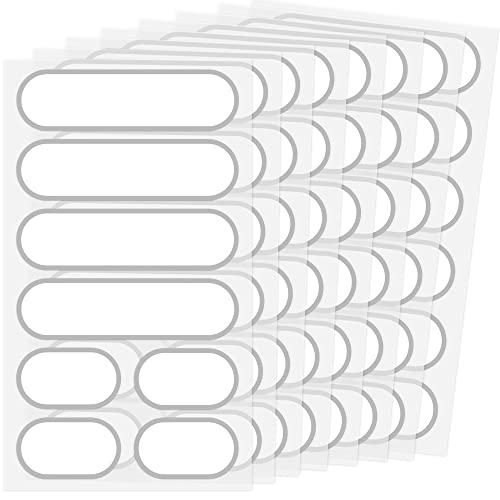
Counts are the figure every listing leads with and they mean very little on their own. Hebayy supplies 500 labels and every one of them is blank. VITEVER supplies 308, of which 279 carry a printed name. LOPURO supplies 300, made up of 183 printed names, 96 expiration date labels and 21 blanks. Aixoom supplies 170, and CHUBBIEE 64 with nothing printed on any of them.
Size is where the sets actually diverge. VITEVER and LOPURO both build on a 2.5 by 2.5 inch square, VITEVER adding a 1.6 inch square and LOPURO a 1.1 by 0.6 inch date label. Hebayy is an oval at 2.4 by 1.2 inches. CHUBBIEE is long and narrow at 3.54 by 0.98 inches, with a 1.67 inch version alongside it. Aixoom publishes no label size at all.
What the table cannot tell you is how a flat 2.5 inch square behaves on a curved jar, which no maker addresses. The only figure Aixoom publishes is 8.5 by 11 inches, and that is the backing sheet rather than a label. Two candidates were left out. One duplicates the LOPURO structure almost exactly, 183 printed names plus 96 date labels, differing only in how many blanks come with it. The other publishes no label size anywhere and its single published figure is a 3 pound weight, which cannot be right for a set of vinyl stickers.
Whether the Label Comes Off Again
Four removal claims and one silence
Reusable means one specific thing on a pantry label: it lifts off without leaving glue behind. CHUBBIEE names the mechanism, calls it easy peel, and says the label removes cleanly when you switch ingredients or update a date. Hebayy says its glue peels off without a sticky stain. VITEVER and LOPURO both state removable and repositionable in the same breath as waterproof.
Aixoom says nothing about removal at all. Its durability bullet covers resistance to water, oil and smudging, and the rest of the listing is about the cursive font and the rooms you might use it in. On a set sold for a pantry you reorganize, a missing removal claim is the most important absence in the listing, and it is the reason this one sits last of the five.
Repositionable is not the same as removable
Those two words get used together and they describe different moments. VITEVER states both and explains the second, saying a label can be adjusted with no residue left if you want to move it. LOPURO uses the same pair of words. That is a claim about the first minute on the jar rather than about the label you peel off a year later, and no listing here separates the two cases.
Hebayy makes a broader claim in a different direction: dishwasher, microwave oven and fridge are all listed as available, on a label made from formulated paper. A paper label surviving a dishwasher is an unusual thing to assert, and the listing gives no cycle, no temperature and no number of washes, so there is nothing in it to check the claim against.
Printed Names or a Blank You Write On
What a printed set gets you, and what it fixes
Three of the five arrive with the names already on them. VITEVER prints 279 of its 308, LOPURO 183 of its 300, and Aixoom 133 of its 170. That takes handwriting out of the job, which is the entire appeal, and it introduces a different constraint: you get the words somebody else chose. None of the three publishes its word list, so what is in the pack is a surprise.
Two of them at least ship a way to search it. VITEVER includes a catalog page and says it tells you which page a given label is on. LOPURO includes an alphabetical catalog for the same reason. Aixoom includes neither, but does publish its breakdown, 133 names plus 8 ampersands, 3 hashtags, 8 numbers and 18 blanks, which is more openness about contents than either of the other two offers.
The two blank sets and how you write on them
Hebayy and CHUBBIEE are blank by design. Hebayy supplies 500 oval labels on a perforated roll and tells you to apply a ball pen or a permanent marker, which is the only writing instruction anywhere on this page. CHUBBIEE supplies 64 writable vinyl labels in two sizes and leaves the choice of pen entirely to you.
Blank sets solve the problem printed sets create. You can write buckwheat, or a date, or the name of a child’s snack, and you are not confined to a list drawn up in advance. The cost is handwriting on every jar and a pen that has to live nearby, which is exactly what the printed sets exist to avoid. Neither approach wins; they suit different pantries.
Size, Shape and the Container You Own
A square, an oval and a long rectangle
Shape follows the container more than taste does. VITEVER and LOPURO both build on a 2.5 by 2.5 inch square, which suits a straight sided bin or a wide jar face. Hebayy is a 2.4 by 1.2 inch oval, closer to a freezer bag label than a jar label. CHUBBIEE is long and narrow at 3.54 by 0.98 inches, the shape that runs along a canister rather than facing you from it.
The second sizes matter as much as the first. VITEVER supplies 24 smaller squares at 1.6 by 1.6 inches against 252 of the larger ones, which is the split a pantry with spice jars needs. The LOPURO second size is a 1.1 by 0.6 inch date label rather than a small name label. The CHUBBIEE second size is 1.67 by 0.98 inches, the same width as its long label and under half the length.
Paper, vinyl and where the label ends up
Material splits four to one. VITEVER and LOPURO both state matte white vinyl. CHUBBIEE states vinyl and says directly that it chose vinyl over standard paper because paper tears and comes apart when wiped. Hebayy is the paper one, described as formulated paper, sturdy and tear resistant. Aixoom says transparent sticker without naming what the film actually is.
Color is the other half of that choice. VITEVER, LOPURO and Hebayy are white, which covers whatever is printed on the container underneath. Aixoom is clear with black script, which reads cleanly on glass and disappears on a printed bag. CHUBBIEE publishes no color at all, which on a label is a strange thing to leave out of a listing.
Which One Fits Your Kitchen
The pantry with jars of several sizes. VITEVER. Three shapes across 308 labels, 252 squares at 2.5 by 2.5 inches and 24 at 1.6 by 1.6, with 279 names already printed and a catalog page for finding them.
Whoever tracks dates as well as contents. LOPURO. 183 printed names at 2.5 inches square, 96 expiration date labels at 1.1 by 0.6, and 21 blanks, all stated removable and repositionable.
Meal prep and the freezer. Hebayy. 500 oval labels at 2.4 by 1.2 inches on a perforated roll, blank for a ball pen or marker, and the only set stated for the dishwasher, microwave and fridge.
Anyone with pop top canisters. CHUBBIEE. 64 writable vinyl labels in two long shapes, 3.54 by 0.98 inches and 1.67 by 0.98, stated to peel off with no residue when the contents change.
The glass jar pantry. Aixoom. 170 clear labels in black cursive, 133 printed names plus 18 blanks in round, square and long shapes. It is the only clear set here, and the only one silent on removal.
What We Could Not Verify
Six things a buyer would want that none of these listings answers.
- Any label size for the Aixoom set, whose only published figure is an 8.5 by 11 inch sheet.
- The printed word list on any of the three preprinted sets.
- Whether the CHUBBIEE labels are white, clear or colored.
- How long any of the five stays stuck, since no listing gives a duration.
- What a dishwasher cycle does to the Hebayy paper labels, beyond the word available.
- A credible weight for any set, since the one weight published is not believable.