How the Five Compare on the Numbers
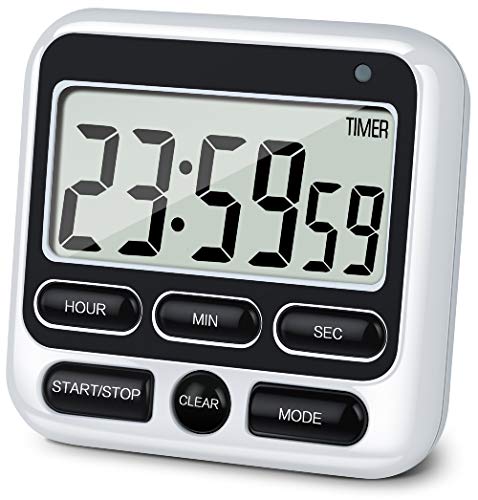
The figure that decides which of these is any use to you is the maximum countdown, and across five timers it varies by a factor of twenty four. KTKUDY counts up or down for up to 24 hours. TempPro reaches 23 hours 59 minutes and runs two countdowns at once. Antonki stops at 99 minutes 59 seconds. NUOSWEK is a 60 minute dial. ALBAYRAK publishes no range at all.
The second figure is how loud it gets, and three of the five publish one. TempPro states 70 to 105 dB across high, medium and low, with a silent mode as well. KTKUDY states 70 to 90 dB and an alternative light mode. ALBAYRAK states 85 dB from a mechanical bell. NUOSWEK publishes no figure and instead explains why it is loud: the case has no back cover on it.
What the table cannot tell you is what it is like to have one of these running on a counter. NUOSWEK is the only listing to admit that its timer ticks, calling the gear noise normal, and the only one to explain that the spring has to be wound all the way round past 55 before it will ring at all. One candidate was left out: a digital timer with the same 24 hour range and the same 0.14 pound weight as the KTKUDY, publishing no screen size and no decibel figure.
How Long It Will Count, and How Many Things at Once
Twenty four hours against ninety nine minutes
A 99 minute limit sounds like plenty until you braise something. Antonki tops out at 99 minutes 59 seconds, which covers an egg, a cake and a homework session, and does not cover a pot roast. KTKUDY counts up or down for up to 24 hours and says so directly against timers limited to 99 minutes 59 seconds, naming slow cooker meals and smoking as the reason it needed the range.
The two mechanical timers are shorter again. NUOSWEK is a 60 minute dial and says so in its own title. ALBAYRAK publishes no maximum at all, which on a dial timer is a strange omission, because the number is printed on the face of the product. Neither will help with anything that takes an afternoon, and neither of them pretends otherwise.
The one that runs two countdowns
TempPro is the only pick that holds two countdowns at the same time. Two separate alarms can be set for two events, each programmable up to 23 hours 59 minutes, which is the difference between timing a roast and timing a roast plus the potatoes that go in halfway through. Nothing else here can hold a second time at all.
It also carries the fuller clock. TempPro switches to a calendar and clock mode with a 12 or 24 hour display and month, date and year. KTKUDY has a 12 hour clock and a daily alarm, which is what it counts as its third and fourth functions. Antonki, NUOSWEK and ALBAYRAK have no clock mode, so a kitchen still needs a clock on the wall.
How You Find Out Time Is Up
Decibels, where anyone publishes them
Alarm volume is the most quotable specification here and the least consistent. TempPro publishes the full range, 70 to 105 dB, and gives high, medium and low to choose between, which is the only volume control on this page. KTKUDY publishes 70 to 90 dB and says it can be heard from another room. ALBAYRAK publishes a single figure, 85 dB, from a mechanical bell.
The other two publish nothing. Antonki says the beeping can be heard from another room and leaves it there. NUOSWEK takes the most unusual route, explaining that there is no back cover on the timer and that this is why the alarm is very loud, which is a mechanism rather than a figure, but at least it is an explanation you can reason about.
Silent modes and a timer that ticks
Three of the five can be silenced completely. KTKUDY switches between sound and light so the alert becomes visual. Antonki drops to a flashing red light with no beep at all, and names classrooms and a baby’s room as the reason. TempPro has a silent mode alongside its three volumes. That covers the case where a kitchen timer follows you into a quiet room.
The mechanical pair cannot be silenced, and one of them is not silent while it runs. NUOSWEK states outright that there is a ticking sound from the gear and that this is normal. ALBAYRAK says nothing about noise while running, only about its 85 dB bell at the finish. A spring driven movement makes noise by definition, and only one listing here admits to it.
Batteries, Steel and Where It Sits
Two timers with no battery at all
NUOSWEK and ALBAYRAK need no power source, which is the whole argument for a mechanical timer and the reason they still sell. Neither can go flat mid bake. NUOSWEK is unusually explicit about the cost of that: you must wind the spring from zero through 5, 10, 15 and on past 55 before setting the time, and if you skip that step the timer will not ring.
The three digital timers all need a battery and only Antonki says which one. It ships with two AAA cells already fitted, one per timer, and tells you to switch the timer off at the back when it is not in use. KTKUDY and TempPro publish no battery type at all, which is exactly the thing you want to know before the first one dies mid recipe.
Magnets, stands and a hanging hole
Four of the five will go on a fridge. KTKUDY publishes three rear magnets and a fold out stand. TempPro has a magnet and a tabletop stand. ALBAYRAK has a magnetic back on a 304 stainless body. Antonki is the only one with a third option, a hanging hole, though it notes you have to supply the string for that yourself.
NUOSWEK publishes no mounting at all and is a dial timer at 3 inches across and 3.4 inches high, so it sits wherever you put it down. The rest are close in size: KTKUDY is 3.15 inches square and 0.87 thick, ALBAYRAK is 2.7 by 1.7 by 2.7 inches, and TempPro takes the most counter space at 4 by 4.5 by 1.5 inches.
Which One Fits Your Kitchen
Long cooks and slow cookers. KTKUDY, for a 24 hour count in either direction, a 2.8 inch LCD, 70 to 90 dB or a silent light mode, and dedicated hour, minute and second buttons rather than combinations to remember.
Two dishes finishing at different times. TempPro. Two independent countdowns to 23 hours 59 minutes each, 70 to 105 dB across three volumes plus silent, a full calendar clock and a stainless steel jacket.
A classroom or a quiet house. Antonki. Two timers with AAA cells already fitted, a silent flashing red light instead of a beep, and three ways to mount each one including a hanging hole.
Whoever is finished with batteries. ALBAYRAK. A 304 stainless mechanical timer at 2.7 by 1.7 by 2.7 inches and 0.28 pounds, with a magnetic back and an 85 dB bell at the end.
The simplest possible egg timer. NUOSWEK. A 60 minute wind up dial needing no battery, which warns you that it ticks and tells you plainly to wind it past 55 first or it will not ring.
What We Could Not Verify
Six things a buyer would want that these listings do not answer.
- The maximum countdown on the ALBAYRAK dial, which publishes none.
- Battery type for either the KTKUDY or the TempPro timer.
- Any alarm volume figure for Antonki or NUOSWEK.
- Whether the ALBAYRAK movement ticks while it runs.
- Any dimensions at all for the Antonki timers.
- Whether an alarm on any of the three digital timers can be cut short once it starts.