How the Five Compare on the Numbers
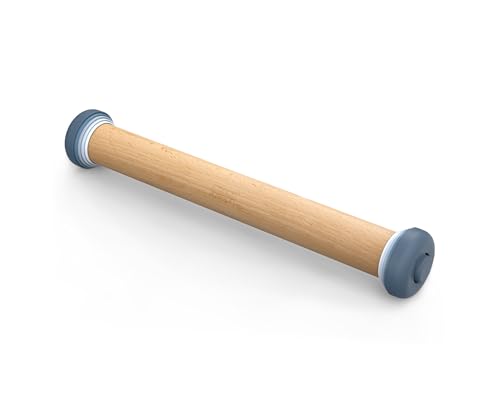
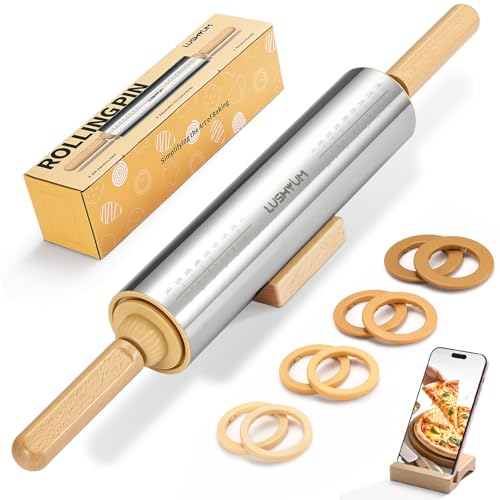
The rings are the product, and these five sets are not the same. Joseph Joseph supplies five, at 2, 4, 6, 8 and 10 mm. Folksy Super Kitchen supplies five, at 2, 3, 5, 8 and 10 mm. AMUZHI and BIDFUL both supply four, at 2, 3, 6 and 10 mm. Geesta supplies five ring sizes and publishes no thickness figure for any of them.
The inch labels on those rings do not line up with each other. BIDFUL and AMUZHI both call 1/8 inch 3 mm. Joseph Joseph calls 4 mm 1/6 inch, a fraction almost nobody uses, and labels 8 mm as 5/16. Joseph Joseph is also the only listing that says its thicknesses are approximate. The others print a fraction and a metric figure side by side as though both were exact.
What the table cannot settle is what a ring actually delivers, because a ring sets the gap at the ends while the dough sits in the middle. Two candidates were left out. One is a third 430 stainless 17 inch pin distinguished mainly by a bundled pastry mat, whose listing calls 1/8 inch 4 mm where two others call it 3. The other publishes dimension fields reading 17 by 17 inches for a rolling pin, which cannot be right.
What the Rings Actually Give You
Four steps or five
Four rings or five is the whole difference between these sets on paper. Joseph Joseph gives five, adding an 8 mm step that AMUZHI and BIDFUL skip, so its ladder runs 2, 4, 6, 8 and 10 in even steps. Folksy Super Kitchen also gives five and arranges them differently, 2, 3, 5, 8 and 10 mm, which is finer at the thin end where a wrapper lives.
AMUZHI and BIDFUL both run 2, 3, 6 and 10 mm, jumping from 3 to 6 and then from 6 to 10. For a pie crust that gap is irrelevant. For dumpling wrappers against pasta sheets it is not, and a finer ladder at the thin end is the main reason to prefer five rings to four. AMUZHI counts four pairs rather than four rings, because a ring goes on each end, and it is the only listing to say so.
Where the inch labels disagree
Every listing except one prints inch fractions alongside metric, and they do not agree with each other. BIDFUL and AMUZHI both give 1/8 inch as 3 mm. Joseph Joseph gives 4 mm as 1/6 inch and 8 mm as 5/16, and it is the only one of the five to add the word approximately. Folksy Super Kitchen skips fractions entirely and publishes millimeters only.
That is not pedantry when the ring is the measuring device. A baker working from an American recipe reads 1/8 inch and a baker working from a European one reads 3 or 4 mm, and the same ring is being sold as both. The honest position is the one Joseph Joseph takes: these figures are approximate, and a ring is a stop rather than a caliper.
Wood, Steel and What Each Does to Pastry
Two beech pins, one teak and two steel
Material is the second real choice. Joseph Joseph and BIDFUL are both beech. Geesta is teak. AMUZHI is 430 stainless steel and Folksy Super Kitchen is 18/8, which its own listing also writes as 304. BIDFUL makes the case for wood directly, saying wood does not conduct heat and therefore controls temperature better than an aluminum pin does.
Folksy Super Kitchen makes the opposite case, that non-porous steel cannot absorb anything and that dough does not stick to a seamless surface the way it does to wood or plastic. Both arguments sit in the listings and neither is settled here. What is verifiable is the weight: the two steel pins publish 1 pound and 0.81 pounds against 0.93 for the beech pin.
The steel one you put in the fridge
AMUZHI is the only listing on this page that tells you how to use the material. It says to put the pin in the fridge for 30 minutes before rolling butter based doughs, because chilled steel stays cool longer and stops butter melting into the layers. That is a technique note rather than a feature, and it is the most useful sentence in these five listings.
Nobody else offers a working method. Folksy Super Kitchen is also steel and says nothing about chilling. The beech pins cannot be chilled to any useful effect and do not claim to be. Geesta argues for its shape instead, a French style handle free body that it says gives more control, with an extra handle press design on top of that.
Length, Markings and Cleaning
Fifteen and three quarter inches to twenty three
Length varies more than you would guess. Folksy Super Kitchen is published at 15.75 inches, Joseph Joseph at 16.54, and AMUZHI and BIDFUL both at 17. Geesta is published at 23 inches, which is a different class of tool: long enough to roll a full pastry sheet in one pass, and long enough to be awkward in a kitchen drawer.
Weight follows length. Geesta is the heaviest of the four that publish one, at 2.64 pounds. The Folksy pin is the lightest at 0.81 pounds. The AMUZHI steel barrel is 1 pound and the Joseph Joseph beech pin 0.93. BIDFUL publishes no weight at all, which on a 17 inch beech pin leaves its heft a matter of guesswork.
Etched rulers and one pin you must not soak
Three of the five put a ruler on the pin itself. AMUZHI etches a dual sided scale in both inches and millimeters. Geesta laser etches centimeter and inch markers. Folksy Super Kitchen says it has dimensions on the surface without saying in what units. Joseph Joseph and BIDFUL print nothing on the barrel at all and expect a ruler on the bench.
Cleaning splits along the same line as material. Folksy Super Kitchen states dishwasher safe outright. Geesta says the rings clean up in the dishwasher, which is a claim about the rings rather than the teak. AMUZHI says the pin disassembles for cleaning. BIDFUL is the one to read twice: wipe the flour off with a warm damp cloth and avoid soaking it, which is what wood requires.
Which One Fits Your Kitchen
Even steps across the whole range. Joseph Joseph. Beech with five ring sets at 2, 4, 6, 8 and 10 mm, twist to remove, published at 16.54 inches and 0.93 pounds, and the only listing candid enough to call its thicknesses approximate.
Butter pastry and laminated dough. AMUZHI. A 430 stainless 17 inch barrel with four pairs of color coded screw on rings, a ruler etched in inches and millimeters, and an instruction to chill it for 30 minutes first.
Thin wrappers and noodles. Folksy Super Kitchen. Five silicone rings reaching down to 2 mm with a 3 and a 5 between, on an 18/8 steel barrel at 15.75 inches and 0.81 pounds, stated dishwasher safe.
Full pastry sheets. Geesta. Teak, published at 23 inches and 2.64 pounds, handle free in the French style with five PP rings, laser etched centimeter and inch markers, and a wooden holder.
A pin that stays cool without a fridge. BIDFUL. Beech at 17 inches with four rings at 2, 3, 6 and 10 mm, arguing that wood does not conduct heat. Wipe it clean and never soak it in water.
What We Could Not Verify
Six things a buyer would want that these listings do not answer.
- Ring thicknesses for the Geesta pin, which publishes five sizes and no figures.
- A published weight for the BIDFUL pin.
- What units the Folksy surface markings are in.
- Ring material on the Joseph Joseph and BIDFUL pins.
- Whether either wooden pin can be washed beyond a wipe.
- Barrel diameter on any of the five.