How the Five Compare on the Numbers
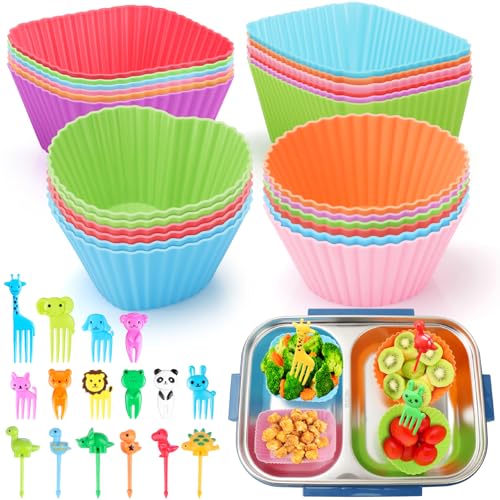
Read the piece counts carefully, because two of these kits count things that are not dividers. DOUDOULE advertises 100 pieces and its own breakdown is 24 silicone cups and 76 animal food picks. LAIYPHO advertises 66 pieces and breaks down to 20 cups and 46 picks. The Silicone Kitchen and SAWNZC both supply 24 pieces and every one of them is a cup, so the smaller number is the larger set of dividers.
Shape mix is the second figure. SAWNZC, DOUDOULE and LAIYPHO all supply round, square and rectangular cups. The Silicone Kitchen skips round entirely, giving 8 rectangles and 16 squares, and it is the only listing here that publishes the cup dimensions: squares of 1.97 inches and rectangles of 1.97 by 3.94. Round cups waste the corners of a rectangular lunch box.
What the table cannot tell you is cup depth, which decides whether a filled cup clears the lid of your lunch box. The Silicone Kitchen publishes two plan dimensions and no height, and the other three cup sets publish nothing at all. Since none of the four states a wall thickness either, how well a cup stands up when loaded is a claim rather than a measurement on every one of them.
How Many of the Pieces Actually Divide Anything
Twenty Four Cups, or Twenty Four of a Hundred
The headline number on a divider kit is the first thing to check against its own breakdown. DOUDOULE says 100 pieces on the front and 24 silicone cupcake liners plus 76 animal food picks in the first bullet. LAIYPHO says 66 pieces and breaks down to 20 cups plus 46 picks. Both are accurate. Neither is a hundred dividers or sixty six dividers.
Set against that, The Silicone Kitchen and SAWNZC both publish 24 and mean 24 cups. So a 24 piece set has more dividers than a 66 piece set and the same number as a 100 piece one. If your problem is keeping a sandwich away from grapes, the piece count on the box is close to meaningless and only the cup count matters.
The Picks Are Doing a Different Job
That is not to say the picks are filler. DOUDOULE and LAIYPHO both sell them as a way of getting a child to eat, and LAIYPHO goes as far as naming the designs, dinosaurs, giraffes and pandas, alongside what it calls Morandi colors for the cups. A 76 pick supply lasts a school year, and a pick is genuinely consumable in a way a silicone cup is not.
The difference between those two kits is therefore a ratio rather than a quality. DOUDOULE gives 24 cups to 76 picks and publishes a weight of 0.55 pounds for the lot. LAIYPHO gives 20 cups to 46 picks and publishes no weight, but names its shapes, its designs and its color family. Buy on the ratio you will actually use.
Cups in a Box, or a Box With Walls
What a Silicone Cup Does That a Wall Cannot
A silicone cup moves. That is its whole advantage over a molded compartment: you decide each morning whether today needs four small cups or two large ones, and the cup comes out to be washed separately from the box. All four cup sets here make the same non stick and reusable argument against paper liners, and three of them double as baking cups on a tray.
The Silicone Kitchen pushes that furthest, stating its cups are safe in an oven, a microwave, an air fryer, a dishwasher and a freezer, and that they stand free on a baking sheet without grease or spray. SAWNZC states a temperature range instead and claims its liners are thicker and sturdier so they hold shape under heavy food without tilting in a lunch box.
What a Sealed Compartment Does That a Cup Cannot
A cup cannot hold a dressing, and shell and turtle is on this page because it can. Its 4 compartments are molded into a 1200 milliliter box, and every compartment has its own silicone gasket under a lid held by 4 locking buckles. That is the only sealing described anywhere in this data, and it is the difference between carrying a dip and carrying dry food in separate corners.
It also supplies 4 silicone muffin liners in the box alongside a spoon, a fork and a plastic sauce jar, which is a tacit admission that fixed compartments alone are not enough. Its container goes in a microwave and a dishwasher but the lid does not, and it publishes 6.1 by 8.4 by 2 inches, so unlike the cup sets you can check it against a bag.
Heat, Standards and the Sizes Nobody Publishes
One Temperature Range and One Set of Dimensions
SAWNZC is the only pick on this page with a temperature range: minus 104 to 446 degrees Fahrenheit, safe for ovens, microwaves, refrigerators and dishwashers. That range matters because a silicone cup that goes from a freezer to an oven is doing two jobs, and it is the only figure here you could check a baking instruction against.
The Silicone Kitchen is the only pick that publishes cup dimensions, with squares of 1.97 inches and rectangles of 1.97 by 3.94, and the only one naming a standard, food grade silicone meeting FDA and European LFGB requirements. Between the two of them you have one temperature figure and one size figure, from two different listings, and neither publishes what the other does.
Two Listings Left Out
The first was another 24 piece cup set in round, square and rectangular shapes, 8 of each in 4 colors, published with the same temperature range of minus 104 to 446 degrees Fahrenheit as SAWNZC. Given an identical range and an identical shape mix, these may well be the same cups under two names, so only one is here. Its own bullets also give 446 degrees in one place and 450 in another.
The second was an 80 piece kids kit of 20 silicone cups in three shapes and 60 animal food picks, published at 0.44 pounds. It sits exactly between the two kits already on this page, with fewer cups than DOUDOULE and more picks than LAIYPHO, and it publishes nothing that neither of those two does. Three listings for one idea is two too many.
Which One Fits Your Kitchen
The packer who measures the box first. The Silicone Kitchen is the only pick that publishes cup sizes, 1.97 inch squares and 1.97 by 3.94 inch rectangles, 16 squares and 8 rectangles with no round cups to waste a corner. It names FDA and European LFGB standards and is stated safe in an oven, microwave, air fryer, dishwasher and freezer.
The lunch with something heavy in it. SAWNZC gives 24 cups in round, square and rectangular shapes and is the only pick publishing a temperature range, minus 104 to 446 degrees Fahrenheit. It claims its liners are thicker than others so they keep their shape when filled and do not tilt in a lunch box.
The child who needs persuading to eat. DOUDOULE supplies 100 pieces, of which 24 are silicone cups and 76 are animal food picks, at a published 0.55 pounds. That is the largest supply of picks here and the same cup count as the two plain sets, in food grade silicone stated BPA free and odorless.
The lunch that should look like a treat. LAIYPHO gives 20 cups in three shapes plus 46 animal picks, naming dinosaur, giraffe and panda designs and describing its cup colors as Morandi hues. Stated dishwasher safe and usable for baking, dips and freezing. It publishes no weight and no cup dimensions.
The lunch that includes a dressing. shell and turtle is the divided box itself, 1200 milliliters across 4 compartments at 6.1 by 8.4 by 2 inches, with a silicone gasket in every compartment and 4 locking buckles. It ships with a spoon, a fork, a sauce jar and 4 silicone liners. The container is microwave safe, the lid is not.
What We Could Not Verify
These are sold by the piece, and almost nothing about a single piece is published:
- Cup depth on all four cup sets, which decides whether a filled cup clears the lid.
- Wall thickness on all four, although one of them claims to be thicker than the others.
- Cup dimensions for three of the four sets. Only one publishes any figure at all.
- A temperature range for four of the five, including the divided box and three cup sets.
- How many cups of each shape are in the DOUDOULE and LAIYPHO kits, which give only a total.
- A published weight for four of the five, and any capacity figure for any of the cups.