How the Five Compare on the Numbers
This search term returns three kamado grills, one built in charcoal grill that is not a kamado at all, and four accessories. Rather than pretend otherwise, this page compares the three kamados, adds the closest grill to them, and adds the one accessory that changes how a kamado actually behaves. The three accessories left out are a stainless drip pan, a charcoal basket and a charcoal insert for directing heat.
Weight is published on three of the five and it is the most revealing figure here. Kamado Joe is 429.9 pounds, the heaviest of the three by a wide margin, because it is the only one built from ceramic. Weber is 236 pounds of insulated steel. Char-Griller is the lightest of the three at 97 pounds. Stanbroil and SMOKEWARE publish no weight at all.
What the table cannot tell you is the cooking area on two of the three kamados. Kamado Joe and Weber publish no square inch figure and no grate diameter, so the only sized kamado here is the smallest of the three by weight. Nor does either publish a temperature range, which on grills sold to run at 225 F for twelve hours and then sear at 600 is the omission that matters most.
Only One of These Kamados Is Ceramic
Ceramic, Dual Wall and Triple Wall
The word kamado describes a shape and a cooking style, not a material, and these three take three different routes to it. Kamado Joe is ceramic, which is the traditional build and the reason it weighs 429.9 pounds. Weber is porcelain enameled steel with a dual walled insulated body. Char-Griller is triple wall insulated steel, and it weighs 97 pounds against the ceramic grill’s 429.9.
That spread of more than 300 pounds is the single most useful fact on this page. Ceramic holds heat longer and more steadily and is very difficult to move once sited. Insulated steel comes to temperature faster, weighs a quarter as much, and can be rolled across a patio, which is why Char-Griller is the only one of the three to publish caster wheels at all.
What Each Build Publishes Instead
Char-Griller frames its steel as a fuel argument, saying the insulated body retains heat and limits airflow for greater efficiency and longer burn times. Weber frames its dual walls as a speed argument, saying the insulation allows precise and quick temperature changes, which is the opposite emphasis from the same feature.
Kamado Joe does not argue about heat retention at all, which is the usual advantage of ceramic. It argues about control instead: app and digital control of temperature from anywhere, a fan that holds the temperature, an automatic fire starter, and a choice between an automatic cook mode and a traditional kamado mode. It has moved the discussion off the material entirely.
The Only Grill Here With Real Figures
445 Square Inches and 200 to 700 Degrees
Char-Griller is the only pick of the five to publish a cooking area, a cooking diameter and a temperature range: 445 square inches of total space, a 20 inch cooking diameter, and 200 F to 700 F. It also publishes indexed dual dampers and a built in gauge, so the range comes with a described means of hitting a point inside it.
Its dimension fields, however, cannot be right. They read 12.2 by 17.72 by 18.5 inches, and a grill with a 20 inch cooking diameter cannot be 12.2 inches across anything. That set describes a carton or a component, not the grill, so the figures used here are the maker’s own sentences, which are the ones a person wrote and checked.
What the Premium Pair Leave Out
Between them, Kamado Joe and Weber publish no cooking area, no grate diameter and no temperature range. Kamado Joe’s own size field says extra large. Weber’s says large. Those are the most expensive grills in this pool and they are the two whose capacity cannot be established from their listings at all, which is the reverse of what a buyer would expect.
What they publish instead are systems. Kamado Joe publishes a two tier divide and conquer arrangement for multi zone cooking and an air lift hinge that makes the dome liftable with one finger. Weber publishes a One Touch cleaning system, an adjustable grate and readiness for its own accessory cookware. Both are real features and neither tells you how much food fits.
The Built In Grill and the Chimney Cap
Why the Stanbroil Is Not a Kamado
Stanbroil is a 14 gauge stainless charcoal grill made to drop into an outdoor kitchen counter, and it publishes the figure that matters for that job: a cutout of 30 5/8 inches wide by 21 1/4 deep by 8 1/2 high. It has an insulated hood, top and bottom heat seals, ventilation controls, a built in gauge and a charcoal bed whose height adjusts.
What it does not have is the thick walled, sealed, egg shaped body that makes a kamado a kamado, and it is not sold as one. It is on this page because it is the only other charcoal grill in the pool, and because a built in charcoal unit with an adjustable charcoal bed is a genuine alternative for anyone building a counter rather than buying a standalone grill.
The Accessory That Fixes a Kamado Habit
SMOKEWARE’s chimney cap is not a grill, and it addresses the one thing all three kamados here manage through their top vent. Its claim is that it maintains the vent setting when the grill is opened and closed, which is the daily annoyance of a sliding daisy wheel, and that it allows cooking in rain or snow because the cap stays on.
It also carries the clearest compatibility statement in this pool, in capitals: it does not fit the Kamado Joe Junior. It is published for the Classic and the Big Joe, which means it fits the Kamado Joe on this page and nothing else here. Its bullets publish no figure of any kind, so its 5.88 by 5.88 by 5 inch fields are all there is.
Which One Fits Your Kitchen
Overnight cooks you do not want to watch. Kamado Joe publishes app and digital temperature control, a fan that holds the setting, a one push automatic fire starter, a choice of automatic or traditional mode, a two tier cooking system and an air lift hinge. At 429.9 pounds of ceramic it is sited once and never moved.
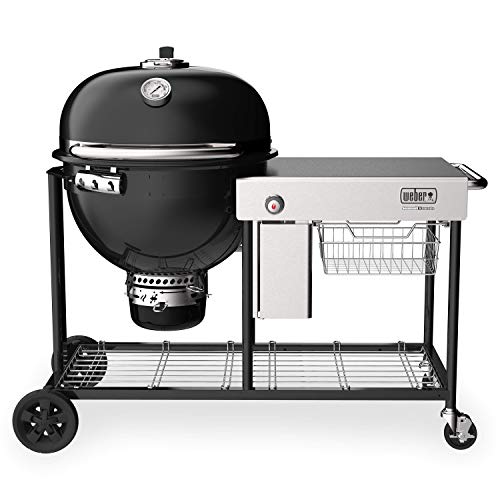
Lighting charcoal without a chimney starter. Weber publishes gas ignition, a dual walled insulated steel body in porcelain enamel, a RapidFire lid damper for reaching high heat and a One Touch cleaning system. At 236 pounds it is half the ceramic grill’s weight and publishes no cooking area.
Knowing what you are buying. Char-Griller is the only pick to publish a cooking area, 445 square inches, a 20 inch diameter and a range of 200 to 700 F, on triple wall insulated steel with cast iron grates, an EasyDump ash pan and 8 inch locking casters. Its dimension fields cannot be right.
Building charcoal into a counter. Stanbroil publishes a cutout of 30 5/8 by 21 1/4 by 8 1/2 inches in 14 gauge stainless, with an insulated hood, top and bottom heat seals, an adjustable charcoal bed and a built in gauge. It is not a kamado and does not claim to be.
Keeping a vent setting through the weather. SMOKEWARE is a stainless chimney cap, not a grill, that holds its vent setting when the dome opens and closes and allows cooking in rain or snow. It fits the Kamado Joe Classic and Big Joe, and its listing states in capitals that it does not fit the Junior.
What We Could Not Verify
These six things decide what a kamado can actually do, and these listings settle none of them.
- Cooking area on two of the three kamados. Kamado Joe and Weber publish neither a square inch figure nor a grate diameter, and their size fields say only extra large and large.
- Temperature range on four of the five. Only Char-Griller publishes one, 200 to 700 F, on grills whose entire appeal is running very low and then very high.
- Wall thickness on all three kamados. Ceramic, dual wall and triple wall are named and not one of them is given a measurement.
- Weight on two of the five. Stanbroil publishes none for a unit that has to be supported by a counter, and the chimney cap publishes none either.
- Which dimension fields describe the Char-Griller. Its 12.2 inch field cannot belong to a grill with a stated 20 inch cooking diameter.
- Fuel capacity anywhere. No listing states how much charcoal any of these holds or how long a load lasts, including the one that sells itself on longer burn times.