How the Five Compare on the Numbers
The word cup means five different things across these listings, so it is the first figure to throw away. Chemex states 8 cups and defines a cup as 5 oz. Bodum states 8 cups of 4 oz each. Melitta states 42 ounces and calls it 6 cups. AGOGO states 34 ounces and no cup count. Roogaluckeep brews 1 to 2 cups directly into a mug and never states a volume.
Read in ounces instead and the group falls into three sizes: a 42 oz set, two 34 oz carafes, and a single-serve dripper with no carafe at all. Weight follows the same split, from 0.16 lb for the Roogaluckeep, which is a steel cone and nothing else, to 2.24 lb for the Melitta, which includes a stainless thermal carafe.
Two rows of that table are worth mistrusting. The Chemex published dimensions read 6.4 by 9.6 by 1.3 inches, and a 1.3 inch tall coffeemaker does not exist, so those fields were discarded. Its published weight is also 1.3 lb, the same number as the bad height, which is the kind of coincidence that suggests a data entry rather than a measurement. Only the maker’s own sentences were used for it.
Why the Cup Is Not a Unit
Four Ounces, Five, or Seven
Chemex is the only maker here that states its convention outright: all Chemex coffeemakers are measured using 5 oz as one cup. Bodum states 8 cups of 4 oz each. Melitta states 42 ounces and 6 cups in the same sentence, which works out larger again. Three makers, three different cups, and the numbers on the front of the box therefore cannot be compared with each other at all.
The practical consequence is that a Bodum 8 cup and a Chemex 8 cup are not the same brewer. Bodum publishes 34 oz and Chemex does not publish an ounce figure at all, so its total has to be taken from its own definition. If you brew 12 oz mugs, one is roughly three mugs and the other is roughly four, from two carafes both labeled 8 cups.
The Single-Serve That Sits on a Mug
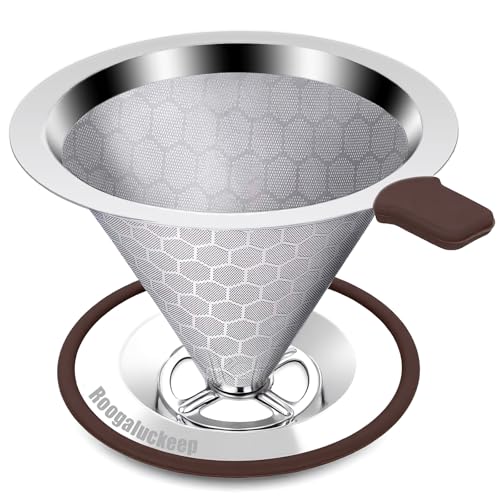
Roogaluckeep is a different object again. It is a one-piece 304 stainless cone with no carafe, no glass and no plastic touching the coffee, and it brews 1 to 2 cups in under 3 minutes straight into whatever mug you own. It publishes the figure that actually matters for that: it fits mug rims from 2.5 to 3.5 inches.
At 0.16 lb it is by far the lightest thing here, roughly a tenth of the Bodum, and its published fields of 4.51 by 4.53 by 3.35 inches are consistent with a cone rather than a carafe. Its filter is described as 600 mesh with precision spiral ribs, which is the only mesh figure published by any maker in this pool.
Paper, Permanent Mesh, or Both
What the Filter Does to the Cup
This is the real fork. Chemex and Melitta are paper systems: Chemex requires bonded filters that are not included in the box, and Melitta ships a start-up supply of its own number 4 cone filters. Bodum and Roogaluckeep are permanent steel, and Bodum says explicitly why, arguing that a mesh filter extracts aromatic oils and subtle flavors instead of letting a paper filter absorb them.
That argument runs both ways and both makers are honest about their side of it. Paper traps oils and fine particles, which is what produces the very clean cup Chemex is known for. Steel mesh passes them, which produces a heavier body and a little sediment. AGOGO covers both, shipping a dual layer 304 steel filter and pairing it with pre-folded paper filters for travel.
Mesh Counts and Layer Counts
Among the steel filters, only two figures are published anywhere. Roogaluckeep states a 600 mesh ultra-fine filter with spiral ribs for slow even extraction. AGOGO states two layers of 304 stainless with, in its own words, no middle layer, which is a pointed claim aimed at three-layer filters that clog. Bodum says only permanent stainless steel mesh, with no mesh figure and no layer count.
A mesh number and a layer count are not the same specification, so those two cannot be compared with each other either. What they do tell you is which maker thought about sediment. Roogaluckeep states no sediment in your cup, AGOGO states it blocks fine grounds while retaining oils, and Bodum leaves the question alone entirely.
Glass, Steel, and Three Listings That Share Sentences
The Only Published Glass Thickness
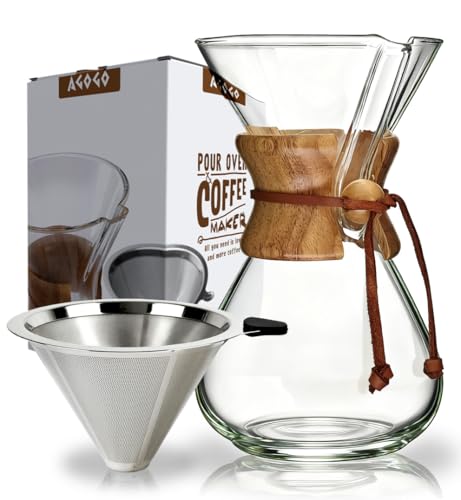
Four of these makers use borosilicate glass and one publishes how thick it is. AGOGO states 3.3 mm and says it withstands boiling water and refrigerator cold with no odors or chemical residue. Chemex states non-porous borosilicate that will not absorb odors or chemical residues. Bodum states heat-resistant borosilicate and adds the important qualifier that its carafe is single wall.
Single wall matters because it means the coffee starts cooling immediately, which is why the Melitta set exists in this comparison at all: it puts a plastic cone over a stainless thermal carafe holding 42 ounces, so the brew stays hot without a hotplate. Chemex solves the same problem differently, stating that its coffee can be covered and refrigerated for reheating without losing flavor.
Three Carafes Writing the Same Bullets
Three listings were left off this page because they read like one listing. Cosori, Yopinmall and Unbreakable all sell a borosilicate carafe with a wooden sleeve and a steel filter, and they share sentences word for word: the decanter is thermal resistant enough to be heated on the stove on a low flame, and the wooden sleeve and sleeve tie can be cleaned with a few swipes of a cloth.
Yopinmall goes further and reproduces Bodum’s own sales line about a mesh filter extracting aromatic oils instead of them being absorbed by a paper filter. Their stated volumes differ, 34 oz, 27 oz and 27 fl oz, while two of the three claim 8 cups from different totals. Where listings copy each other like this, the specifications they publish cannot be treated as independent measurements.
Which One Fits Your Kitchen
The cook who wants the cleanest cup. Chemex Classic, borosilicate glass with bonded paper filters that are not in the box, and the only maker here that defines its own cup, 5 oz. Its published dimensions and 1.3 lb weight are not believable and were not used.
The household that brews once and drinks all morning. Melitta’s set, a plastic cone over a 42 ounce stainless thermal carafe, called 6 cups, with a start-up supply of number 4 paper filters and a top rack dishwasher safe cone and lid.
The drinker who wants oils in the cup. Bodum at 34 oz, borosilicate with a cork band, made in Portugal, using a permanent stainless mesh filter rather than paper. It states 8 cups of 4 oz each and states plainly that the carafe is single wall.
The cook who wants both filter options. AGOGO at 34 oz, the only listing here that publishes a glass thickness at 3.3 mm, with a dual layer 304 steel filter, paper filters, a cleaning brush and towel, and a stated one year warranty.
The single mug drinker. Roogaluckeep, a one piece 304 stainless cone at 0.16 lb with no plastic touching the coffee, a 600 mesh filter, and the only published fit figure in this group: mug rims from 2.5 to 3.5 inches.
What We Could Not Verify
These are the makers’ own figures, and these are the things they do not tell you.
- Chemex publishes no volume in ounces, only 8 cups with a stated 5 oz convention.
- The Chemex published height of 1.3 inches cannot be right, and its weight is the same number, so neither was used.
- AGOGO publishes no cup count and no cup size, only 34 ounces.
- Bodum publishes no mesh figure and no layer count for its permanent steel filter.
- Only one maker publishes a glass thickness, so durability cannot be compared across the four glass brewers.
- No maker publishes a brew time except Roogaluckeep, which states under 3 minutes for 1 to 2 cups.