How the Five Compare on the Numbers
Every one of these five requires you to buy gas separately, so the cylinder is not what separates them. What does is the nozzle. Mysoda is the only maker here claiming silence, with a stated noise cancellation feature, and the only one claiming a bubble characteristic: an improved anti freeze nozzle producing a larger amount of smaller bubbles. Nobody else describes what happens where the CO2 meets the water.
The second axis is how much counter and cupboard space the machine takes, because all five are tall towers. Their published heights run from 16.14 inches for the Mysoda and the Aarke to 18.6 inches for the Philips field, and every one is between 5 and 6 inches wide. Weight runs from 2.42 lb for the Philips to 5.29 lb for the Mysoda, with one listing publishing none.
One row disagrees with itself. Philips publishes fields of 7.8 by 9.4 by 18.6 inches and then states in its own bullet that the machine is 9.5 inches deep by 5 inches wide by 16.7 inches high. Those are not the same object: the field version is nearly two inches taller and almost three inches wider. The maker’s sentence was used here, and it is the version that matters for cupboard clearance.
What Happens at the Nozzle
The Only Listing That Mentions Noise
Carbonating water is loud. The gas rushes into the bottle and vents, and in a quiet kitchen it is the noisiest thing that happens at a sink. Mysoda is the only maker in this pool that acknowledges it, describing the Ruby 2 as silent and naming a noise cancellation feature alongside a quick-lock mechanism. No decibel figure is given, so the claim cannot be checked against anything.
It also makes the only claim here about the bubbles themselves, stating an improved anti freeze nozzle that creates a larger amount of smaller bubbles for smoother carbonation. The freezing part is real physics: expanding CO2 chills the nozzle, and ice at the outlet is a known nuisance on these machines. Naming it as a design target is more specific than anything its rivals say.
Dissolution Against Delivery
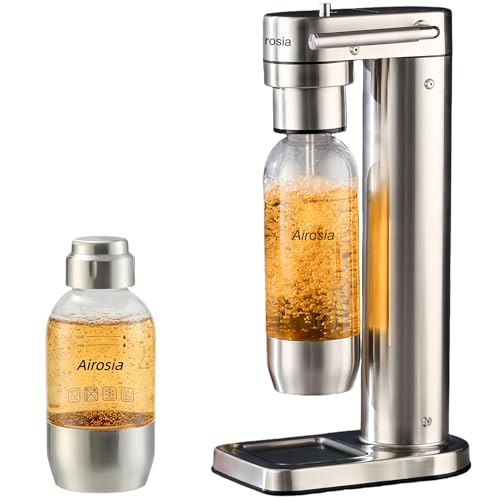
Airosia approaches the same problem from the other end, describing a specialized control system in a removable sub-machine that ensures CO2 is fully dissolved, which it claims gives richer and longer-lasting bubbles than traditional soda makers. That is a claim about retention rather than bubble size, and like Mysoda’s it comes with no measurement attached.
Aarke, Philips and Pupdumm publish nothing about the nozzle, the bubbles or the noise. Aarke instead describes the feel of the operation, a damper controlled lever intended to make carbonating a deliberate action rather than a jab at a button. Philips and Pupdumm describe press counts: once for gentle, two or three times for bold, with Pupdumm adding a duration of two to three seconds per press.
Height, Width, and Getting the Bottle In
All Five Are Towers
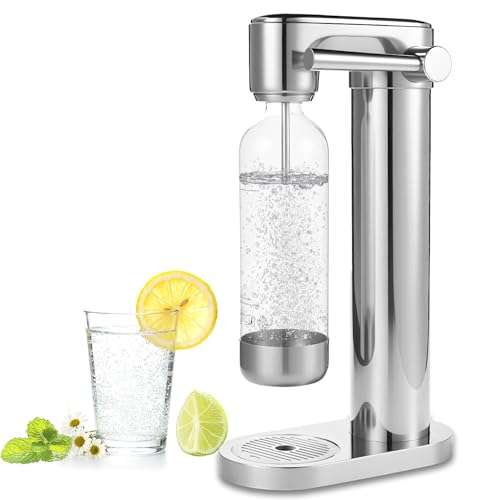
These machines occupy a narrow footprint and a lot of vertical space, and the vertical space is the constraint people forget. The published fields give 16.14 inches for both the Mysoda and the Aarke, 16.5 for the Airosia, 16.69 for the Pupdumm and 18.6 for the Philips, against a maker’s statement of 16.7 for that same Philips. Widths are between 5 and 6 inches on every one.
That matters because a standard upper cabinet sits around 18 inches above a countertop, and you also have to lift a bottle up and into the machine. A 16 inch body needs meaningfully more than 16 inches of clearance in practice, and none of these five publishes the clearance required to load it, which is the figure a buyer with cabinets actually needs.
The Same Machine, Two Sets of Numbers
There is a useful check available here. This Aarke Carbonator 3 listing publishes 5.91 by 10.24 by 16.14 inches, which is a coherent description of a tall narrow tower. Another listing of the same Carbonator 3 in a different finish publishes 6.02 by 16.34 by 10.16, with the largest figure in the depth position and 10.16 as the height.
Those cannot both describe the same product, and the second one contradicts every other machine in the category. It is worth knowing because it shows how these fields get filled: not measured per listing, but entered per variant, sometimes in the wrong order. Where a listing’s own sentence exists, as with the Philips, that sentence is the better source.
Bottles, Locks, and Being Tied to One Supply
The Restriction Only One Maker Prints
Philips is unusually explicit about something every one of these machines has: a proprietary bottle. It states that the machine is compatible only with the Quick Twist carbonated bottle of specific named model numbers, and lists them. That is a real constraint on a part that gets scratched, cloudy and eventually replaced, and it is the kind of thing normally left for the buyer to discover.
The other four do not print a restriction and that does not mean there is none. Aarke ships a 27.05 fl oz bottle and describes easy screw-in cylinder installation. Mysoda ships a 1 L bottle with a quick-lock system. Pupdumm ships a BPA free PET bottle. Airosia ships two, a 1 L and a 0.5 L, which is the only listing here giving you a second bottle size in the box.
What a Second Bottle Buys
Airosia’s pairing of a 1 L and a 0.5 L bottle is more practical than it sounds. Carbonated water goes flat once opened, so a household of one carbonating a full liter is throwing away fizz, and the smaller bottle is the answer. It is also the only listing here whose bottle count matches the way a single person actually drinks.
Airosia’s other distinguishing feature is the removable sub-machine, which is what lets it carbonate juices and cocktails directly in the bottle rather than water only. Pupdumm gets at the same idea differently, suggesting you infuse fruit, flavored syrups or herbal blends in the bottle, though it describes turning plain water into sparkling water rather than carbonating juice itself.
Which One Fits Your Kitchen
The person carbonating in a quiet flat. Mysoda Ruby 2, the only listing here claiming silence and a noise cancellation feature, with an anti freeze nozzle stated to give more and smaller bubbles, a scratch proof coating, a quick lock and a 1 L bottle. The heaviest here at 5.29 lb.
The buyer who wants the yield in writing. Aarke Carbonator 3, publishing 2000 ounces per cylinder, roughly 167 standard 12 oz cans, through a damper controlled lever in seamless stainless steel, with a 27.05 fl oz bottle. Designed in Sweden, at 3.79 lb.
The kitchen with the least room. Philips, which states 9.5 inches deep by 5 inches wide by 16.7 inches high in its own words and weighs 2.42 lb, the lightest here. Read the bottle restriction first: replacements must be its named Quick Twist models.
The household of one, or the cocktail drinker. Airosia, the only listing here shipping two bottles, a 1 L and a 0.5 L, in food grade 304 stainless, with a removable sub machine for carbonating juices and cocktails and a control system stated to dissolve the CO2 fully.
The buyer who wants the plainest version. Pupdumm, stainless steel, taking standard 60 L threaded cylinders with a quick twist fitting, at 4.41 lb, with a BPA free PET bottle and a stated method: press two to three times for two to three seconds each.
What We Could Not Verify
These are the makers’ own published figures. These are the gaps that mattered.
- Mysoda claims silence and noise cancellation without publishing a decibel figure.
- No maker publishes the vertical clearance needed to load a bottle, only the machine height.
- Two of the five publish a yield per cylinder, and they use different units.
- The Philips published fields disagree with its own stated dimensions by nearly two inches of height.
- Only one maker prints a bottle compatibility restriction, and silence from the others is not evidence of none.
- Neither bubble claim, smaller bubbles or fuller dissolution, comes with any measurement.