How the Five Compare on the Numbers
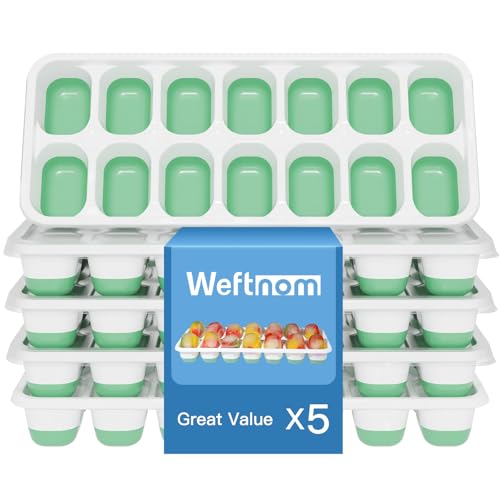
One listing was left out. ChefAide publishes four trays at 14 cubes each for 56 in total, on the same dual material plan as Weftnom, a rigid upper half with a flexible silicone bottom, and it publishes no tray dimension at all. Weftnom does the same job with five trays at 0.64 pounds, so ChefAide would have added a sixth column and no new information to a page about fitting a small freezer.
For a small freezer the decisive figure is the footprint of one tray and how tall the stack gets, because a tray that will not lie flat on a shelf is useless however many cubes it makes. Only two of these five publish a dimension for the tray. Azxb states 7.3 by 5.1 by 1.2 inches per tray. DOQAUS states 8.2 by 4.5 by 3.6 inches for its whole four pack with its bin.
What the table cannot tell you is the figure a small freezer owner needs most, which is the height of a stack of trays with their lids on. Four of these five call themselves stackable and none says what a stack of two or three measures. Nor does any listing state how much water a single cavity holds, so cube volume has to be inferred from the cube dimensions where they exist.
Footprint Is the Only Thing a Small Freezer Cares About
The One Tray That Publishes Its Own Size
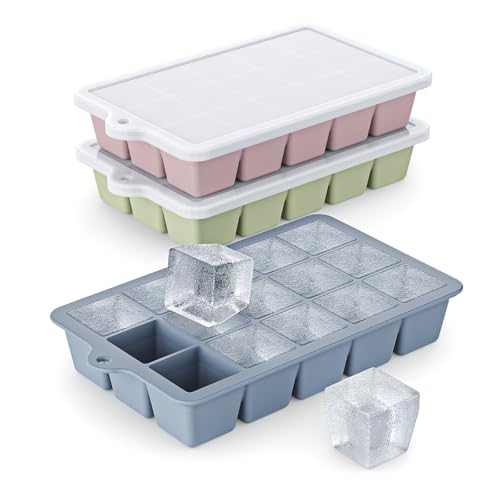
Azxb states 7.3 by 5.1 by 1.2 inches for a tray, and it states it twice, once in the size field and once in a feature bullet, which is rare enough to be worth trusting. Those figures describe one tray rather than a carton, and they are the only numbers on this page you can hold against a measured shelf before ordering. Two trays of that footprint stack into something a freezer drawer can take.
The 1.2 inch figure is the one that matters second. A tray that sits a little over an inch deep leaves room above it in a shallow drawer or on a narrow shelf, and it is the reason Azxb can claim stacking without the stack becoming a tower. Nothing else here publishes a tray thickness, so for the other four the only guide is the word slim.
What a Bin and a Scoop Cost You in Space
DOQAUS publishes 8.2 by 4.5 by 3.6 inches, and that figure is for the four pack as a system, because the set includes a central storage container and a scoop as well as the trays. The 3.6 inch figure is a stack, not a tray. That makes it the one listing here whose published dimension describes a block of freezer space rather than a single item.
That is a fair trade if you want ice stored loose rather than left in the trays. The bin holds cubes you have already released, so the trays go back to filling while yesterday’s ice waits in the container. In a small freezer it is also the opposite of what most people need, which is the flattest possible thing that still makes ice, and DOQAUS is upfront that its target includes apartment and RV freezers.
All Silicone or a Rigid Frame
Why Weight Tells You Which You Are Getting
The published weights here look inconsistent until you read the construction. Weftnom states 0.64 pounds for five trays and PET Hous states 1.34 pounds for four. That is not an error in either listing. Weftnom puts a thin silicone bottom inside a PP frame, so most of the tray is rigid plastic, while PET Hous is silicone throughout including the lid, and silicone is heavy for its bulk.
Vethwal sits between them at 0.8 pounds for three trays, which is consistent with all silicone construction in a smaller set. Because the counts differ, none of these figures can be ranked against another as a tray weight, and this page does not try. What they do say is which listing gives you more silicone, and a heavier tray is a floppier tray to carry full.
How Each Design Releases a Cube
Every listing here promises easy release and each describes a different mechanism. Weftnom says to push up from underneath and states that the PP frame means no banging and no broken plastic. Azxb describes a twist and push design. PET Hous says to twist or push from the bottom and credits an independent cavity design, meaning each cube sits in its own pocket rather than a shared slab.
Vethwal describes non sticky flexible cavity surfaces and says the tray can be twisted or pushed from the bottom. The practical difference is what happens when a tray is full and your freezer is crowded. A rigid frame lets you slide a full tray onto a shelf one handed; an all silicone tray needs two hands or a flat surface, which is a real cost in a small freezer.
Cube Count, Cube Size and How Often You Refill
Cubes Per Batch Against Trays In the Freezer
Weftnom states 70 cubes per batch across five trays at 14 each, the highest batch figure here. PET Hous states 60 across four trays at 15 each. Azxb states 30 across two trays at 15 each. Vethwal states 15 cubes per tray across three trays but never states a total. DOQAUS states four trays and no cube count for any of them.
In a small freezer that ranking inverts. Five trays is five trays of shelf whether or not they stack, and 70 cubes at once is only useful if there is somewhere to put them. Two trays refilled daily takes less permanent space than five trays filled once a week, which is why the two pack belongs on this page at all.
A One Inch Cube and a Thin Slab Are Not the Same Ice
Two listings state a cube of 1.2 by 1.2 by 1.2 inches, PET Hous and Vethwal, and both aim it at whiskey and cocktails. A cube that is equal on all three sides melts more slowly than a flatter one of the same footprint, which is the whole argument for this shape in a glass of spirits. Neither listing states how much water a cavity takes.
Azxb states 1.5 by 1.2 by 0.7 inches, which is a different piece of ice entirely: broader across the top and under three quarters of an inch deep. That shape chills a drink faster and dilutes it sooner, and it drops into a narrow bottle neck or a travel cup in a way a cube will not. Weftnom and DOQAUS publish no cube dimension.
Which One Fits Your Kitchen
You have measured the shelf and need it to fit. Azxb is the only listing here that publishes a tray size, 7.3 by 5.1 by 1.2 inches, stated in both the size field and a feature bullet. Two trays, 15 cubes each, 30 per batch, and a stated range of -40 F up to 428 F.
You want the most ice in one go. Weftnom states five trays at 14 cubes each for 70 per batch, at 0.64 pounds for the set, with a silicone bottom in a PP frame and snap on spill resistant lids. It publishes no tray dimension, so measure before you commit five trays of shelf.
You want ice stored loose, not left in the tray. DOQAUS adds a central storage container and a scoop to four silicone trays, published at 8.2 by 4.5 by 3.6 inches for the set and 0.86 pounds. Note the maker’s own warning that the lids allow airflow.
You want cocktail cubes and a place to hang the lids. Vethwal states three trays making 15 cubes each at 1.2 by 1.2 by 1.2 inches, 0.8 pounds for the set, with removable silicone lids that carry small holes for hanging and a stated tolerance for dishwashers and microwaves.
You want solid silicone and do not mind the weight. PET Hous is silicone throughout including the lid, four trays at 15 cubes each for 60 per batch, 1.34 pounds for the set, cubes at 1.2 by 1.2 by 1.2 inches, and a first use instruction to boil 15 to 20 minutes.
What We Could Not Verify
These are the figures a small freezer owner would actually ask for, and most of them are missing.
- No listing states the height of a stack of its trays with the lids fitted, though four of the five claim stacking as a feature.
- Three of the five publish no tray dimension at all, so Weftnom, Vethwal and PET Hous cannot be checked against a measured shelf.
- No listing states the water volume of a single cavity, so cube volume can only be inferred where a cube dimension exists.
- DOQAUS publishes no cube count for any of its four trays, and no dimension for the storage bin on its own.
- Azxb publishes no weight, so it cannot be compared with the four listings that do.
- Only Azxb states a temperature range, so freezer and microwave tolerance for the other four rests on the phrase food grade silicone.